
You've just paid to fill your CRM with new contacts. The campaign generated attention, the form captured email addresses, and the sales team has a clean list to work from. Then the follow-up stalls. Nobody receives a relevant next message, some contacts stop seeing your emails, and a promising acquisition campaign slowly turns into an inactive database.
That pattern is common because email marketing for lead generation isn't a single broadcast. It's a system that captures permission, reaches the inbox, teaches the buyer, and creates a measurable path to a qualified conversation. The system only compounds when each new subscriber enters a relevant nurture flow and the sending infrastructure protects visibility.
Why Email Still Wins for Lead Generation
A typical B2B SaaS team can generate a strong signup spike, then discover that the follow-up never reaches part of the audience. Others receive the same newsletter regardless of role, problem, or buying stage. Revenue is lost before sales can act, because inbox placement determines whether a lead can click, reply, or book a meeting.
Email remains one of the most measurable acquisition channels for small and mid-sized businesses. A 2026 industry summary found that 48% of marketers named email marketing their top lead-generation method, ahead of website landing pages at 44% and content marketing at 43%. The same summary reported a typical return of $36 for every $1 spent, equivalent to a 3,500% ROI. (EmailToolTester's lead-generation statistics)
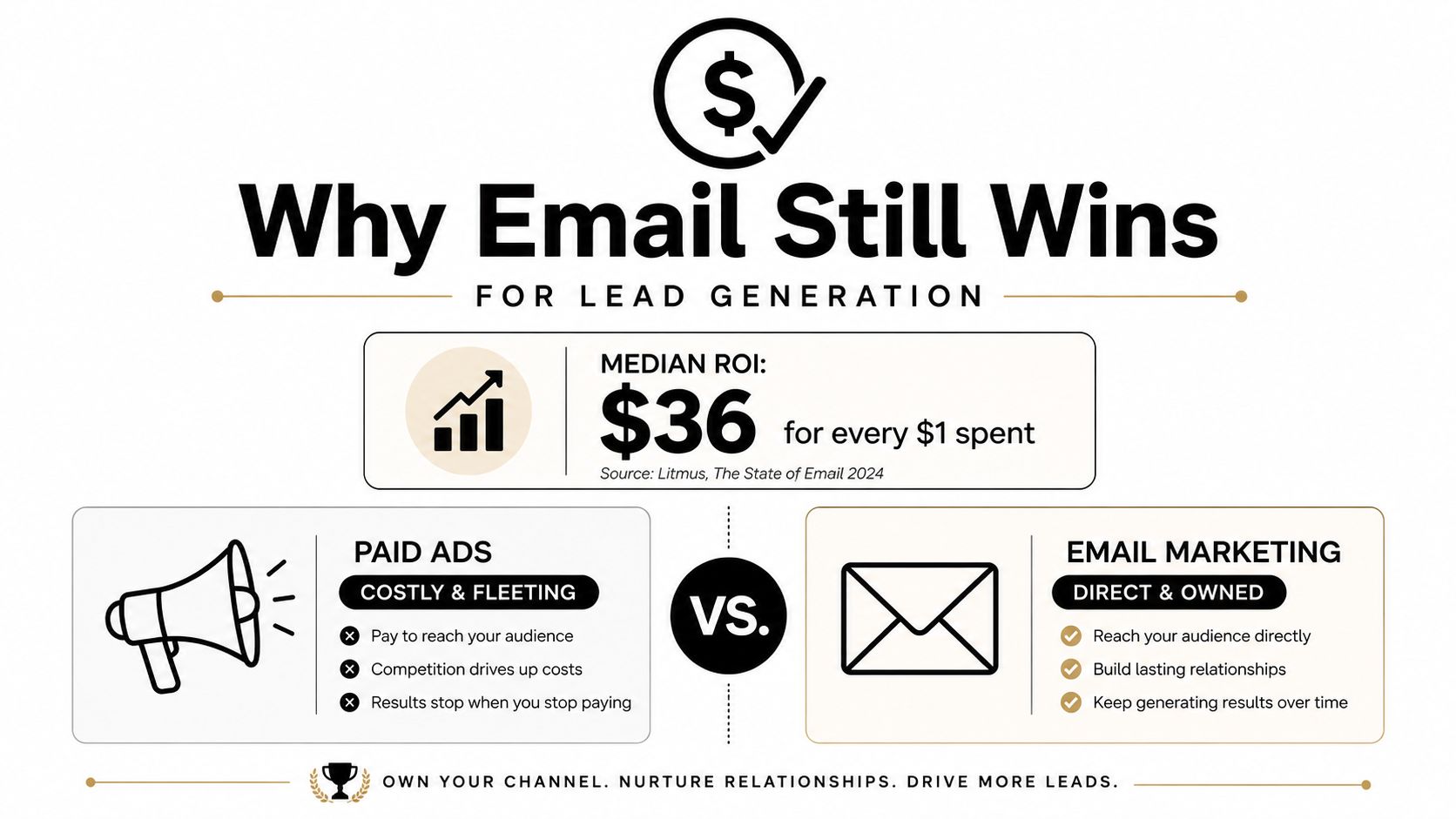
That economics explains why 74.7% of marketers are actively growing their email lists, while 59% rate email as the most reliable channel for driving leads, according to the same 2026 summary. Email gives an SMB direct access to opted-in prospects without paying for every later impression. It also connects a click to a landing-page action, CRM stage, meeting, or opportunity.
The advantage appears after the signup, not just at acquisition. A newsletter sent to the entire database may create occasional clicks, but a sequence can answer objections, reinforce the original offer, and identify the contacts showing meaningful intent. The list becomes a working revenue channel when subscribers have a clear reason to remain engaged.
The first email isn't the campaign
Gary Thuerk sent a widely recognized mass marketing email in 1978 to about 400 ARPANET users, and the message reportedly generated around $13 million in sales. That event established email as a direct-response channel, not merely an awareness medium. (Email Marketing for Business's lead-generation statistics)
The modern lesson is about follow-up discipline. A 2026 compilation reports that 70% of marketers stop after sending one email, potentially missing 76% of total leads. The same source notes that 83% of B2B marketers agree email is important for lead generation.
Practical rule: Treat every signup as the beginning of a conversation, not the end of a campaign.
A useful program delivers the promised asset immediately, then follows with education tied to the buyer's problem. Later messages can address objections, show relevant use cases, and give sales a clear signal when engagement and fit justify personal outreach. That multi-touch sequence usually creates more opportunity than repeating a single promotional broadcast.
Permission still matters. If a sales team supplements an inbound strategy with carefully researched prospecting data, resources such as exportable lead lists for sales can help organize outbound research. Those records should not be added to a marketing list without consent.
Deliverability is the revenue foundation
A message in spam cannot generate a click, reply, meeting, or sale. Independent 2026 benchmark summaries place typical global inbox placement around 83% to 85%, while 90% to 95% or higher is considered strong and 95% or higher is treated as top-tier performance. (Geysera's 2026 email deliverability benchmarks)
Treat deliverability as a commercial metric. Monitor inbox placement by mailbox provider, hard bounces, spam complaints, and provider-level engagement. Opens are less dependable because privacy features can distort them, so a stable open rate may conceal a worsening inbox problem. Clicks, replies, conversions, and placement trends provide a clearer operating view.
Start with domain authentication:
- SPF identifies which sending services are allowed to send for your domain.
- DKIM adds a verifiable signature that helps mailbox providers confirm the message was not altered.
- DMARC tells receiving providers how to handle messages that fail authentication and gives the domain owner reporting visibility.
List hygiene protects that foundation. Remove hard bounces promptly, suppress contacts who repeatedly show no engagement, and investigate complaint patterns by source. Purchased lists create a separate risk. Those contacts have not granted permission, often engage poorly, and can weaken sender reputation for prospects who did choose to hear from you.
A 2026 deliverability benchmark reports a global average inbox placement of 83.5%, with 6.7% landing in spam and 9.8% missing entirely. The same source says 64.6% of businesses report that deliverability problems have directly hurt revenue or retention, while only 23.6% verify lists before every campaign. (Email Marketing for Business's email best-practices statistics)
Set up authentication, begin with engaged contacts, suppress unhealthy records, and monitor placement by provider before scaling volume. Subject lines can improve response, but they cannot rescue a message that never reaches the inbox.
Lead Magnets and Signup Forms That Convert
A lead magnet should solve one specific problem in one specific format. The signup form should make that promise obvious before the visitor has to think about it. If someone can't tell what they'll receive, why it matters, and what happens next, the form creates friction before the nurture program gets a chance.
Match the offer to buying intent:
- A one-page worksheet suits problem-aware visitors who want a practical starting point.
- A 20-minute video training works when the prospect needs explanation before considering a solution.
- A comparison guide supports decision-stage research and can reveal which alternatives the buyer is evaluating.
- A swipe file or template pack attracts high-intent visitors who want something they can use immediately.
- A diagnostic quiz captures the email while collecting answers that can route the contact into a relevant segment.
Keep the form proportionate to the value of the offer. Email-only forms create the least friction. Ask for name, company, role, or a stated problem only when the answer changes the follow-up or qualification process. Button copy should name the outcome, such as “Get the worksheet” or “See my recommendations,” rather than relying on a vague label.
A short explanation of how to build an email list can help teams connect acquisition mechanics to the larger nurture system. For businesses building permission-based opt-in programs, it's also useful to partner with Ecommerce Boost for email when the audience and offer fit an ecommerce context.
| Lead Magnet | Funnel Stage | Conversion Rate | Next Flow |
|---|---|---|---|
| One-page worksheet | Problem aware | Establish your own baseline | Deliver the worksheet, then teach the related problem |
| Video training | Consideration | Establish your own baseline | Send a recap, a deeper lesson, then a low-pressure invitation |
| Comparison guide | Decision | Establish your own baseline | Address selection criteria and offer a relevant conversation |
| Template pack | High intent | Establish your own baseline | Show implementation steps and present the next logical solution |
| Diagnostic quiz | Discovery and segmentation | Establish your own baseline | Route answers into a tailored educational sequence |
Avoid promising a conversion-rate range without a comparable audience, traffic source, offer, and form. Your first useful benchmark is your own performance by source and buyer stage.
Landing Page Patterns That Pull More Leads
Most landing-page improvements come from message alignment, not decoration. The headline should continue the promise made in the email or ad, the form should request only information the next step needs, and the button should describe the action in plain language.
A single-offer long-scroll page works well for focused campaigns where the visitor needs enough context to trust the offer. Put the promise and form near the top, then use proof, objections, process details, and a repeated form for visitors who need more evidence. Remove unrelated navigation and competing calls to action.
A two-step form uses a soft gate. The visitor first clicks an outcome-focused button, then sees the fields. This can make the initial decision feel lighter, but it also adds another interaction and can frustrate visitors who prefer transparency. Use it when the first step clearly communicates value and the second step stays short.
A pop-up or slide-in paired with an existing article is useful when the content already attracts relevant visitors. The offer should extend the article's topic, not interrupt it with an unrelated promotion. On mobile, test the collapsed layout, close control, tap targets, and whether the form blocks the reading experience.
| Pattern | Best Traffic Source | Form Length | Conversion Lever | Watch Out For |
|---|---|---|---|---|
| Single-offer long scroll | Paid campaigns and focused email | Short to moderate | Message match and proof | Too much copy before the value is clear |
| Two-step form | High-intent content and referral traffic | Short after the click | Lower perceived initial friction | Extra interaction and hidden expectations |
| Pop-up or slide-in | Existing organic content | Very short | Contextual offer timing | Mobile interruption and weak relevance |
Test one meaningful change at a time. Keep campaign IDs, UTM parameters, and source fields intact so a design change doesn't destroy attribution. A cleaner page with weaker message match isn't an improvement.
Building Autoresponder and Nurture Flows
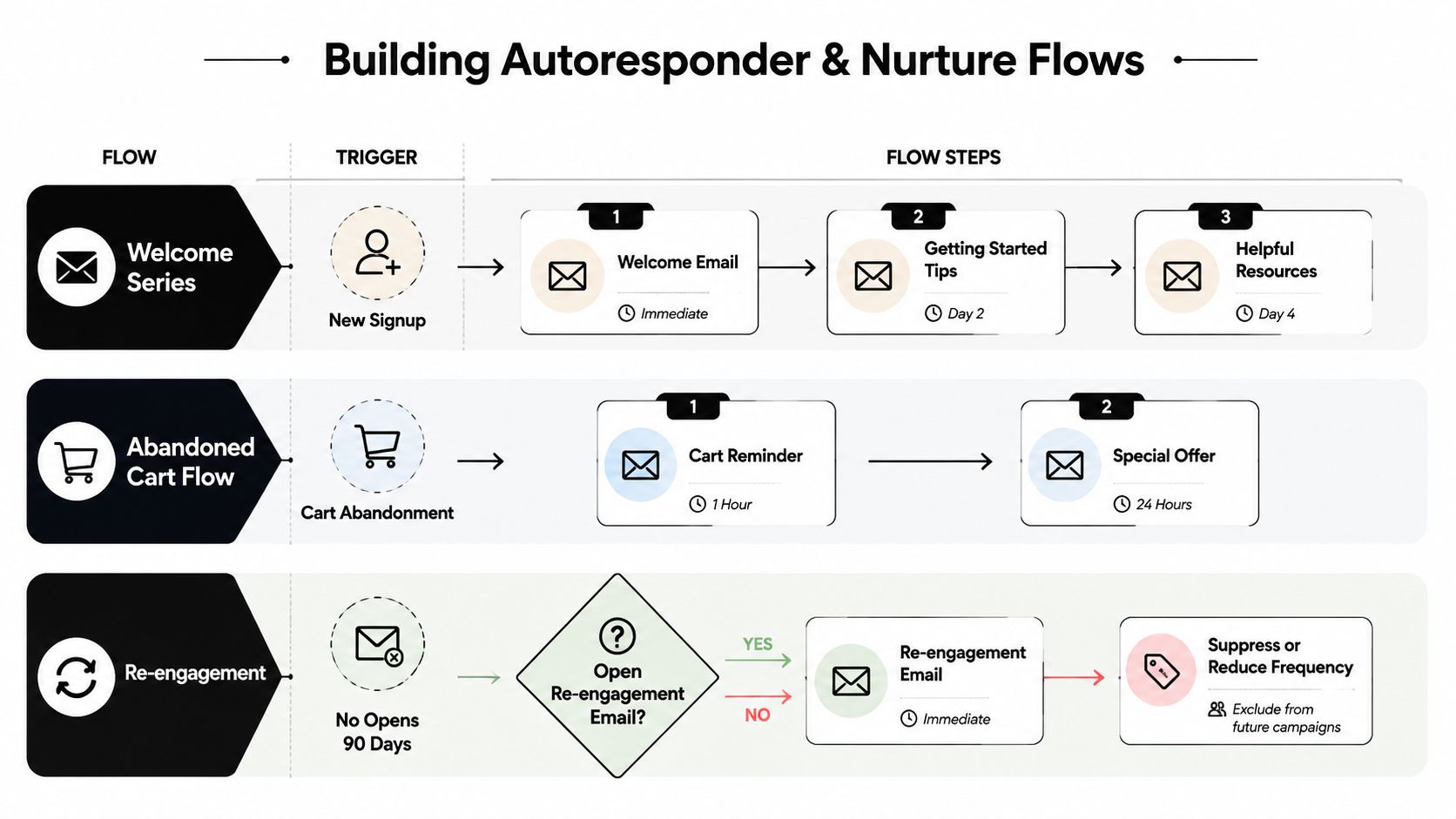
A useful nurture flow has a trigger, a reason for each message, and a defined conversion event. The three foundational flows are the welcome series, the abandoned-action flow, and re-engagement.
Welcome series
Send the promised asset immediately. Follow with a short educational arc that helps the subscriber interpret the problem, avoid common mistakes, and decide whether a conversation makes sense. A practical sequence can include five to seven messages:
- Deliver the offer and set expectations.
- Explain the problem behind the download.
- Provide a useful framework or example.
- Address a common objection.
- Show how a qualified buyer evaluates options.
- Invite a reply or consultation.
- Close the sequence with a clear next step and a preference option.
Each email should earn the next one. Don't turn onboarding into a feature catalogue before the subscriber understands the problem.
Abandoned actions
Trigger this flow when someone begins a high-intent action but doesn't complete it, such as a consultation request, product checkout, or assessment. The first reminder should clarify what was left unfinished and remove confusion. A later message can answer objections or offer help without automatically discounting the purchase.
Keep the flow narrow. A person who abandons a low-value content form shouldn't receive the same urgency as someone who reaches a pricing or booking step.
Re-engagement
Re-engagement is primarily a list-quality process. Identify contacts with sustained inactivity, send a concise message that offers a clear preference or unsubscribe choice, and suppress those who don't respond. Keeping every inactive address may make the database look larger while reducing the quality of future sends.
Before reviewing automation logic, marketers can also examine automatically sending email for workflow fundamentals. For outbound programs that require verified firmographic context, outbound data for Lemlist campaigns can support prospect research, but outbound data still requires appropriate compliance and should remain separate from permission-based nurture.
A useful sequence builder records the trigger, audience, exclusion rules, send timing, goal, and exit condition. The CRM should receive the meaningful events, especially replies, meeting requests, and movement into a qualified stage.
Segmentation and Personalization That Earn Replies
Segmentation doesn't need to begin as a complex data project. Start with the information that changes the message: opt-in source, company size, role, and stated interest. A subscriber who downloaded a pricing comparison has a different question from someone who requested a beginner worksheet, even if both entered through the same website.
Use each field for a clear decision:
- Opt-in source: Send content that continues the topic that attracted the subscriber.
- Company size: Adjust examples, implementation detail, and buying process.
- Role: Speak to the responsibility that person carries.
- Explicit interest: Route the contact toward the problem they selected rather than a general newsletter.
A first name in the subject line is surface personalization. Behavioral personalization uses the action itself. The latter usually gives you more strategic value because it changes timing, content, and the CTA.
Suppose one general newsletter promotes a guide about improving lead follow-up. Split it by role and behavior. A sales manager who clicked the workflow article receives a process audit invitation. A founder who downloaded the worksheet receives a lightweight implementation sequence. A service marketer who watched the training receives examples of CRM handoff and reporting. The subject, opening, proof, and CTA now reflect the reason each person engaged.
Keep segments large enough to receive consistent learning. Over-segmentation can produce tiny sends, delayed testing, and an automation maze that nobody maintains. A practical segment earns its place when it changes the offer, message, timing, or sales action.
For a plain-language reference on how people are grouped by observed actions, review this guide to behavioral segmentation. Also create negative segments. Exclude current customers from acquisition offers, suppress active opportunities from generic nurture, and remove contacts who already completed the requested action.
The strongest personalization often comes from sequence position. A subscriber on the first educational message needs context. A subscriber who repeatedly visits a service page may need a direct answer and a human follow-up. Personalization should make the email more useful, not merely more familiar.
Copy and Subject Lines That Get Clicked
Every email needs one reader, one problem, and one next action. A subject line should create relevance or useful tension without hype. The first sentence should remind the recipient why the message arrived, then move quickly toward the promised value.
Use the lead magnet, role, pain point, or prior behavior as the opening cue. Keep paragraphs short, use descriptive links, and choose one primary CTA. Secondary links can dilute the decision when the email's real purpose is to generate a reply or booking.
| Goal | Subject-Line Pattern | Body Opening | Primary CTA |
|---|---|---|---|
| Welcome | Your requested [resource] | “You asked for [resource], so here it is. Start with [specific section].” | Get the resource |
| Educational nurture | A practical way to address [problem] | “Most teams begin with [common approach]. The harder part is [specific issue].” | See the framework |
| Case study | How a team approached [problem] | “This example is relevant if you're dealing with [condition]. Focus on the decision, not the headline result.” | Read the example |
| Product invitation | A next step for [use case] | “If [problem] is now a priority, this is how the next step works.” | Explore the solution |
| Re-engagement | Still interested in [topic]? | “We haven't heard from you recently. Choose what you want to receive, or leave the list.” | Update preferences |
Test specificity, sender identity, preview text, benefit framing, and personalization. Change one meaningful variable at a time, otherwise you won't know which decision affected the result. Don't optimize for curiosity alone. A subject line that attracts an unqualified click can make the campaign look healthy while producing little pipeline.
Before sending, check six things:
- Promise consistency: The email delivers what the subject and landing page imply.
- Mobile readability: The opening and CTA work on a narrow screen.
- Link accuracy: Every link reaches the intended page and carries attribution.
- Permission safety: The recipient knows why they're receiving the message.
- Unsubscribe access: The opt-out path is visible and functional.
- Language quality: Remove false urgency, exaggerated claims, and manipulative phrasing.
Good copy doesn't corner the reader. It makes the next useful step obvious.
Measuring, Benchmarking, and Improving Every Month
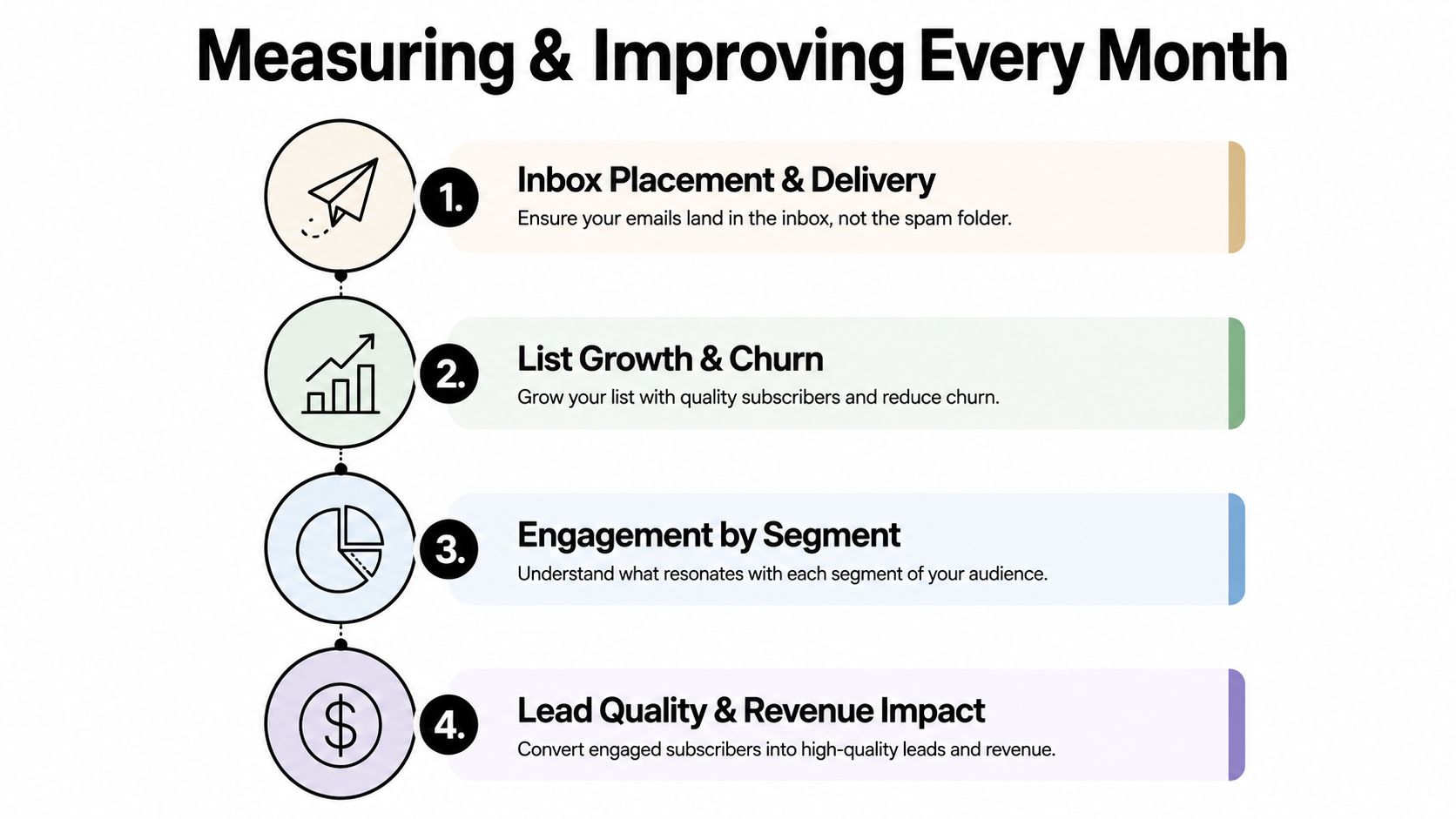
A lead-generation email program should be reviewed as a chain, not a collection of isolated rates. Start with authentication and inbox placement, then inspect list growth, engagement, landing-page conversion, qualification, meetings, opportunities, and revenue.
A 2026 B2B benchmark summary reports email click-through rates around 2%, website conversion near 2.9%, and MQL-to-SQL conversion around 13% overall. Those figures are directional rather than promises, because audience, offer, traffic source, and sales process change the meaning of every metric. (Saleshive's B2B lead benchmarks)
Measurement principle: A click is evidence of interest. A qualified CRM stage is evidence that the interest may matter commercially.
Use UTM parameters, hidden form fields, CRM source fields, and campaign IDs to preserve the path from email to pipeline. Agree with sales on what makes a lead qualified, what disqualifies it, and how quickly a high-intent action receives personal follow-up.
| Metric | What it reveals | Action it triggers |
|---|---|---|
| Inbox placement | Whether subscribers can see the message | Review authentication, reputation, and provider-level performance |
| List growth and churn | Whether acquisition produces a healthy audience | Improve the offer, source quality, or preference experience |
| Click rate by segment | Whether the message earns a relevant action | Refine copy, CTA, and audience fit |
| Landing-page conversion | Whether the post-click experience keeps the promise | Reduce friction and improve message match |
| Qualified-lead rate | Whether engagement comes from the right buyers | Adjust targeting, form questions, and offer specificity |
| Meetings and opportunities | Whether nurture creates sales motion | Improve handoff timing and follow-up |
| Revenue impact | Whether the program contributes to commercial outcomes | Reallocate effort toward profitable segments and offers |
Run the review on a repeating monthly rhythm:
- First week: Check authentication, inbox placement, bounces, complaints, acquisition sources, and permission quality.
- Second week: Compare message clicks with landing-page behavior and identify friction after the click.
- Third week: Review nurture progression, replies, qualified stages, meeting outcomes, and disqualification reasons with sales.
- Fourth week: Choose one or two tests involving the offer, audience, copy, landing page, or handoff.
The final checklist is operational: confirm permission, maintain authentication, suppress unhealthy contacts, segment by useful signals, align the offer with intent, limit form friction, inspect sequence exits, document sales follow-up, and record every test. A 2025 benchmark compilation notes that email is used by about 69.2% of marketers, while one B2B benchmark reports 2.5% conversion, reinforcing the need to judge the whole journey rather than celebrate sending volume. (Vib's B2B email marketing benchmarks)
SWAT Marketing Solutions helps SMBs connect list building, email campaigns, drip sequences, landing pages, CRM integration, and performance reporting into a lead-generation system. Visit SWAT Marketing Solutions to request a practical assessment of your website, acquisition path, and email follow-up process.