
Building an email list is fundamentally about creating your own private communication channel. You do this by collecting email addresses from people genuinely interested in what you do, usually by offering them something valuable in return. The basic toolkit involves lead magnets, opt-in forms, and smart traffic strategies to turn casual website visitors or social media followers into a dedicated audience you can reach anytime.
Why Your Email List Is Your Best Marketing Investment

Before we jump into the "how," it's critical to understand the "why." Think of your social media following as rented land. One algorithm change from Facebook or Instagram can instantly tank your reach, cutting you off from the very people who chose to follow you.
Your email list, on the other hand, is property you own outright.
This ownership gives you incredible stability and control. You aren't held hostage by platform updates or passing trends. Instead, you have a direct line to your most engaged fans, allowing you to build relationships, share useful content, and drive sales—all on your own terms.
The Unbeatable ROI of an Owned Audience
The numbers don't lie. Email marketing consistently delivers a staggering 36:1 return on investment, making it one of the most profitable channels you can use. This is especially important when you consider that organic reach on social media often struggles to break 5%.
While social platforms are great for getting discovered, email is where you turn that initial interest into real loyalty. In fact, 51% of consumers say they prefer to be contacted by brands via email. It's their chosen channel. You can find out more about why this makes list building a priority for 2026 and beyond.
Owning your audience means you’re building a tangible business asset. Every subscriber represents a direct relationship, insulated from the volatility of third-party platforms. It’s the difference between shouting into a crowd and having a meaningful, one-on-one conversation.
This direct connection is the bedrock of sustainable growth. It's how you convert a one-time visitor into a repeat customer and, eventually, into a vocal supporter of your brand.
The Foundation of Lasting Customer Relationships
An email list isn't just a spreadsheet of contacts; it's a community you're building around your brand. It gives you a way to send personalized, helpful content that solves real problems for your subscribers, positioning your business as a trusted expert. You can see how this fits into a bigger picture in our guide on https://swatmarketingsolutions.com/how-to-generate-more-leads/.
By consistently delivering value, you build a level of trust and rapport that you just can't achieve with fleeting social media posts. Once you understand the investment, you can dive deeper into the practical steps for building email list and creating this foundational asset. This relationship-first approach means that when you eventually have something to sell, your audience is already tuned in and ready to listen.
Core Components of a Successful Email List Strategy
Here's a quick look at the essential pillars for building an email list that drives results.
| Component | Its Purpose in Your Strategy | Example for a Local Service Business |
|---|---|---|
| Lead Magnet | The valuable incentive you offer in exchange for an email address. | A local landscaping company could offer a free PDF guide: "5 Common Lawn Care Mistakes North Texas Homeowners Make." |
| Landing Page/Form | The dedicated web page or popup where visitors sign up. It's a focused conversion point. | A simple page with a headline, a brief description of the guide, a high-quality image, and a form asking for a name and email. |
| Email Service Provider | The software (like Mailchimp or Constant Contact) you use to store contacts, send emails, and automate sequences. | Setting up an account to automatically deliver the PDF guide as soon as someone signs up. |
| Onboarding Sequence | A series of automated welcome emails that introduce your brand and nurture the new subscriber. | A 3-email series: 1) Delivers the guide, 2) Shares a client success story, 3) Offers a 10% discount on a first lawn analysis. |
| Ongoing Content | Your regular emails (newsletters, tips, promotions) that keep your audience engaged and your brand top-of-mind. | A monthly newsletter with seasonal lawn care tips, a spotlight on a recent project, and a link to their latest blog post. |
Each of these pieces works together to create a system that doesn't just collect emails but builds a powerful marketing asset for your business.
Creating Lead Magnets People Genuinely Want
Let's be honest. The days of slapping a generic "sign up for our newsletter" box on your website and expecting a flood of subscribers are over. People are protective of their inboxes, and they won't hand over their email address without a seriously good reason.
This is where your lead magnet comes in. It's the irresistible freebie you offer in exchange for that email. Its entire job is to solve a very specific problem for your ideal customer and give them a quick win. It’s not about giving away the farm; it's about offering a valuable taste of your expertise that builds instant trust.
Moving Beyond the Basics
To create a great lead magnet, you have to get inside your customer's head. What’s one nagging issue they constantly face? What’s a small problem you can help them solve right now?
A B2B consultant might notice clients always struggle to run efficient meetings. Instead of a vague ebook, they could offer a "5-Point Productive Meeting Agenda Template." It’s specific, actionable, and immediately useful.
Likewise, a local landscaping company could offer a "DIY Garden Planning Checklist" for new homeowners. This solves a real problem at the exact moment a potential customer is looking for help. The idea is to shift from a broad promise ("learn about us") to a tangible outcome ("plan your garden this weekend").
Choosing the Right Format for Your Audience
The format of your lead magnet matters. It needs to fit your business and, more importantly, how your audience likes to consume information. A video tutorial is perfect if you have a visual product, but a busy professional might prefer a simple checklist they can scan in 60 seconds.
Here are a few popular formats that consistently work well:
- Checklists: Simple to create and super actionable. They give people a clear path to get something done.
- Templates: These are huge time-savers. Think email scripts, budget spreadsheets, or social media content calendars.
- Cheat Sheets or Resource Guides: A curated list of your favorite tools or tips positions you as a helpful expert.
- Video Tutorials or Mini-Courses: Perfect for showing how to do something. A short video builds a much stronger connection than text alone.
- Exclusive Discounts or Free Consultations: For e-commerce brands or service providers, a direct financial incentive is a powerful motivator.
A great lead magnet is a promise kept. It must deliver exactly what you offered, build trust instantly, and leave the new subscriber feeling like they got the better end of the deal. This positive first impression is the foundation for a long-term relationship.
Crafting a compelling offer requires a solid understanding of content writing vs copywriting to make sure your landing page and opt-in form actually convert.
The Power of the Content Upgrade
One of the most effective list-building tactics out there is the content upgrade. This is a super-specific lead magnet you offer inside a relevant blog post. For example, in an article about "10 Ways to Improve Your Home's Curb Appeal," you could offer a downloadable "Curb Appeal Shopping List" right in the middle of the post.
Because the offer is directly tied to what the person is already interested in, conversion rates can skyrocket. It’s not uncommon for these targeted opt-ins to hit conversion rates as high as 10%, pulling in highly qualified leads from your best content.
A Quick-Start Guide to Your First Lead Magnet
Ready to jump in? Don’t overthink it. Just follow these simple steps to get your first lead magnet out the door.
- Identify a Core Problem: What’s the one question you hear from potential customers over and over again?
- Brainstorm a Quick Solution: How can you answer that question in a simple, downloadable format?
- Choose a Simple Format: A one-page PDF checklist or a simple template is a perfect start.
- Give it a Benefit-Driven Title: Instead of "Marketing Guide," call it "The 5-Step Plan to Get Your Next 10 Customers." See the difference?
- Create and Launch: Use a free tool like Canva to design a clean PDF. Don't worry about perfection—just get it done and get it live.
When you focus on providing genuine value and specific solutions, you’ll create lead magnets that attract the right kind of people—an audience that is eager to hear from you and ready to become loyal customers.
Designing Opt-In Forms That Actually Convert
You've created a fantastic lead magnet, but that's only half the battle. If signing up is a clunky or confusing process, even your most interested website visitors will give up and leave. Think of your opt-in form as the crucial gateway between a casual browser and a loyal subscriber—making that experience frictionless is non-negotiable.
This isn't just about flashy graphics; it's about making the decision to subscribe feel easy and logical. A form that converts well respects the user's time and makes it crystal clear what value they're getting in return.
The Anatomy of a High-Converting Form
Every single element on your opt-in form has a job to do. When they all work together, they gently guide the user toward saying "yes." If even one part is weak, it can create enough doubt to lose the conversion for good.
- A Compelling Headline: This is your hook. It needs to grab attention immediately and state the main benefit of your offer. Ditch generic phrases like "Subscribe Here." Instead, try something that focuses on the value, like, "Get Our 5-Step Garden Planning Checklist."
- Benefit-Driven Copy: Keep your text short and focused on the outcome. A few bullet points highlighting exactly what the subscriber gains is a great approach. You're selling the transformation, not just the features of a download.
- A Simple, Clean Design: Clutter is the enemy of conversions. Use plenty of white space and a clear, legible font. Most importantly, only ask for the information you absolutely need. Often, just an email address is perfect to start.
- A Powerful Call-to-Action (CTA): The words on your button really matter. Move beyond "Submit" or "Download." Use action-oriented language that reinforces the value, such as "Send Me the Checklist!" or "Get Instant Access."
This visual breaks down the simple but powerful journey of turning a visitor into a subscriber.
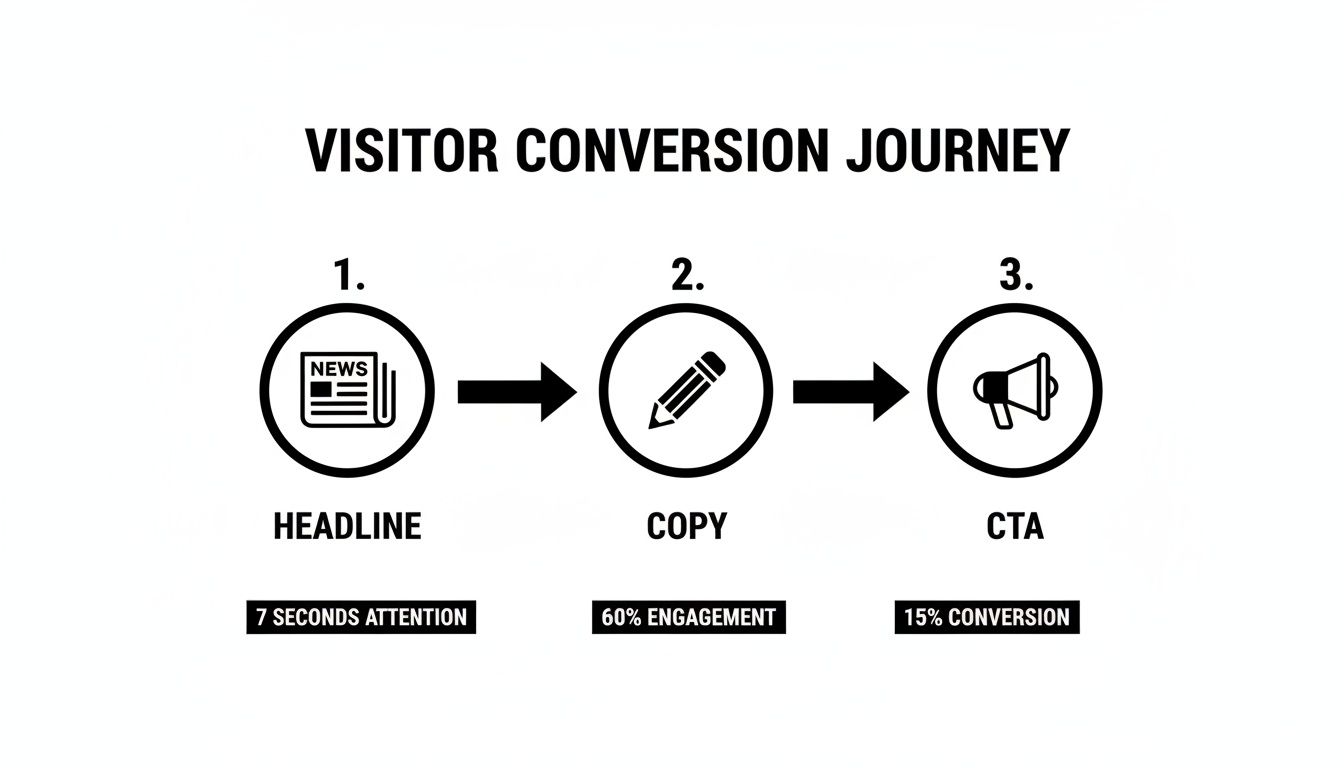
As you can see, it's a quick trip: a strong headline earns you a few seconds of their time, compelling copy builds desire, and a clear CTA gives them the final nudge they need to sign up.
Strategic Form Placement and Types
Where you put your form is just as important as what's in it. You want to meet your visitor at the right moment without being disruptive. We've all been annoyed by those pop-ups that appear the second a page loads—that's a surefire way to send people running.
Instead, try these more strategic options:
- Embedded Forms: Placing a form directly within a relevant blog post is incredibly effective. The reader is already engaged with the topic, so their interest is at its peak.
- Slide-In Boxes: These forms pop up in the corner of the screen after a user scrolls a certain distance down the page. They're less intrusive than a full-screen takeover but still very visible.
- Exit-Intent Pop-Ups: This smart technology triggers a form only when a user's cursor moves toward the "close" button. It's your last chance to make an offer and can be surprisingly good at capturing leads you would have otherwise lost.
The best opt-in forms feel like a natural part of the user's journey, not an interruption.
Building Trust at the Point of Conversion
At the end of the day, people give their email addresses to businesses they trust. You can build that trust right on your form with a couple of simple additions.
A small line of text under the CTA button, like "We hate spam, too. Your email is safe with us," can go a long way in reducing anxiety. Adding a link to your privacy policy also shows you're professional and transparent. For a deeper look at creating these dedicated conversion points, check out our guide on designing effective landing pages.
These small trust signals reinforce that you're a legitimate business that values your subscribers' privacy, making them much more comfortable hitting that subscribe button.
Driving Traffic to Your Email Opt-In Offers
You’ve poured your effort into creating an irresistible lead magnet and a slick, easy-to-use opt-in form. Fantastic. But now the real work begins—getting actual human beings to see your offer. Just building it and hoping people stumble upon it is a recipe for a stagnant, sad-looking email list. It's time to shift from a passive "build it and they will come" mindset to a proactive, multi-channel promotion strategy.
This means you have to be strategic, placing your offer right in front of your ideal audience—both on your own digital turf and out across the wider web. The idea is to create a whole network of pathways that all lead people right back to your valuable offer.
Maximize Your Onsite Traffic
Your website is your home base, making it the most obvious and effective place to start capturing leads. These visitors are already there because they have some interest in what you do, which makes them the warmest audience you could ask for. Your job is to make your offer impossible to miss, but without being annoying about it.
One of the most powerful tools for this is the exit-intent pop-up. This clever technology senses when a visitor is about to click away from your site and presents your offer at that critical moment. It's a surprisingly effective way to turn an abandoning visitor into a brand-new subscriber.
Another key tactic is to embed your offer right inside your most popular content. Dive into your website analytics and find your top-performing blog posts. From there, create a "content upgrade"—a super-specific lead magnet that relates directly to that post—and place the opt-in form right there in the article. For instance, if your most-read article is about "local SEO tips," you could offer a downloadable "Local SEO Audit Checklist."
Pro Tip: Don't just slap a generic form at the very bottom of the post and call it a day. Weave the offer naturally into the content itself. A callout box partway through the article that says, "Want the exact checklist I use to audit my clients' local SEO? Get it here," feels much more authentic and valuable.
Comparing Onsite vs. Offsite List Building Tactics
Understanding the different methods for capturing new subscribers helps you choose the right mix of strategies for your business. Some tactics are quick wins on your own territory, while others require venturing out to find new audiences.
| Tactic | Best For | Effort Level | Potential Impact |
|---|---|---|---|
| Exit-Intent Pop-ups | Converting abandoning website visitors | Low | High |
| Content Upgrades | Capturing highly engaged readers | Medium | High |
| Social Media Bios | Driving steady traffic from followers | Low | Medium |
| Paid Social Ads | Reaching new, targeted audiences quickly | High | Very High |
| Guest Posting | Tapping into established, relevant audiences | High | High |
| Local Partnerships | Leveraging community and shared audiences | Medium | Very High |
This table gives you a quick snapshot, but the best approach almost always involves a blend of these tactics. Relying on just one method limits your growth potential.
Go Beyond Your Website to Find Subscribers
While optimizing your own site is essential, true list growth explodes when you venture out to where new audiences hang out. This means getting active on platforms where your ideal customers already spend their time. Your social media profiles are the perfect place to start.
Don’t just post about your lead magnet every once in a while. Make it a permanent, unmissable part of your profiles.
- Your Bio Link: Change the link in your Instagram, X (formerly Twitter), and LinkedIn bios so it points directly to your lead magnet's landing page.
- Pinned Posts: Design a sharp, eye-catching graphic that promotes your offer and pin it to the top of your Facebook page or X profile.
- Cover Photos: Use your Facebook or LinkedIn cover photo like a billboard for your offer. Include a clear call-to-action that tells people exactly where to click.
These small tweaks turn your social media profiles into lead-generation machines that work for you 24/7.
Amplify Your Reach with Paid and Partner Traffic
To really put your growth into overdrive, you need to explore paid advertising and strategic partnerships. Running targeted ads is one of the absolute fastest ways to get qualified traffic straight to your landing page. Facebook Ads, for instance, let you target users based on their specific interests, online behaviors, and demographics, making sure your offer lands in front of the right people. You can learn more by reading our guide on the different types of Facebook advertising.
Guest posting is another powerhouse off-site tactic. When you write an article for another blog in your niche, you gain immediate exposure to a fresh, highly relevant audience. The trick is to make sure your author bio links back to your lead magnet, not just your homepage. This gives their readers a compelling, tangible reason to click over and join your list.
Finally, for local businesses, collaborations can be a goldmine. Imagine a real estate agent partnering with a mortgage broker to co-host a free webinar on "First-Time Home Buying." They can promote the event to both of their audiences and agree to share the registrant list, effectively doubling their lead generation from a single effort.
This kind of proactive promotion is vital because email lists naturally shrink over time. Typical list growth is around 0.5% to 2% per month for B2B lists, while e-commerce brands might see 2% to 6%. But here's the catch: over a year, many lists lose 15% to 30% of their subscribers due to churn. A multi-channel promotional strategy ensures a steady flow of new subscribers, turning your list-building from a slow trickle into a reliable, powerful stream of growth.
Choosing the Right Tech and Setting Up Automation

You've got a killer lead magnet and a plan to get it in front of the right people. Now it's time to build the engine that makes it all run. Getting the tech side right doesn't have to be a nightmare. It really boils down to two things: picking an Email Service Provider (ESP) that can grow with you and putting a simple, effective automation in place from day one.
Think of your ESP as the command center for your email marketing. It’s the software you'll use to store your contacts, send out emails, and—most critically—automate that all-important welcome sequence.
Selecting Your First Email Service Provider
When you first start looking, the sheer number of ESPs out there can feel pretty overwhelming. My advice? Don't get lost in the weeds comparing every single feature. Right now, all you need is a platform that's easy to use, reliable, and can handle a basic email sequence.
Many of the big names like Mailchimp, ConvertKit, and Constant Contact offer free or very affordable starter plans that are perfect for a new list. These tools were built for business owners, not developers, and they have everything you need to hit the ground running.
Your first ESP doesn’t need to be your forever ESP. Choose a platform that feels intuitive and allows you to build your first welcome sequence without friction. The best tool is the one you'll actually use consistently.
Focus on finding a provider that makes it dead simple to create a sign-up form and build a multi-email automation. That core functionality is all you need to create a powerful first impression with every single person who joins your list.
Crafting a Powerful Welcome Email Sequence
That first impression is everything. When someone gives you their email address, they're trusting you, and they expect to hear from you almost immediately. A welcome email sequence is an automated series of emails that delivers on that promise, introduces your brand, and starts to build a real relationship.
For a new subscriber who just grabbed your lead magnet, you don't need anything complicated. A simple but effective three-part series is the perfect place to start.
Here's a blueprint you can steal:
- Email 1 (Sent Immediately): Deliver the goods. The subject line needs to be direct and obvious, like "Here's Your [Lead Magnet Name]!" Inside, give them a direct link to the download and a quick, warm welcome. That's it.
- Email 2 (Sent 1-2 Days Later): Tell your story. This is where you connect on a human level. Share why you started your business and what you stand for. Let them know what they can expect from you in future emails.
- Email 3 (Sent 3-4 Days Later): Give them more value. Send over another quick tip, a link to your most popular blog post, or a short video tutorial related to what they were interested in. This reinforces that you're an expert who is genuinely there to help.
This simple sequence ensures every new lead gets a consistent, positive experience with your brand. It turns a one-off download into the start of a real conversation.
The Importance of Simple Segmentation from Day One
As you're setting up that first opt-in form, start thinking about how you can organize your subscribers from the very beginning. We call this segmentation, and even the most basic version of it can be a superpower down the road.
Most ESPs let you "tag" a new subscriber based on how they joined your list. For instance, you could automatically add a tag like Downloaded_Garden_Checklist to anyone who signs up for your DIY gardening guide.
This tiny step is a game-changer. Imagine a few months from now you decide to launch a new landscaping service. Instead of emailing your entire list, you can send a targeted offer only to the people you already know are interested in gardening. Your open rates will be higher, you'll get way more engagement, and you'll see far fewer unsubscribes. It’s a foundational piece of building an email list that actually drives your business forward.
Answering Your Top Email List Questions
Getting started with email marketing always brings up a few questions. It’s easy to get bogged down in the details instead of just getting started. Here are some clear, direct answers to the common sticking points we see small business owners run into all the time.
How Many Subscribers Do I Actually Need?
This is always the first question, but the truth is, there's no single magic number. The focus should always, always be on quality over quantity.
Think about it: an engaged list of 100 people who are genuinely excited to hear from you is way more valuable than a list of 10,000 who just ignore or delete your emails. For a local service business, a few hundred loyal customers on an email list can drive a surprising amount of predictable revenue.
Instead of chasing a big number, start with a small, achievable goal. Aim for your first 50 or 100 subscribers. Then, concentrate on serving that core group really, really well. Real success isn't measured by your list size, but by your open rates, click-throughs, and actual conversions.
What Are the Key Legal Rules I Must Follow?
When it comes to the legal side of email marketing, it all comes down to two main ideas: consent and transparency. You absolutely must have clear, explicit permission before you add anyone to your marketing list.
This is the whole point behind major regulations like GDPR in Europe and the CAN-SPAM Act here in the U.S. In plain English, this means you should never, ever buy an email list. It's the fastest way to wreck your brand’s reputation and get your emails sent straight to the spam folder.
To keep everything above board, you also need to:
- Include a clear unsubscribe link in every single email. Any reputable email platform will make this mandatory anyway.
- List your physical business address somewhere in the email, which is usually done in the footer.
- Avoid using misleading or deceptive subject lines that don't actually reflect what's inside the email.
Following these rules isn't just about avoiding legal trouble; it’s about building a foundation of trust with your audience right from the start.
Building your email list the right way—with explicit permission—ensures you're communicating with people who actually want to hear from you. This respect for their inbox is what transforms a simple contact list into a powerful business asset.
How Often Should I Email My List Without Being Annoying?
Finding the perfect email frequency really depends on your specific industry and what your audience expects. A great starting point for most small businesses is about once a week or every other week. What's most important is that you're consistent. Consistency is far more important than frequency.
It’s much better to send one high-value, well-thought-out email every week than to blast out three mediocre ones that feel rushed. Your subscribers signed up because they want quality from you, not just more noise in their inbox.
Pay close attention to your email metrics. If you see your unsubscribe rate spike after you start sending more emails, that's a pretty clear sign to pull back. The best way to know for sure? Just ask! You can poll your audience in a welcome email or a simple survey to find out what they'd prefer. Some email platforms even let subscribers choose their own frequency in a preference center.
Start with a consistent schedule, pack your emails with value, and listen to what your audience tells you. You'll eventually find the perfect rhythm that keeps your list engaged and happy to see your business's name pop up.
Ready to turn these insights into action? The team at SWAT Marketing Solutions builds data-driven strategies that help businesses like yours attract, engage, and convert customers. From SEO-ready websites to targeted email campaigns, we handle the technical details so you can focus on growth. Learn more at https://swatmarketingsolutions.com.