
Are you wondering, “How to improve local SEO?”
If you want to improve your local SEO, the first place you need to pour your energy is your Google Business Profile (GBP). This, along with ensuring your Name, Address, and Phone (NAP) information is rock-solid consistent everywhere online and building out dedicated pages for your locations, forms the bedrock of a successful strategy. These steps are what make your business pop up when local customers are actively searching for what you offer.
Mastering Your Digital Front Door: Google Business Profile
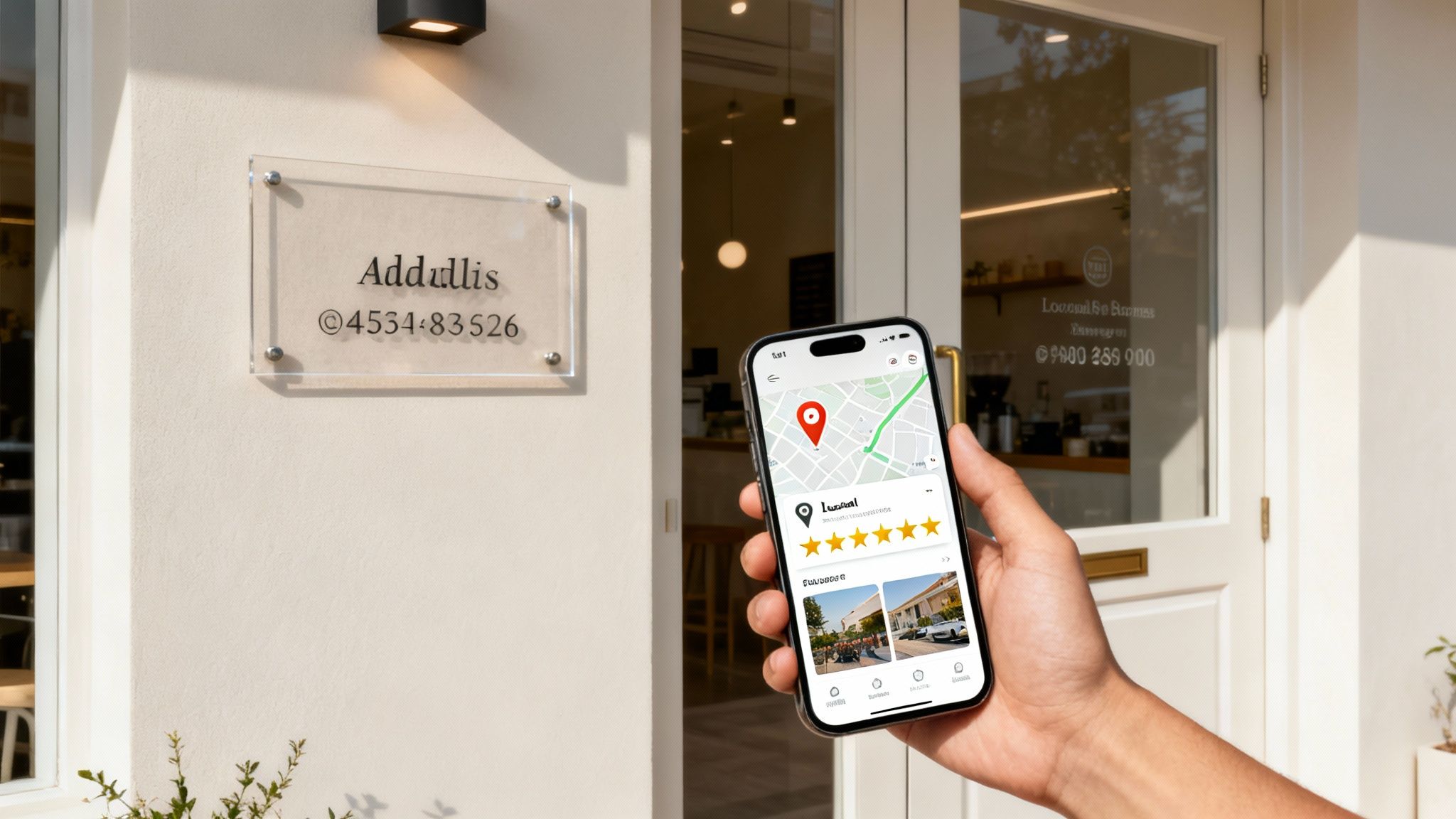
So let’s begin answering your question, “How to improve local SEO?” Think of your Google Business Profile as the digital front door to your company. For a huge chunk of your potential customers, this is the very first time they’ll ever interact with your brand. Long before they click over to your website, they’re seeing your hours, checking out your photos, reading reviews, and getting directions—all right there in Google Search or on Google Maps.
This makes your GBP the single most powerful tool in your local SEO arsenal. A neglected profile is like a shop with a busted sign and dirty windows; it just doesn’t build trust. But a sharp, fully optimized profile? That’s a 24/7 salesperson working for you, answering questions and funneling customers right to your door.
Choosing Your Business Categories Wisely
Once you’ve got the basics down, the next critical move is picking the right business categories. This one decision has a massive impact on the kinds of searches you’ll show up for.
- Your Primary Category: This needs to be the one category that perfectly describes your main business function. If you’re a roofer who also does siding, which service is your bread and butter? Pick that one. It carries the most weight with Google.
- Secondary Categories: Don’t just stop at one. This is your chance to capture the full scope of what you do. That roofer can—and should—add “Siding contractor” to show up for those searches, too.
This isn’t about spamming categories. It’s about giving Google an accurate, detailed picture of your services so it can connect you with the right local customers.
To make sure you’re covering all your bases, I’ve put together a checklist that walks you through everything from the absolute must-haves to the more advanced tweaks that can give you an edge.
GBP Optimization Checklist From Basic to Advanced
| Priority Level | Optimization Task | Why It Matters |
|---|---|---|
| High | Verify Your Profile | Unclaimed profiles can’t be fully managed and lack trust with Google. This is non-negotiable. |
| High | Select Accurate Primary & Secondary Categories | This directly tells Google which search queries your business is relevant for. It’s a huge ranking factor. |
| High | Ensure 100% NAP Consistency (Name, Address, Phone) | Your NAP must match your website and other key citations exactly. Inconsistency confuses Google and hurts rankings. |
| Medium | Upload High-Quality, Geo-tagged Photos & Videos | Visuals build trust and increase engagement. Geo-tagging adds a subtle location signal. |
| Medium | Write a Compelling, Keyword-Rich Business Description | This is your chance to tell customers and Google what you do and where you do it. Use local terms. |
| Medium | Enable and Respond to Q&As and Messaging | Shows you’re an active, engaged business. Pre-populating Q&As can proactively answer common questions. |
| Low | Regularly Post Updates (Offers, Events, News) | Keeps your profile fresh and gives customers a reason to choose you. Signals activity to Google. |
| Low | Add Products and Services with Descriptions | Details the full scope of your offerings, helping you rank for more specific long-tail keyword searches. |
Working your way through this list ensures your “digital front door” is not just open for business, but is actively welcoming customers in.
The Power of NAP Consistency
Imagine you’re meeting three friends for lunch, but you give each one a slightly different address. It would be chaos. That’s exactly what happens when Google finds conflicting information about your business scattered across the web.
Your NAP (Name, Address, Phone Number) has to be identical everywhere it appears online. I’m talking about your website, your GBP, social media profiles like Facebook, and industry directories like Yelp. Even tiny differences—like “St.” vs. “Street” or “Co.” vs. “Company”—can create enough confusion to hurt your credibility with search engines.
A consistent NAP is the bedrock of local SEO. It sends a clear, powerful signal to Google that your business information is reliable, which is a fundamental ranking factor.
Bringing Your Business to Life with Visuals and Details
A bare-bones profile isn’t going to cut it. You need to fill it out with rich, engaging content that shows off your business and makes a real connection with potential customers.
Get in the habit of uploading high-quality photos and videos. Show off your storefront, your team in action, finished projects, or even happy customers (just be sure to get their permission!). A pro tip is to geo-tag these photos with your location’s coordinates before you upload them—it’s another small but helpful local signal for Google.
Your business description is more prime real estate. Don’t just stuff it with keywords. Write a compelling summary that speaks directly to the needs of your local customers. Mention specific neighborhoods you serve or talk about what makes you a trusted part of the community.
The numbers don’t lie. Complete Google Business Profiles are 70% more likely to attract store visitors. When you consider that the average local profile gets over 1,200 views a month and that 42% of searchers click on the Map Pack results, it’s crystal clear why this is your most valuable piece of digital real estate. If you want to dive deeper, you can explore more local SEO statistics to see the full picture.
Developing Hyper-Local Website Content
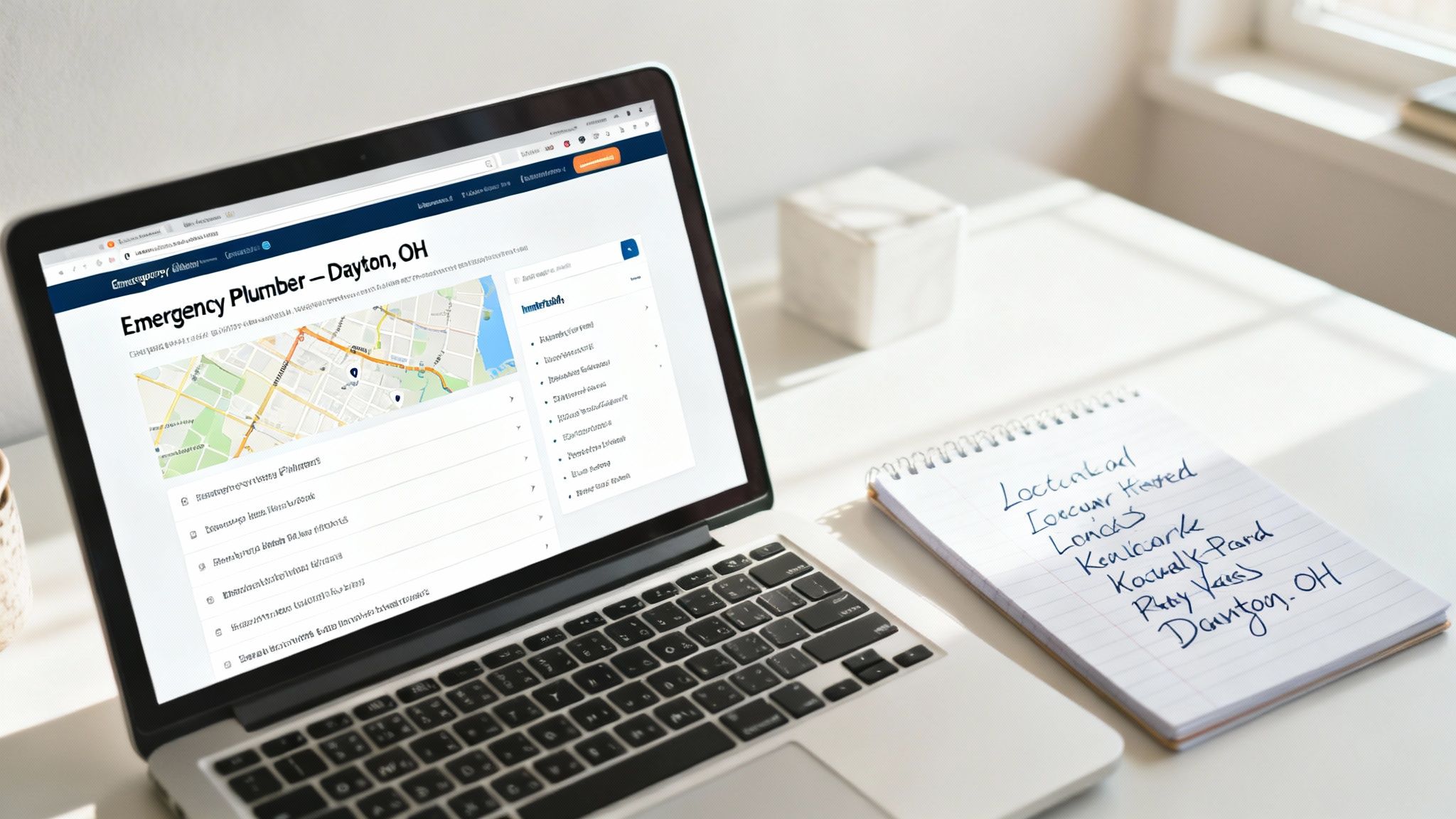
Think of your Google Business Profile as the digital welcome mat to your business. But your website? That’s the home they step into. It needs to scream “local expert” from every single page. This signals to both search engines and potential customers that you are the authority in your specific geographic area.
Simply sprinkling your city’s name across your homepage just won’t cut it anymore. To really move the needle with local SEO, your entire content strategy has to be deeply and intentionally rooted in the community you serve. It’s about moving past generic descriptions and creating pages that solve the real-world problems of your local audience.
Create Dedicated Location and Service Pages
If your business serves multiple towns or has more than one physical storefront, creating dedicated pages for each is non-negotiable. A generic “Services” page simply can’t compete against a highly specific landing page when a user is searching with clear local intent.
Each location page should be its own unique resource—almost like a mini-homepage for that specific community.
- Unique Content: Don’t just copy and paste descriptions. Write original content about what makes that location and its services unique.
- Local Details: Make sure to include the specific NAP (Name, Address, Phone Number), business hours, and an embedded Google Map for that location.
- Team and Testimonials: Build trust by featuring photos of the local team and reviews from customers right there in that area.
The same strategy applies to your services. Create distinct pages for each core service you offer and combine them with location details. For example, a page titled “Emergency Plumbing in Dayton, Ohio” will almost always outperform a general “Plumbing Services” page for that specific search query.
Mastering Local Keyword Research
Targeting the right keywords is the foundation of this whole effort. Your goal is to figure out the exact phrases local customers are typing into Google when they need what you do. This usually looks like a combination of a service and a geographic area.
Put yourself in your customer’s shoes. They aren’t just searching for “roofer.” They’re searching for “roofer near Washington Park” or “best metal roofing contractor in Morristown NJ.”
By focusing on these hyper-local, long-tail keywords, you attract highly qualified traffic from users who are often further down the buying funnel and ready to take action.
Your research needs to uncover terms that show clear local intent. While tools can certainly help, your own common sense is often the best guide. Brainstorm all the variations of your services paired with your city, nearby towns, specific neighborhoods, and even well-known local landmarks. If you need a refresher on the basics, you can learn more about effective keyword research strategies to build a strong foundation.
Weave Local Flavor Into Your Content
Truly authentic local content goes way beyond just keywords; it shows you’re actually part of the community. A blog is the perfect place to do this.
Try writing articles that are genuinely helpful to the local population and subtly tie back to what you do.
- A Landscaping Company: Could publish a guide on “The Best Drought-Resistant Plants for New Jersey Gardens.”
- A Local Cafe: Might create a post about “Upcoming Weekend Events in Downtown Morristown.”
- A Roofing Contractor: Could write about “Preparing Your Dayton Home for Ohio’s Storm Season.”
This approach positions your business as a valuable local resource, not just another company trying to make a sale. It builds brand loyalty and can attract powerful local backlinks from community blogs, news outlets, and event pages. Of course, a well-designed site is crucial for these efforts. A fantastic example of this principle in action is a Long Island’s premier creative studio for web design, branding, and SEO, which shows how a strong local presence begins with a great digital home.
Implement Local Business Schema
Finally, you need to speak Google’s language. Local Business schema is a piece of code you add to your website that explicitly tells search engines the most important details about your business.
This special markup helps Google instantly understand your:
- Business name
- Address and phone number
- Hours of operation
- Services offered
- Customer reviews and ratings
Getting this schema implemented correctly can significantly increase your chances of showing up in rich results, like the map pack or knowledge panels. This makes your listing stand out right on the search results page. It’s a technical step, but it’s absolutely critical for cementing your authority as a local business.
Building Trust Through Reviews and Reputation

In the local market, trust is everything. While your Google Business Profile gets you on the map and your website tells your story, it’s your online reviews that often seal the deal. They’re powerful social proof, telling both customers and search engines that you’re a credible, high-quality choice in the community.
A steady flow of positive reviews is a huge ranking signal for the local map pack. It shows you’re an active, respected business that delivers on its promises. Think about it: a recent survey found that 95% of consumers use reviews, and an incredible 86% see them as a vital part of their decision-making process. Your reputation has a direct line to your local SEO performance.
Cultivating a Five-Star Reputation
Asking for reviews can feel awkward, but it really doesn’t have to be. The trick is to build it right into your customer service process so it feels natural.
Timing is everything. Ask for a review right after a great experience, when the customer is happiest. This could be immediately after a successful service call, when a project is completed, or right after a purchase in your store.
Make it dead simple for them:
- Email & SMS Requests: Shoot them a quick follow-up message with a direct link to your Google review page. A little personalization goes a long way—use their name and mention the service they received.
- In-Person Prompts: For brick-and-mortar shops, a small sign at the register or a QR code on the receipt works wonders. For a simple walkthrough, check out this guide on how to increase Google reviews with QR codes.
It’s also smart to monitor your reputation beyond just Google. Customers might be talking about you on Yelp, Facebook, or industry sites like TripAdvisor or Angi. To get a handle on your digital footprint, running a free local listings report is a great way to see where your business is being mentioned online.
The Art of Responding to Feedback
Getting reviews is only half the battle; you have to engage with them. Responding to feedback, both good and bad, shows everyone that you’re an attentive business owner who genuinely cares about the customer experience.
When someone leaves a glowing review, a simple “thank you” is nice, but a specific one is better. Acknowledge their comments to show you actually read it. Instead of just “Thanks!”, try something like, “We’re so glad you enjoyed the new patio seating! Thanks for coming by.”
Negative reviews are stressful, but they are also a golden opportunity.
A thoughtful, professional response to a negative review can turn a dissatisfied customer into a loyal advocate. More importantly, it demonstrates to every future customer reading it that you take accountability and are committed to excellent service.
Here’s a simple framework for handling negative feedback:
- Acknowledge and Apologize: Thank them for bringing it to your attention and apologize that their experience wasn’t up to par.
- Take it Offline: Offer a direct way to connect, like an email address or phone number, to resolve the issue privately. This keeps a lengthy back-and-forth out of the public eye.
- Stay Professional: Never argue or make excuses. Your response is for every potential customer who will read it down the road.
By actively managing your online reputation, you’re not just collecting stars. You’re building a powerful asset that attracts new business and sends all the right signals to Google, cementing your spot as a trusted local leader.
Forging Local Links and Community Partnerships
When it comes to SEO, high-quality backlinks from other websites are like a massive vote of confidence in Google’s eyes. But for a local business, not all links carry the same weight. A link from some random national blog is one thing, but a link from your local Chamber of Commerce or a popular neighborhood news site? That’s pure gold.
This is how you prove to Google that you’re not just a business in the community—you’re a trusted, active part of it. The goal shifts from just collecting any link you can get to earning genuine local endorsements. It’s all about building a backlink profile that mirrors your real-world relationships and authority, right in your own backyard. These local links don’t just help your search rankings; they drive real, ready-to-buy referral traffic from customers just around the corner.
Think Like a Community Leader
Honestly, the best local link-building strategies don’t even feel like “SEO” work. They feel more like good, old-fashioned community engagement. Forget sending out cold, generic emails begging for links. Get involved in ways that make people want to talk about you online.
This approach builds real connections that naturally lead to powerful, relevant backlinks. It’s a strategy that pays off in ways that go far beyond just a simple clickable link.
- Sponsor a Local Youth Sports Team: So many Little League or youth soccer teams have a sponsors page on their website, almost always with a link back to your business. It’s a simple way to support local kids and earn a fantastic, hyper-local link.
- Host a Free Workshop or Event: If you’re a local CPA, why not host a “Small Business Tax Tips” workshop? A garden center could offer a class on “Spring Planting for Beginners.” Events like these create local buzz, and they often get picked up and promoted by community calendars, local bloggers, and news outlets—all great sources for valuable links.
The best local links aren’t forced; they’re a natural byproduct of genuine community involvement. When you invest time and resources in your local area, the digital shout-outs tend to follow, sending a powerful signal of trust to search engines.
Strategic Local Partnerships
Teaming up with other local businesses (that aren’t your direct competitors) is another fantastic way to build your local footprint and pick up some great links. The key is to find businesses that serve a similar type of customer.
For instance, a wedding photographer could partner up with a local florist and a catering company. You can all cross-promote each other on your websites with a “Preferred Vendors” page, linking out to each partner. This creates a trusted referral network that helps your customers and gives all of your websites a little SEO boost.
Another great play is to run a joint promotion. A local gym could partner with a nearby health food store to offer a combined discount package. Pushing this collaboration on both of your websites and social media channels is a great way to generate shares and links. To get the most out of this, you can learn more about how to use social media for local businesses to really amplify the news about your partnerships.
Finding and Engaging Local Voices
Every town has its own set of influencers and information hubs. We’re not talking about global celebrities here, but the local food bloggers, the heads of neighborhood associations, and the reporters for the community paper.
Your first job is to figure out who these people are. Start searching for blogs, news sites, or even popular community Facebook groups related to your city. Once you’ve identified them, focus on building a real relationship. Don’t slide into their DMs asking for a link on day one.
Start by engaging with their content. Share their articles, leave thoughtful comments, and offer yourself up as an expert resource for any future stories they might be working on. If you’re a local contractor, you could offer to give them a quote for an article on home renovation trends. When they feature your expert insight, they’ll almost always credit you with a link back to your website. This kind of proactive outreach establishes you as an authority and creates a natural pathway to earning high-quality local links.
Putting It All Together: Your 90-Day Local SEO Action Plan
Real, lasting success in local SEO is a marathon, not a sprint. It’s all about stringing together consistent, focused actions over time. Instead of getting overwhelmed, let’s break the whole process down into a manageable 90-day roadmap. This turns abstract goals into concrete tasks you can actually get done.
This plan is built to create momentum. The first month is all about shoring up your foundations. The second month shifts to expansion and content creation. The final 30 days are dedicated to building real authority and scaling up what works. Follow this sequence, and you’ll see tangible growth right in your own backyard.
The First 30 Days: Foundational Audit and Optimization
Your initial month is about getting your house in order. You can’t build a strong local presence on a shaky foundation. The main goal here is to audit everything you already have, fix the big problems, and make sure your business information is perfectly consistent everywhere it exists online.
Here’s what to tackle first:
- Complete Google Business Profile (GBP) Overhaul: Go through every single section of your GBP, top to bottom. Make sure everything is 100% complete and accurate, from your primary and secondary categories to your hours and service attributes. Get at least 10 new, high-quality, geo-tagged photos uploaded—show off your team, your storefront, and your work in action.
- NAP Consistency Audit: Use a tool or just manually search for your business across major directories like Yelp, Apple Maps, and Facebook. Open up a spreadsheet and track any little inconsistency you find in your Name, Address, and Phone number (NAP). Then, start submitting corrections for every single error.
- On-Page SEO Basics: Take a hard look at your website’s homepage and main service pages. Your title tags, meta descriptions, and H1 headings absolutely must include your main local keyword (e.g., “Morristown Plumber”). Also, add your full NAP to your website’s footer and embed a Google Map on your contact page.
This foundational work is non-negotiable. With 98% of customers using the internet to find info on local businesses, inconsistent data is a major red flag for both them and the search engines.
The Next 30 Days: Content and Review Generation
With a solid base in place, month two is all about creating content that proves your local expertise and actively building your social proof. We’re shifting from fixing old problems to actively building your future reputation. It’s time to show Google and your customers that you’re an active, authoritative voice in the community.
The focus now is simple: create valuable local content and get a system in place for generating customer reviews.
This is where you go from being just another online listing to becoming an active local resource. It’s what separates the businesses that simply show up from those that truly dominate local search.
Your plan for this month:
- Launch a Review Generation Campaign: Set up a simple system to consistently ask happy customers for reviews, whether it’s through email or text. Set a realistic goal, like getting 10 new, quality reviews this month.
- Publish Your First Hyper-Local Blog Post: Write and publish a blog post that is genuinely useful for people in your area. If you’re a landscaper, this could be something like a “Guide to Spring Planting in Morris County.”
- Build Out One Location or Service Page: Create a detailed, unique page for your most important service or a secondary location. Optimize it with specific local keywords, testimonials, and photos.
The Final 30 Days: Link Building and Authority
In the last month of this initial push, the focus moves to off-page signals and building authority. This means earning trust from other reputable local websites. High-quality local backlinks are a huge ranking factor, telling Google that your business is a respected part of the community fabric.
This timeline gives you a great visual for how to approach your local link building efforts.
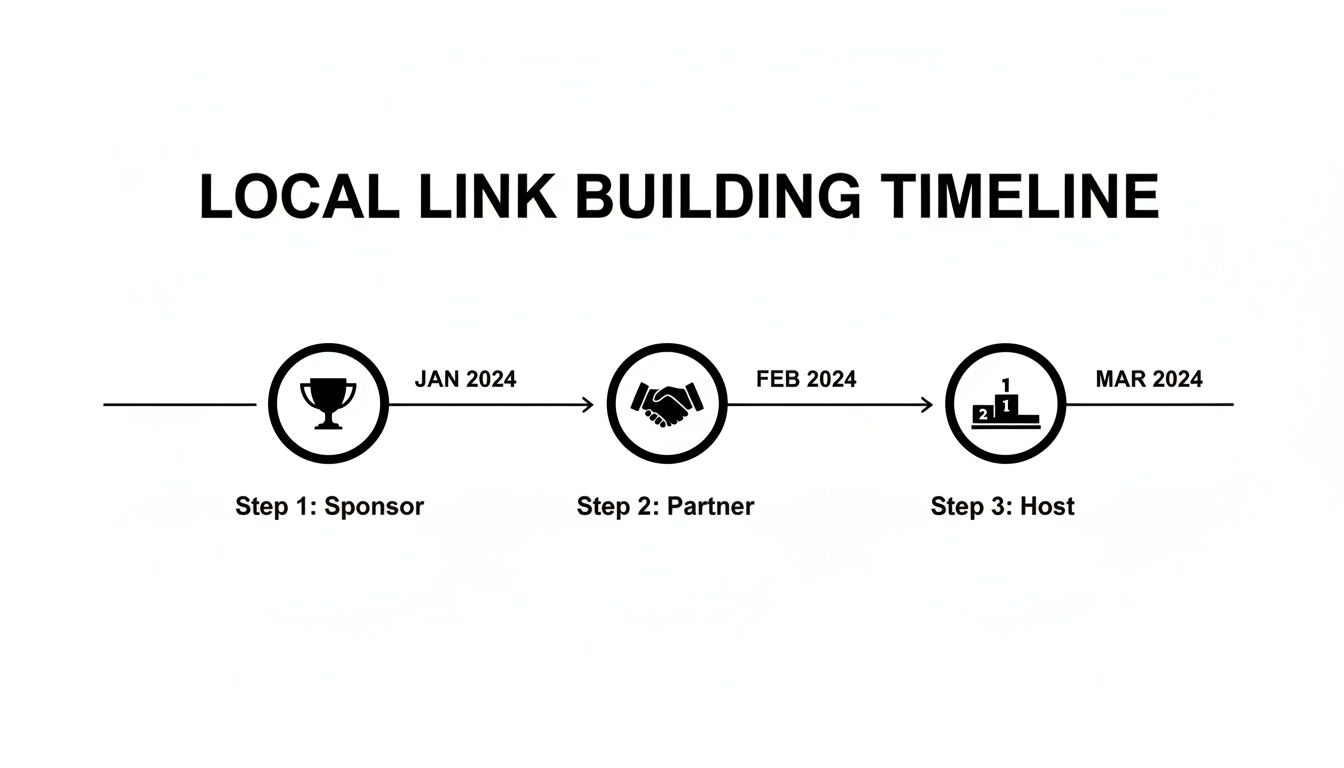
This roadmap shows a natural progression from a simple sponsorship to deeper partnerships and events.
Your actions for this period should mirror this authority-building strategy:
- Sponsor a Local Event or Team: This is often the quickest way to get a high-quality local backlink from a trusted community organization’s website.
- Partner with a Complementary Business: Reach out to a non-competing local business for a cross-promotion. You could offer to write a guest post for their blog or add them to a “local partners” page on your site in exchange for the same.
- Analyze and Repeat: At the end of the 90 days, dive into your Google Analytics and GBP Insights to see what’s actually working. Look at your rankings, phone calls, and website clicks to figure out which efforts moved the needle. Then, double down on those winning strategies for the next quarter.
To make this even easier, here is a sample roadmap you can adapt for your own business.
Your 90-Day Local SEO Action Plan
| Timeframe | Focus Area | Key Actions |
|---|---|---|
| Days 1-30 | Foundation & Cleanup | Perform full GBP audit & optimization. Conduct NAP consistency check & correct all errors. Implement on-page SEO basics (titles, metas, H1s, footer NAP). |
| Days 31-60 | Content & Reputation | Launch an email/SMS review request campaign (goal: 10+ new reviews). Publish one hyper-local blog post. Build out one new, in-depth service or location page. |
| Days 61-90 | Authority & Link Building | Secure one local sponsorship link (e.g., charity event, kids’ sports team). Identify & contact 5 potential local business partners. Analyze KPIs & plan the next 90 days. |
This plan provides a clear, actionable path forward. By focusing on these priorities in sequence, you build a powerful foundation that will continue to pay dividends long after the first 90 days are over.
Answering Your Local SEO Questions
Diving into local search optimization can feel like a maze, often leaving business owners with more questions than answers. Let’s clear up some of the most common queries we hear, giving you straightforward advice so you can move forward with confidence.
So, when can you expect to see results? The truth is, local SEO is a marathon, not a sprint. While you might notice some early movement from quick wins—like fully optimizing your Google Business Profile—within a few weeks, the big results take time to build.
For a brand-new business or one just getting started with local SEO, a realistic timeline to see meaningful traction in rankings and traffic is three to six months of consistent, focused work. This gives Google’s algorithm enough time to recognize and trust all the positive signals you’re sending.
This timeframe is a solid benchmark, but it’s not set in stone. Things like how competitive your industry is, your specific market, and how hard you push your efforts all play a big part in how quickly you climb the local ladder.
How Local SEO Differs from Traditional SEO
A frequent point of confusion is the line between general SEO and local SEO. They share the same DNA—keywords, quality content—but their goals and tactics are worlds apart. It’s like the difference between fishing with a giant net and fishing with a spear.
Traditional SEO casts that wide net, trying to pull in a national or even global audience. It’s all about broad keywords and building authority on a massive scale.
Local SEO, on the other hand, is like spear fishing. It’s incredibly targeted, zeroing in on a specific geographic area. The main goal isn’t just to show up in search results; it’s to drive real-world actions like phone calls, requests for directions, and people walking through your door.
Here’s a quick look at what sets them apart:
- Geographic Intent: Local SEO is all about “near me” searches and location-specific keywords, like “plumber in Dayton Ohio.”
- Key Ranking Factors: Your Google Business Profile and local citations (NAP consistency) are huge for local but aren’t as critical for traditional SEO.
- User Goal: The searcher usually needs something right now. They have an immediate, transactional need for a product or service in their area.
Getting this distinction right is crucial. If you try to apply a generic SEO strategy to a local business, you’ll completely miss the specific signals Google needs to rank you in the all-important Map Pack.
Common Mistakes That Sabotage Local Rankings
Even with the best of intentions, it’s surprisingly easy to make mistakes that tank your local rankings. Avoiding these common slip-ups is just as important as doing the right things.
One of the biggest culprits we see is NAP inconsistency. Even tiny variations in your business Name, Address, and Phone number across online directories can confuse search engines and damage their trust in your business. For example, using “St.” on one website and “Street” on another is a small detail with a potentially large impact.
Another major misstep is neglecting customer reviews. It’s not enough to just get them; you have to respond to all of them, good and bad. Ignoring feedback tells potential customers (and Google) that you’re not engaged, which hurts your reputation and your search visibility. Since 95% of consumers use reviews to guide their decisions, this is an area you absolutely can’t afford to ignore.
Finally, many businesses drop the ball on creating truly local content. Just peppering your city’s name throughout a generic service page won’t cut it. You need to develop content that speaks directly to the local community, answers their unique questions, and shows you’re a genuine part of the neighborhood you serve.
Ready to stop wondering how to improve local SEO and guessing and start ranking? The expert team at SWAT Marketing Solutions can build a customized local SEO strategy that drives real results for your business. From optimizing your online listings to creating compelling local content, we handle the details so you can focus on your customers. Get your free website assessment and see how we can help you dominate your local market.