
Multi channel marketing is all about using a few different platforms to chat with your customers. Think social media, email, your website, and even your physical, brick-and-mortar store. It’s like fishing with multiple lines in the water—each one is a separate chance to connect with people right where they’re already hanging out.
A Quick Look at Multi Channel Marketing
Let’s imagine you’re trying to promote a local coffee shop. If you were using a multi channel strategy, you wouldn’t put all your eggs in one basket. Instead, you’d be active on Instagram showing off your amazing latte art, sending out weekly email newsletters with special offers, and running an old-school loyalty program with punch cards in your physical shop. Each channel works on its own, but they’re all pointed toward the same goal: getting more people to walk through your door.
The big idea here is pretty simple: be present where your customers are. People jump between their phones, laptops, and real-world experiences all day long, so using multiple channels is the best way to keep your brand visible. It’s about giving your customers choices in how they want to engage with you.
The Core Philosophy Behind It
At its heart, this approach is all about the product. The main goal is to blast your message across various platforms to get people interested and drive sales.
The channels run in parallel, but they don’t necessarily talk to each other or create one seamless journey for the customer. For example, a special you’re running on Facebook might be completely different from an offer you send to your email subscribers. This separation lets you fine-tune your messaging for each platform’s unique audience and format, so you can test what works best in each space. It’s a really practical starting point for businesses looking to expand their reach without needing the complex technical setup of other strategies.
The goal of multi channel marketing is to give consumers a choice and allow them to buy whenever and wherever they want to. It’s about casting the widest net to get maximum customer engagement.
To really get it, you need to understand the key traits that set this strategy apart. Let’s break down the core components that truly define a multi channel marketing approach.
Core Characteristics of Multi Channel Marketing
| Characteristic | Description |
|---|---|
| Channel Focus | Each channel (like email, social media, or retail) is treated as its own thing, with its own separate strategy. |
| Customer Interaction | The business pushes messages out to the customer through multiple, disconnected touchpoints. |
| Data Flow | Customer data usually stays locked within each channel, meaning what happens on one platform doesn’t affect the others. |
| Primary Goal | To get your message in front of as many people as possible and create more opportunities for them to engage or buy. |
These characteristics highlight a strategy built on breadth rather than depth. By focusing on maximizing reach across several independent channels, you create more doors for customers to walk through.
Choosing Your Key Marketing Channels
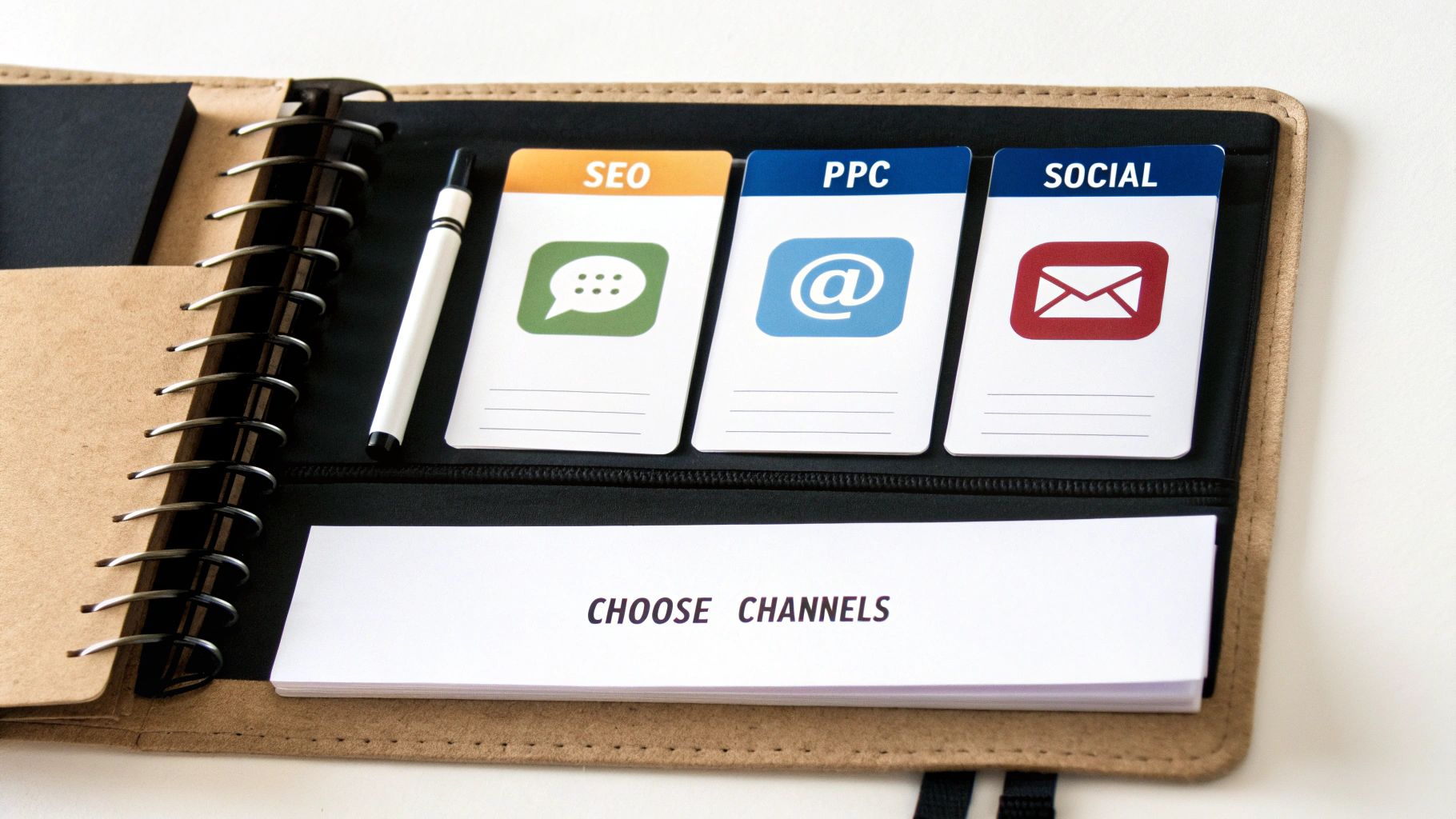
Picking the right platforms is probably the most important step in building a multi-channel marketing strategy that actually works. The goal isn’t to be everywhere at once. Instead, you need to be in the right places—wherever your ideal customers are already spending their time.
Think of it like putting together a toolkit. You don’t need every tool ever made, just the specific ones that will get the job done right.
For most businesses, this toolkit is a core set of digital channels that work together to pull people in, keep them interested, and turn them into customers. Each one has its own job to do, but they all support your bigger plan.
The Foundational Four Channels
While there are dozens of platforms out there, a few have become absolute essentials for any modern business. Let’s look at the four pillars of a strong multi-channel approach.
1. Organic Search (SEO)
Search Engine Optimization is your long-term foundation. It’s all about getting your website to show up in Google when people are searching for what you offer. Good SEO builds trust and makes you look like an authority, and it works around the clock to bring in quality traffic without you having to pay for every single click.
2. Paid Advertising (PPC)
Pay-Per-Click ads, like Google Ads, are your spotlight. While SEO builds up steam over time, PPC gets you seen immediately. You can target very specific keywords, people, and places to put your brand right in front of folks who are ready to buy. It’s perfect for sales, new product launches, or just getting leads in the door fast.
3. Social Media Marketing
Social media is your community hangout. Platforms like Facebook, Instagram, and LinkedIn are where you build real relationships, tell your brand’s story, and connect with customers on a more personal level. It’s less about the hard sell and more about creating loyalty. You can find out more about building a solid plan in our guide to social media marketing for businesses.
4. Email Marketing
Email is your direct line. Unlike social media, you own your email list. That gives you a surefire way to reach your customers without getting lost in an algorithm. It’s fantastic for nurturing leads, sending out personalized offers, and getting people to come back and buy again.
Key Takeaway: A winning strategy doesn’t just use a bunch of channels; it understands why each one exists. Think of it this way: SEO builds your permanent digital storefront, PPC rents a billboard on a busy highway, social media hosts your community events, and email delivers a personal invitation right to their inbox.
Selecting Your Channel Mix
So, how do you decide which channels to focus on? The answer comes from knowing your business goals and, just as importantly, your customers.
Start by asking a few critical questions:
Where is my audience actually hanging out online? Use your analytics and maybe even a customer survey to figure this out.
What am I trying to achieve right now? If you need sales today, PPC is a great bet. If you want to build a loyal following, put more energy into social media and email.
What resources do I have? SEO is a major time investment, while PPC requires a solid budget. Be honest about what you can handle consistently.
By starting with a focused mix of 2-3 high-impact channels, you can get really good at them before trying to add more. This makes sure your multi-channel marketing efforts are both effective and something you can actually stick with.
The Tangible Benefits of a Multi Channel Strategy
Going with a multi-channel strategy is about more than just showing up on different platforms; it’s about driving real, measurable results for your business. When we move past the buzzwords, this approach directly impacts your bottom line by growing your brand’s footprint and building much stronger connections with customers.
Think of it this way: Imagine your business is a single shop on a quiet side street. You’ll get some foot traffic, sure, but your reach is pretty limited. A multi-channel approach is like opening pop-up shops in a busy mall, running ads on the local radio, and sending flyers directly to people you know are interested. All at once, you’re more visible to a much, much wider audience.
This expanded presence creates way more opportunities for people to engage with you. By meeting customers where they already are—whether that’s a Google search, their social media feed, or a weekly newsletter—you make it simple for them to find and interact with your brand on their own terms.
Amplify Your Reach and Engagement
One of the biggest wins here is the ability to cast a wider net. Instead of putting all your eggs in one basket, you create multiple paths for customers to find you. This not only boosts your visibility but also helps people remember your brand because they see it consistently in different places.
A wider presence naturally leads to deeper engagement. Businesses that use three or more channels see engagement rates up to 494% higher than those sticking to just one. That’s how you turn passive viewers into active customers.
This jump in interaction isn’t just for show. It translates directly into more qualified leads, more website traffic, and a healthier sales pipeline. The global multi-channel marketing market, valued at $6.96 billion in 2023, is expected to soar to $28.6 billion by 2030. That’s a crystal-clear sign of how important this has become, all driven by the undeniable shift in how people interact with brands online.
Build Resilience and Deeper Relationships
Relying on a single platform is just plain risky. An unexpected algorithm change from Google or a new policy on a social media site could dry up your lead flow overnight. A multi-channel strategy is your insurance policy, spreading your risk across several platforms. If one channel suddenly tanks, the others can keep your marketing efforts afloat.
This consistent presence also builds trust and fosters deeper customer relationships. Every touchpoint reinforces your brand’s message, creating a familiar and reliable experience that encourages loyalty. Over time, these interactions lay the groundwork for long-term customer value. To really know if it’s working, it’s essential to understand the marketing automation ROI, which is a key piece in making sure your multi-channel investments are paying off.
At the end of the day, a well-run multi-channel strategy delivers concrete results you can see in your analytics, connecting every marketing dollar back to what matters most: sustainable business growth.
Multi Channel vs Omnichannel: Unpacking the Difference
This is one of the most common hurdles for businesses to clear, but the difference between multi-channel and omnichannel marketing becomes obvious once you picture it.
Think of a multi-channel strategy as a wheel with spokes. Each spoke is a different marketing channel—social media, email, your website—and they all point to the customer at the center. The key here is that the spokes don’t connect with each other.
In this setup, each channel pretty much does its own thing. An Instagram campaign might have a completely different message or offer than an email blast you send to your list. It’s a solid approach for casting a wide net and lets you create content that feels native to each platform.
An omnichannel strategy, however, is more like a spider’s web. Every channel is woven together, creating a single, seamless path for the customer. Their experience just flows from one touchpoint to the next without a hitch, which requires a much deeper level of integration behind the scenes.
The Customer Experience Divide
The real difference comes down to the customer’s point of view. With a multi-channel approach, the brand is at the center, pushing out messages. With omnichannel, the customer is at the center, and every channel works in concert to build a unified experience around them.
For instance, in an omnichannel world, a customer might see a Facebook ad for a pair of shoes, click over to your website, add them to the cart, but then get distracted. A little while later, they get a friendly email reminding them about the exact shoes sitting in their cart. It’s one continuous conversation because the data is shared between channels.
This diagram shows how a multi-channel strategy still brings major benefits by expanding your reach, building relationships, and reducing risk.
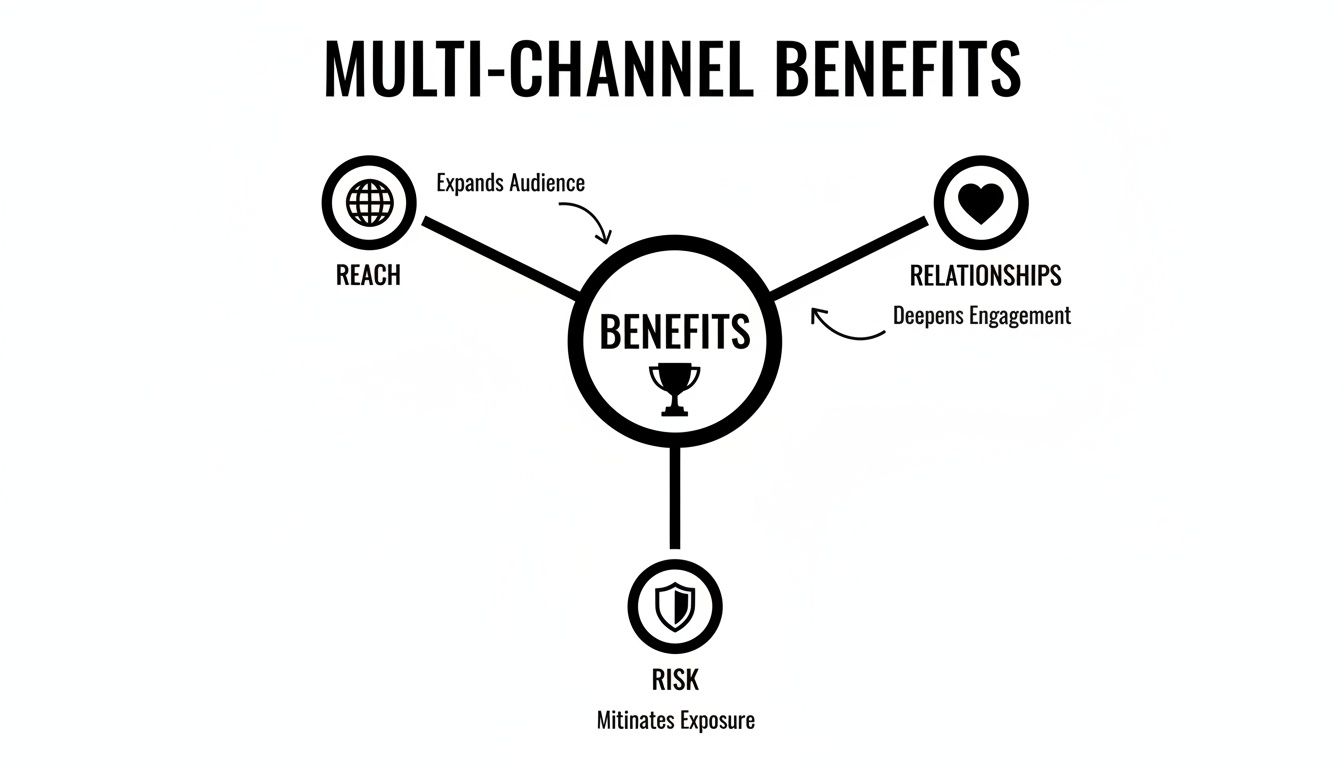
It highlights that even without that deep integration, just being on multiple channels provides a strong foundation for business growth.
A simple way to remember it: Multi-channel is like having many separate conversations in different rooms. Omnichannel is one long, continuous conversation that follows the customer from room to room.
Getting all your customer data into one central place is what makes this kind of seamless experience possible. To see how technology makes this happen, check out our insights on CRM integration and its benefits.
To make it even clearer, here’s a direct comparison of how these two approaches stack up.
Multi Channel vs Omnichannel Key Differences
The table below breaks down the core distinctions between multi-channel and omnichannel marketing, focusing on how they approach the customer, handle data, and what they aim to achieve.
| Aspect | Multi Channel Marketing | Omnichannel Marketing |
|---|---|---|
| Main Focus | Product and Brand | Customer Experience |
| Channel Integration | Channels work independently in silos. | All channels are fully integrated and work together. |
| Data Flow | Data is often isolated within each channel. | Customer data is shared across all channels in real-time. |
| Business Goal | Maximize reach on various platforms. | Create a seamless and consistent customer journey. |
Ultimately, while multi channel marketing focuses on getting your message out across many platforms, omnichannel focuses on unifying those platforms to serve a single, customer-centric journey.
How to Build Your First Multi Channel Campaign

Putting all this theory into practice doesn’t have to be a headache. Building your first multi-channel marketing campaign is really about taking smart, methodical steps backed by good data. This framework will walk you through the essentials to get your campaign off the ground and set you up for success.
The whole process kicks off with knowing where you’re going. If you don’t have a clear goal, you’re just making noise online without any real purpose. For your first campaign, try to focus on a single, measurable objective.
Think of it like setting the destination in your GPS before you even start the car. It makes sure every turn you take gets you closer to where you want to be.
Step 1 Define Your Goals and Audience
Before you even think about which channels to use or what to write, you have to answer two basic questions: who are you talking to, and what do you want them to do? Vague answers just won’t work here.
Get really specific with your goals. Are you trying to bump up online sales by 15% this quarter? Generate 50 solid leads for your service? Maybe you just want to boost sign-ups for an upcoming webinar. Having a clear, number-driven goal is your north star.
Next, you need to get to know your audience—and I mean really know them. Go beyond the basic demographics and build out a detailed buyer persona.
Where do they hang out online? Are they scrolling Instagram, reading niche industry blogs, or are they all business in LinkedIn groups?
What are their biggest headaches? You need to understand the exact problems your product or service is built to solve.
What kind of content grabs their attention? Do they love quick-hit videos, deep-dive articles, or fun, interactive quizzes?
This deep-seated understanding of your audience is the bedrock of any good multi-channel effort. It tells you exactly where to be and what to say when you get there.
Step 2 Select Your High-Impact Channels
Now that you’re armed with insights about your audience, you can pick your channels. The trick here is to start small and stay focused. A classic mistake is trying to be everywhere at once, which just stretches your resources thin and leads to total burnout.
Pick just 2-3 channels where your ideal customers are most active. For instance, a B2B software company might zero in on LinkedIn for professional networking, use Google Ads to catch people actively searching for a solution, and run a targeted email campaign to nurture those leads. You can learn more about building great email strategies from our guide on professional email marketing services.
On the flip side, a local bakery would probably get more traction from Instagram for mouth-watering photos, Facebook Ads for targeting the local community, and a solid local SEO plan to show up in “near me” searches.
Pro-Tip: Don’t just jump on the most popular platforms because they’re popular. Choose the platforms where you can actually have a real conversation with your audience and realistically keep up a consistent presence.
Step 3 Craft a Consistent Core Message
While the format of your content will definitely change from one channel to the next, your core message has to stay the same. This is how you build brand recognition and earn trust. Your brand’s voice, values, and what makes you special should be instantly obvious, whether someone sees a tweet, opens an email, or reads your blog.
This doesn’t mean you should copy and paste the same text everywhere. It’s about adapting your core message to fit the vibe of each platform. A professional, data-heavy tone that works on LinkedIn can transform into a more casual, behind-the-scenes look on your Instagram stories.
Finally, get your tracking tools set up from day one. Use something like Google Analytics to see where your website traffic is coming from and dive into your social media analytics to see what’s getting engagement. This data is gold—it tells you what’s working so you can fine-tune your strategy and prove your campaign is delivering a real return.
Measuring Success with the Right Metrics
A multi channel marketing strategy is only as good as the results it brings in. To really get a feel for its impact, you have to look past the surface-level numbers and focus on the metrics that prove your business is actually growing. This means learning the difference between channel-specific data and the big-picture key performance indicators (KPIs) that matter most.
For example, an email open rate or a social media click-through rate (CTR) tells you how a single channel is doing. While that’s important for making daily tweaks, it doesn’t show you the full story.
The real value is in connecting those individual channel metrics to broader business outcomes—the kind that reflect profitability and build customer loyalty.
This is where you stop obsessing over isolated channel performance and start looking at the overall health of your entire marketing engine.
Connecting Channel Data to Business Growth
The metrics that give you the best insights are the ones tied directly to your bottom line. Instead of getting lost in a sea of data, you need to prioritize the KPIs that measure how much your customers are worth and how efficiently you’re acquiring them. This approach helps you see which channels are your heavy hitters and which ones might need a new game plan.
Key business-level KPIs include:
Customer Acquisition Cost (CAC): This metric tells you exactly what you’re spending to land a new customer. A low CAC is a sign that your strategy is working efficiently.
Customer Lifetime Value (LTV): This shows you the total revenue you can expect from a single customer over their entire relationship with your brand. A high LTV means you’re attracting and keeping the right kind of valuable customers.
Conversion Rate by Channel: This helps you pinpoint which platforms are best at turning prospects into buyers. Armed with that knowledge, you can put your budget where it will work hardest.
Ultimately, to figure out the true impact of your multi-channel efforts, it’s vital to learn how to measure marketing effectiveness using these kinds of performance indicators.
The data doesn’t lie. Companies with a deliberate multi-channel strategy see an average 9.5% annual revenue increase because they’re engaging customers more consistently across more touchpoints. When these efforts become even more integrated, the results are even more impressive—customer retention can jump from 33% for single-channel efforts all the way to 89%, proving the long-term value of a broad, connected strategy.
Answering Your Multi-Channel Marketing Questions
Diving into any new strategy is going to bring up some questions. Let’s tackle some of the most common ones we hear from business owners who are figuring out what multi-channel marketing can do for them.
How Many Channels Should a Small Business Start With?
It’s tempting to want to be everywhere at once, but that’s a surefire way to stretch your resources too thin. The best approach is to start with 2-3 channels where you know for a fact your target customers are hanging out.
Focus on getting really good at a few key platforms first. Think about a solid combination like local SEO, one primary social media account, and email marketing. Nail those down before you even think about expanding. Quality always beats quantity here.
Is Multi-Channel Marketing Expensive to Implement?
It really doesn’t have to be. The cost is completely tied to the channels you pick.
Organic channels, like SEO and creating blog content, are more of an investment in time but can pay off big time in the long run. On the other hand, paid channels like Google Ads give you direct control over your budget. The trick is to set a clear budget from the start and watch your spending closely.
The most successful strategies aren’t about being on the most popular channels; they’re about being on the channels that deliver the best results for your investment.
How Do I Keep My Brand Message Consistent?
Consistency is absolutely crucial—it’s how you build trust with your audience. The best first step is to create a simple brand style guide.
This doesn’t have to be complicated. Just outline your main message, your tone of voice, how your logo should be used, and your color scheme. Make sure anyone creating content for your brand has a copy. Then, make it a habit to regularly check in on your channels to ensure they all look and sound like they’re coming from the same place.
Ready to build a powerful multi-channel strategy without all the guesswork? The team at SWAT Marketing Solutions can help you pick the right channels and craft a consistent message that drives real growth. Get your free assessment today!