
If your lead generation efforts feel like you're just shouting into the void, you're definitely not alone. It's a common frustration for small business owners. The real problem usually isn't the specific tactic you're using—it's the lack of a connected, customer-focused system behind it.
True success comes from understanding the why behind your actions, not just the what.
Why Your Lead Generation Efforts Aren't Working
So many businesses jump into lead generation by chasing the newest shiny object, hoping one specific channel will magically open the floodgates. When it doesn’t work, it’s easy to get discouraged. But the issue is rarely the channel itself; it's the missing strategy that connects what you're doing to what a real customer actually needs. Let's break down the most common roadblocks.
Before you spend another dollar on a campaign, it helps to understand the fundamentals. Diving into a guide on Mastering Lead Generation Online is a great starting point to frame up what you need before you launch.
You Are Targeting the Wrong Audience
This is probably the biggest mistake I see. You can craft the most perfect, persuasive message, but if it's aimed at the wrong people, it will fall on deaf ears. Think about it: if you sell high-end, custom landscaping services but your ads are showing up for new homeowners with shoestring budgets, you’re just wasting money. It’s like trying to sell snow shovels in Miami.
"A message that tries to speak to everyone ends up speaking to no one. Specificity is your greatest asset in small business lead generation."
Great lead generation always starts with a razor-sharp picture of your ideal customer. Go deeper than just their age and location. What are their biggest headaches? What are they trying to achieve? Where do they hang out online? Get this right, and everything else gets easier.
Your Strategy Lacks a Cohesive System
Running a Facebook ad, publishing a blog post, and sending a newsletter are just individual tasks. Without a system that ties them all together, they’re just isolated bursts of activity that don’t build any momentum. A potential customer might see your ad and visit your site, but if there's no clear next step or compelling reason to stick around, they'll just click away and forget you.
A system that actually works guides people on a journey:
- Awareness: They first find you through a genuinely helpful blog post that solves a small problem for them.
- Consideration: They like your advice, so they sign up for your newsletter to get more tips.
- Conversion: After you've built some trust, they finally book a consultation when they receive a relevant offer.
See how each piece works together? You’re building a relationship, not just making noise.
You Are Neglecting the Customer Journey
Here's a hard truth: most people are not ready to buy the first time they hear about you. It's just not how it works. Research shows that a staggering 73% of B2B leads are not ready to make a purchase when they first interact with a brand. Another study found that 68% of B2B businesses struggle significantly with this part of the process.
This is where so many small businesses go wrong. If your entire strategy is a constant "Buy Now!" pitch, you're turning away the huge majority of your potential market. You have to create value at every single stage. Offer helpful advice, build trust, and become a resource long before you ever ask for the sale. This guide is designed to help you build that exact system, turning that frustration into a predictable, steady flow of qualified leads.
Building Your Foundational Lead Capture System
Before you run a single ad or write one blog post, you have to get your digital storefront ready for customers. A solid small business lead generation plan isn't just about getting people to your site; it’s about having a system ready to welcome them, guide them, and turn them into real opportunities.
Without this foundation, you're basically throwing a party but forgetting the music and drinks. Your guests won't stick around.
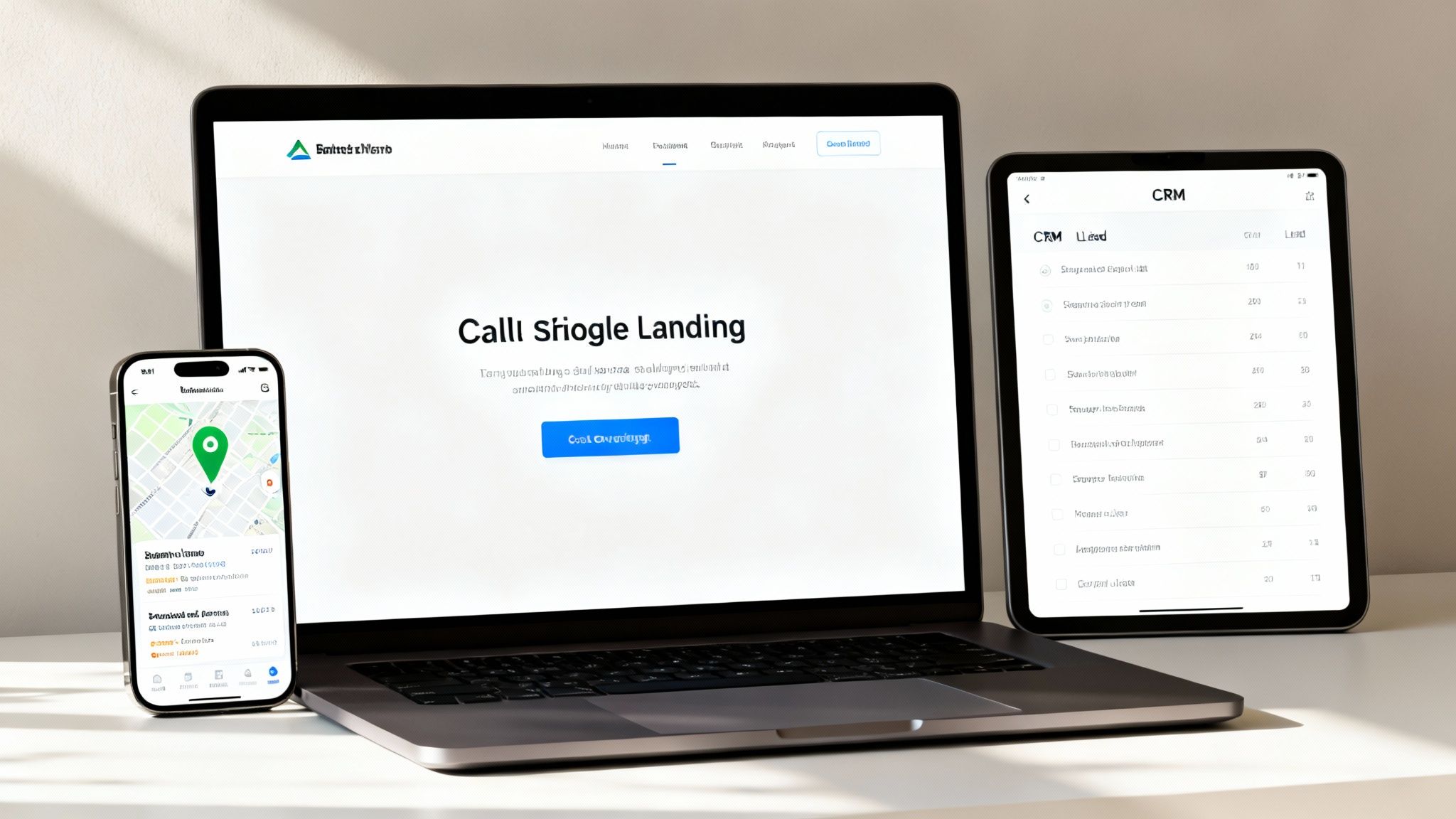
Getting this setup right is non-negotiable. It makes sure every dollar and hour you put into marketing actually has a chance to pay off. Let's walk through the essential assets that will become your lead-capture engine, starting with the heart of your online presence: your website.
Optimizing Your Website For Local SEO
Your website is more than a digital brochure—it’s your best salesperson, working 24/7. For a local business, it absolutely must be set up to attract customers in your service area. This is what we call local SEO, and it’s how you show up in those all-important "near me" searches.
Put yourself in your customer’s shoes. When they search for a "plumber in Morristown," Google wants to show them the most relevant and trustworthy local option. Your job is to send every possible signal that you’re that business.
Here's a quick checklist to get you started:
- Homepage Title Tag: Your main page title should clearly state your service and location (e.g., "Expert Plumbing Services in Morristown, NJ").
- Contact Information: Make sure your business Name, Address, and Phone number (NAP) are easy to find and are exactly the same everywhere online. Consistency is key.
- Location-Specific Pages: If you serve several towns, create a separate page for each one. A page for "Madison HVAC Repair" and another for "Chatham HVAC Repair" tells Google you are a perfect match for searches in those areas.
Nailing these first steps is a must. If you're ready to go deeper, exploring the benefits of SEO for small businesses will show you how a long-term strategy can really pay dividends.
Claiming And Enhancing Your Local Listings
Beyond your website, you need to be present in local directories. The most important one by far is your Google Business Profile (GBP). Claiming and completely filling out this free profile is one of the most powerful things a local business can do. It's what gets you into the coveted Google Map Pack—that block of three businesses at the top of local search results.
But GBP is just the start. Your business info needs to be correct and consistent on dozens of other sites like Yelp, Apple Maps, and directories specific to your industry. Inconsistent details, like an old address or a wrong phone number, confuse both customers and search engines, which hurts your credibility.
Key Takeaway: Consistency is king. An incorrect phone number on one directory can cost you a customer. A systematic approach to managing your listings ensures accuracy and builds trust with search engines.
Trying to update dozens of listings by hand is a nightmare. Thankfully, services exist that can automatically push your correct NAP info across a huge network of directories. This doesn't just save you a ton of time; it also builds powerful "local citations" that give your search ranking a nice boost.
Crafting High-Converting Landing Pages
Finally, let’s talk about landing pages. A landing page is a special, standalone page built for one single purpose. Unlike your homepage, which has lots of links and options, a landing page is designed to remove all distractions and push a visitor toward one specific action—like filling out a form or downloading a free guide.
Think about it: if you run a Facebook ad for a "Free Roofing Inspection" and send people to your homepage, they have to click around to find what they're looking for. But if you send them to a dedicated landing page that only talks about the free inspection and has a big, clear sign-up form, your conversion rate will skyrocket.
Great landing pages all share a few things:
- A Compelling Headline: It needs to grab attention and perfectly match the ad or link that brought the person there.
- A Single Call-to-Action (CTA): There should be only one obvious button, like "Get Your Free Quote Now." No confusion.
- Benefit-Oriented Copy: Focus on what the customer gets. Instead of "We use quality materials," try "Enjoy peace of mind with a 30-year warranty."
- Social Proof: Add customer testimonials or reviews to build trust instantly.
By getting these three foundational pieces—local SEO, consistent listings, and targeted landing pages—in order, you create a powerful system that’s ready to turn clicks into customers.
Activating High-Impact Lead Generation Channels
You've built a solid foundation to capture interest, and now it's time to open the floodgates. This is where your strategy gets put into action, turning your website from a static brochure into a lead-generating machine. It’s not about doing everything at once, but making smart, focused choices that actually get results.
The trick is to create a healthy mix of paid advertising and organic marketing. This two-pronged attack gives you the immediate traffic that ads can bring, plus the sustainable, long-term growth that comes from great content and a strong community. Let’s walk through the playbooks for the channels that pack the biggest punch for small businesses.
Launching Smart Pay-Per-Click Campaigns
Pay-Per-Click (PPC) ads, like the ones you see on Google, are one of the fastest ways to get in front of people who are looking for exactly what you sell, right now. When someone searches for "emergency roof repair near me," you can be the very first result they see. That's incredibly powerful.
But let's be honest, without a smart approach, it's also the fastest way to burn through your marketing budget. Success here isn’t about who spends the most; it's about who is the most relevant.
Here’s how to start smart:
- Focus on High-Intent Keywords: Don't waste money bidding on broad terms like "roofer." Instead, zero in on long-tail keywords that show someone is ready to buy, like "cost to replace asphalt shingle roof" or "best local roofing company reviews." These searches are less competitive and attract much more qualified buyers.
- Write Compelling Ad Copy: Your ad needs to speak directly to the searcher's problem and offer a clear, immediate solution. Stand out from the crowd by mentioning a key benefit like "Free, No-Obligation Estimates" or "24/7 Emergency Service."
- Link to a Relevant Landing Page: Never, ever send ad traffic to your homepage. As we covered earlier, sending them to a dedicated landing page that matches the promise you made in the ad is absolutely crucial for turning that expensive click into a valuable lead.
Remember, blending these different marketing tactics is usually the most effective route. You can learn more about creating a cohesive plan in our guide to multi-channel marketing.
Harnessing the Power of Organic Content
While PPC gets you quick wins, organic content is your engine for sustainable, long-term small business lead generation. This is all about creating genuinely helpful content—think blog posts, how-to guides, or videos—that directly answers your ideal customer's biggest questions. It builds trust and establishes you as the go-to expert in your field.
Think of it this way: a potential customer isn't just searching for a service; they're looking for answers and reassurance. When you provide that value upfront, you become the obvious choice when they’re finally ready to make a purchase.
For example, a painting contractor could create content like:
- A blog post on "How to Choose the Perfect Exterior Paint Color for Your Home."
- A downloadable checklist titled "7 Things to Ask a Painting Contractor Before Hiring Them."
- A short video showing the difference between a cheap paint job and a professional one.
Pro Tip: Your best content ideas will almost always come directly from your customers. What are the top five questions you get on every sales call? Turn each of those questions into its own detailed blog post. You’ll start attracting the exact people you want to talk to.
This approach doesn't just pull in visitors from search engines. It also gives you valuable assets you can share across social media and in your email newsletters, getting more mileage out of every piece of content you create.
Building Community on Social Media
Social media is so much more than a place to shout about your sales. It’s a place to build real relationships. For small businesses, platforms like Facebook, Instagram, and LinkedIn are incredible tools for connecting with your local community and specific professional circles.
The key is to engage, not just sell. Share behind-the-scenes looks at your work, celebrate your customers' successes, and get involved in conversations in local community groups. A local coffee shop, for instance, could post about a new seasonal drink, feature a regular customer in a "Customer of the Week" post, and share news about an upcoming neighborhood street fair. This is how you build a loyal following that thinks of you first.
For many small businesses, using professional platforms can be a game-changer. You can dive deeper into effective LinkedIn Lead Generation for Small Businesses to see how this works. This strategy is powerful because it’s all about building genuine connections, which is what drives long-term customer loyalty and word-of-mouth referrals.
When you truly understand what your prospects need, you can tailor your message perfectly. For small businesses, targeting leads based on where they are in the sales funnel can boost conversion rates by as much as 73%. It's a data-driven approach that means you stop wasting time on cold outreach and start focusing on warm, engaged leads who are much more likely to become customers.
Turning Website Visitors into Qualified Leads
Getting people to your website is a massive win, but it's really only half the battle. A visitor who clicks away without taking action is a lost opportunity. This is the point where your strategy needs to shift from just attracting an audience to actively converting them into qualified leads. The idea is to turn your website from a passive brochure into an active conversation starter.
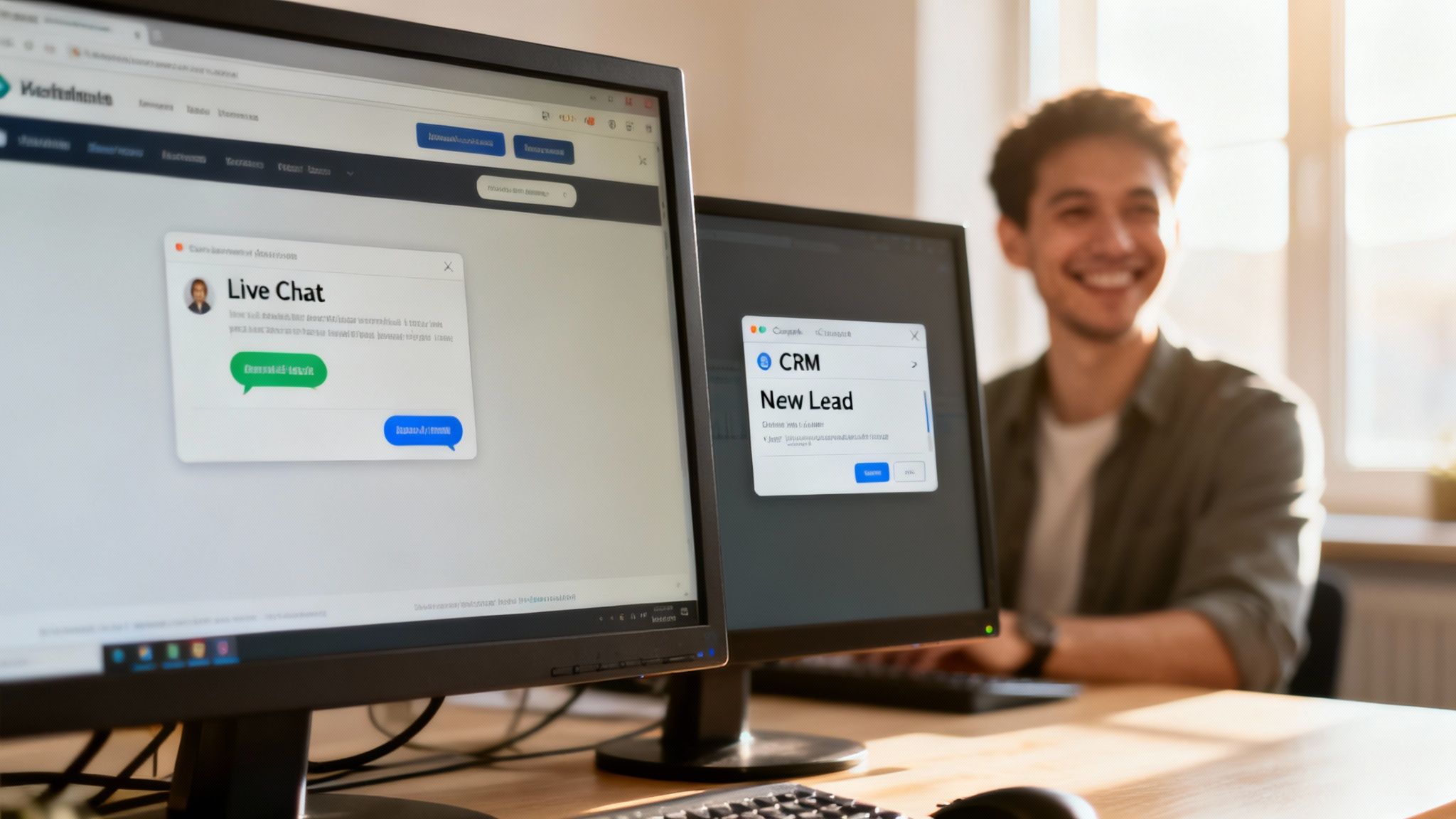
This transformation kicks in when you give visitors simple, immediate ways to connect. Smart tools like live chat and a basic Customer Relationship Management (CRM) system work in tandem to capture interest right when it sparks. You’re making sure no potential customer ever slips through the cracks simply by being helpful, responsive, and organized.
Engaging Visitors in Real Time with Live Chat
Think about it. You’re on a website, ready to buy, but you have a quick question. Waiting for an email response is a pain, and most people just won't bother. Live chat completely solves this by opening a direct line of communication right there on the page.
It’s a powerful tool for small business lead generation because it meets customers right where they are. Instead of making someone hunt for a contact form, you can proactively offer help, answer questions about your services, and steer them toward the right solution in real time.
For instance, a homeowner on a plumber’s website might be wondering if they service tankless water heaters. A quick chat can confirm they do, provide a rough quote, and even get a consultation on the calendar—all in a matter of minutes.
Speed is everything. Simply having tools like live chat to respond within the first 5 minutes can boost your contact rates by an incredible 900%.
Best Practices for Using Live Chat
Just installing a chat widget isn't the whole story; you need a smart approach to avoid annoying your visitors. The key is to be helpful, not pushy.
- Use Smart Triggers: Don't blast every visitor with a pop-up the second they land. Instead, set your chat to appear on high-intent pages, like your pricing or services pages. You can also trigger it after someone has been on a page for a certain amount of time, say 45 seconds.
- Keep Scripts Human: Your automated greetings should sound natural and conversational. Ditch the robotic "How may I assist you?" for something more like, "Hey there! Have any questions about our process? I'm here to help."
- Set Clear Expectations: If you aren't around 24/7, your chat box should clearly state your business hours. When you’re offline, it needs to automatically switch to a simple contact form so you can still capture that lead.
Key Takeaway: The whole point of live chat is making it incredibly easy for a visitor to start a conversation. Be present, be helpful, and make it feel personal. That’s how you build trust and turn a simple question into a warm lead.
Integrating a Simple CRM to Organize Leads
Once you start getting leads from chat, forms, and phone calls, you need one central hub to keep everything organized. That's what a CRM is for. For a small business, this doesn't have to be some beast of a system. A simple CRM is designed to do one thing exceptionally well: capture and track every single interaction with a potential customer.
When a new lead comes in from your live chat or a website form, the CRM can automatically create a contact record. Suddenly, all their info—name, email, what they were interested in, and your conversation history—is in one tidy place. It’s like a perfect digital filing system that never misplaces a sticky note.
This process works hand-in-hand with a well-designed website. You can explore our detailed guide on creating high-converting landing pages to see how they feed directly into an organized CRM system.
Measuring What Matters for Sustainable Growth
You can't improve what you don't measure. For a small business owner, diving into lead generation analytics can feel like trying to drink from a firehose, but it's the only way to know what’s actually working. The goal isn’t to track every single click. It’s about focusing on a few key metrics that directly tell you if you're making money or wasting it.
This is how you move from just guessing to having a real, data-driven strategy. Once you get a handle on a few Key Performance Indicators (KPIs), you can confidently put more money into the channels bringing you customers and cut the ones that aren't.
Identifying Your Core KPIs
For a small business, a handful of numbers tell most of the story. Don't get lost in "vanity metrics" like page views or social media likes. Instead, zero in on the numbers that translate directly into business growth. These are your true north stars.
Here are the essential KPIs you should start tracking today:
- Cost Per Lead (CPL): This is the most important number for any paid marketing campaign, period. Just divide your total ad spend by the number of leads you got. A low CPL means your marketing is efficient.
- Lead-to-Customer Rate: This tells you if you're attracting quality leads. What percentage of those leads actually turn into paying customers? A high rate here means you’re talking to the right people.
- Conversion Rate: This is the percentage of people who visit your website and take the action you want them to, like filling out a form. A strong conversion rate means your landing pages are doing their job.
- Customer Lifetime Value (CLV): This is an estimate of the total revenue you can expect from a single customer over time. Knowing your CLV helps you figure out exactly how much you can afford to spend to get a new lead in the door.
Key Takeaway: You don't need a crazy-complicated dashboard with dozens of charts. Just start by tracking CPL and your Lead-to-Customer Rate. Those two numbers alone will give you a surprisingly clear picture of your marketing ROI.
Setting Up Basic Tracking in Google Analytics
Google Analytics (GA4) is a free and incredibly powerful tool, but let's be honest, the interface can be a bit much. The good news is you only need to set up a couple of basic things to get the data that matters. Your main goal here is to track "conversions"—the most important actions a user takes on your site.
For most small businesses, a conversion is one of two things:
- A Form Submission: Someone fills out your contact form or downloads your guide.
- A Phone Call: Someone clicks the "tap-to-call" button on your website from their phone.
To track form submissions, the easiest way is to set up an event that fires whenever someone lands on your "thank you" page—that's the page they see right after they hit submit. This is a dead giveaway that a lead was generated. Mark that event as a conversion in GA4, and you'll be able to see exactly which channels are sending you leads. This simple setup is the foundation of making smart decisions for your business.
Building a Simple Monthly Performance Report
Once your tracking is up and running, you need a quick way to check your progress without getting lost in data for hours. A one-page monthly report is perfect for this. Think of it as a quick snapshot that helps you spot trends and decide what to do next.
Your report should include:
- Total Leads Generated: Broken down by where they came from (e.g., Google Ads, Organic Search, Social Media).
- Cost Per Lead (CPL): For each of your paid channels.
- Top Performing Landing Pages: Which pages on your site are the real workhorses generating leads?
- Mobile vs. Desktop Performance: Are people converting better on their phones or computers?
Speaking of mobile, ignoring it is a critical mistake. With 70% of leads admitting they will instantly delete an email if it's not mobile-responsive, a mobile-first mindset is non-negotiable. This is why tracking mobile performance is so vital. If your conversion rates are tanking on mobile, that’s a massive red flag you need to fix immediately. You can discover more insights about lead generation trends on salesgenie.com.
Your 90-Day Small Business Lead Generation Roadmap
Having a great strategy is one thing, but turning it into leads requires a real, actionable plan. Let’s face it, knowledge without a plan is just theory. That's why this 90-day roadmap is designed to break down your lead generation efforts into clear, manageable phases. This way, you can build momentum without getting overwhelmed.
It all boils down to a simple, repeatable process: you set things up, you analyze the data, and then you optimize your campaigns.
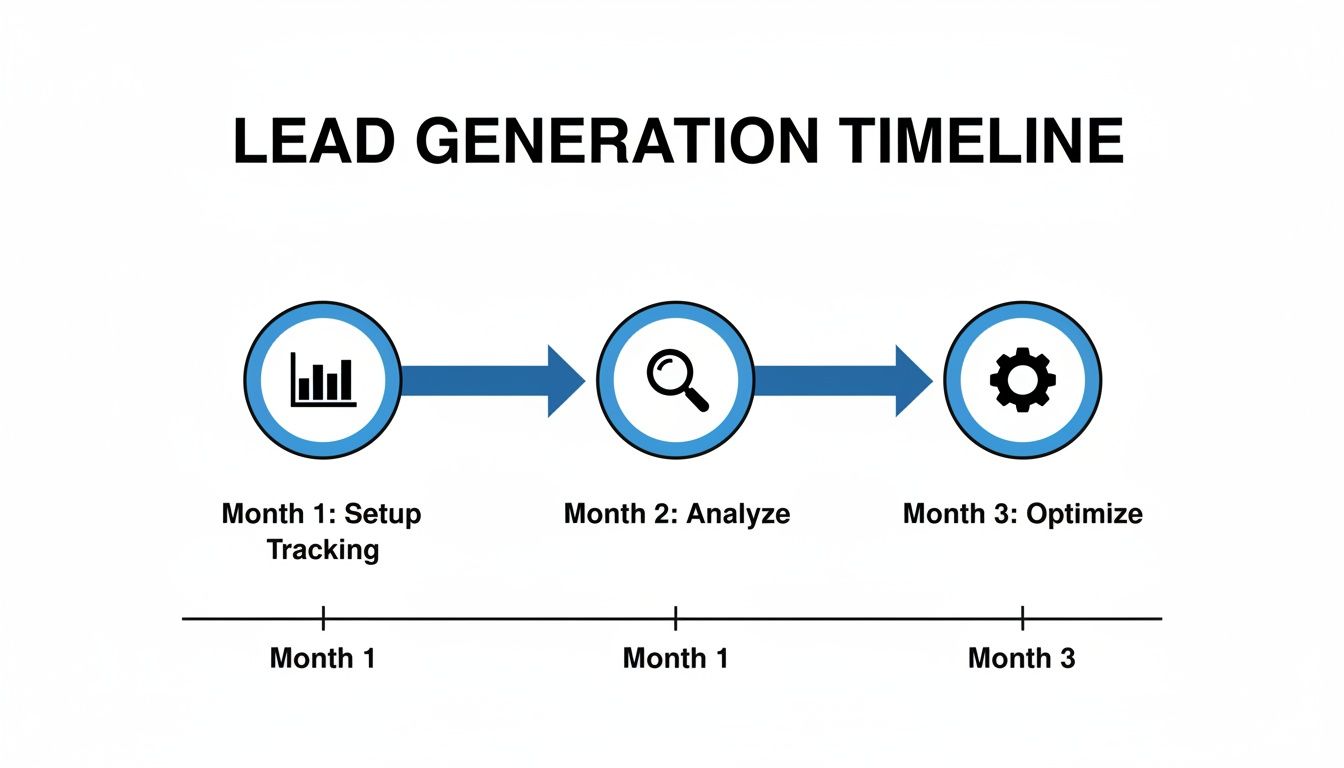
This Setup-Analyze-Optimize flow isn't a one-and-done deal. It's a continuous cycle that drives sustainable growth and, just as importantly, stops you from wasting money.
Phase 1: The First 30 Days
The first month is all about building a rock-solid foundation. I can't stress this enough: your entire focus should be on setup and getting your house in order, not on launching big campaigns. Before you spend a single dollar driving traffic, your digital storefront has to be ready to turn visitors into leads.
Here are your main goals for this phase:
- Website & SEO Audit: Go through all the on-page and local SEO optimizations we covered earlier. Make sure your site is fast, looks great on mobile, and clearly tells people what you do.
- Perfect Your Local Listings: The first thing you should do is claim your Google Business Profile. Then, use a service to clean up your business info across all the other major online directories. Consistency is key here.
- Get Your Tracking in Place: You absolutely have to install Google Analytics 4 correctly. Set up conversion goals for the important stuff, like form submissions and phone calls. You can't improve what you don't measure.
Phase 2: Days 31 To 60
Okay, your foundation is solid. Now it’s time to start driving some traffic. The biggest mistake I see businesses make here is trying to do everything at once. Don't. Pick one or two channels you think will have the biggest impact and put your energy there.
For example, you could launch a very targeted Google Ads campaign focused on a small handful of high-intent keywords. Or maybe you start publishing two high-quality blog posts a month and promote them on your main social media channel. The key here is focused execution.
Phase 3: Days 61 To 90
The last month of this initial push is all about analysis and refinement. By now, you should have some real data to look at, which allows you to start making informed decisions. Dive into your KPIs—especially Cost Per Lead and your Lead-to-Customer Rate—to see what's actually working.
Key Insight: This is where you double down on your winners and cut your losers. If that Google Ads campaign is bringing in quality leads at a price that makes sense, it might be time to increase the budget. If your social media efforts are getting you nothing but crickets, it's time to rethink your strategy.
This is also the perfect time to get serious about lead nurturing. It’s shocking how many leads get wasted simply because no one follows up. In fact, a staggering 79% of marketing leads never convert into sales, and a lack of nurturing is often the culprit. You can see more data behind this in these lead generation statistics on salesgenie.com.
This cycle of launching, measuring, and refining is the true engine of sustainable growth.
Got Questions? We've Got Answers
When you're diving into the world of small business lead generation, it's natural for questions to pop up. We get it. Here are some of the most common ones we hear from business owners, answered in plain English.
What’s a Good Cost Per Lead for a Small Business?
This is the million-dollar question, but there's no magic number. A lead for a local landscaping company might run you $30, while a highly qualified lead for a financial advisor could easily top $150. It all depends on your industry and how competitive it is.
The real key is to stop comparing your Cost Per Lead (CPL) to some universal benchmark and start measuring it against your Customer Lifetime Value (CLV). Think about it this way: if your average customer is worth $2,000 to your business over their lifetime, paying $100 to acquire them isn't just a cost—it's a fantastic investment.
How Many Leads Do I Actually Need?
This isn't a "more is better" situation. Your lead goal should be tied directly to your sales and revenue targets. The best way to figure it out is to work backward.
Let's run a quick scenario:
- Your Goal: You want to land 10 new customers this month.
- Your Closing Rate: On average, you close about 20% of your qualified leads (that’s 1 out of every 5).
- The Math: 10 new customers ÷ 0.20 closing rate = 50 qualified leads needed per month.
See? Now you have a specific, actionable marketing target instead of a vague goal.
Key Takeaway: Your lead generation efforts should be directly tied to your sales goals. Start with your revenue target and work backward to determine the exact number of leads required to hit it.
Which Lead Generation Tactic Works the Fastest?
If you need results right now, paid advertising is almost always your best bet. With platforms like Google Ads or Facebook Ads, you can get your message in front of potential customers in a matter of hours.
But "fastest" doesn't always mean "best" or most sustainable. Organic strategies, like SEO and content marketing, take more time and effort to get going. The payoff, however, is often a steady stream of higher-quality leads at a much lower long-term cost. A smart strategy uses a mix of both—paid ads for the quick wins and organic marketing for lasting growth.
Ready to stop guessing and start growing? The team at SWAT Marketing Solutions builds data-driven lead generation systems that deliver real, measurable results. Get your free website and SEO assessment today and let's uncover your biggest opportunities.