
SEO services for small business focus on strengthening your digital presence so your company is discovered by customers actively searching for your products or services. The objective is not short-term exposure, but sustained visibility at the precise moment buyers are making purchasing decisions.
Unlike paid advertising that stops generating results when the budget runs out, strategic SEO builds a long-term marketing asset. Over time, it delivers consistent organic traffic, higher-quality leads, and compounding returns—making SEO services for small business one of the most cost-effective and sustainable growth strategies available.
Why SEO Services for Small Business Are a Growth Accelerator
Imagine your company as a high-quality storefront offering exceptional products and service—but located on a quiet street with limited foot traffic. Without visibility, even the best businesses struggle to grow. SEO services for small business act as a strategic pathway that places your brand directly in front of customers who are already searching for what you provide.
Search engine optimization is not a technical luxury or passing trend. It is a core digital marketing foundation that determines whether your business is found online or overlooked entirely. Today’s consumers do not flip through directories or rely on word-of-mouth alone. When they need a plumber, bakery, legal consultant, or specialty provider, they turn to Google and search in real time.
Professional SEO services for small business ensure your company appears prominently at that exact moment of intent—when potential customers are ready to take action. By optimizing your website structure, content, local search presence, and authority signals, SEO transforms your business from being hidden in search results to being a trusted option on the first page.
Turning Searches into Customers
The main job of any SEO service for small businesses is to make sure your website shows up when people search for the things you sell. Getting that visibility is a huge deal for a few really important reasons:
- You Catch High-Intent Customers: Unlike old-school ads that interrupt people, SEO puts you in front of an audience that is actively looking for a solution. They’ve already decided they need something and are just trying to find the right business.
- You Build Trust and Credibility: Showing up on the first page of Google is like getting a nod of approval from the most trusted source of information on the planet. Search engines want to show the best, most helpful results, so a high ranking tells people you’re a legitimate and authoritative choice.
- You Get a Measurable Return: SEO is an investment in your company’s growth, not just another monthly expense. For small businesses, organic search is an absolute powerhouse, driving a massive 53% of all website traffic. Better yet, leads coming from search have a close rate of 14.6%, which blows the 1.7% from outbound marketing out of the water.
Simply put, SEO positions your business to be the obvious answer when a potential customer has a question. It makes sure you’re right there, visible and credible, at the exact moment they’re ready to buy.
Before we dive deeper, here’s a quick look at the core components that make up a solid SEO strategy. Understanding these pieces helps you see how they all work together to build your online presence.
Core Components of a Small Business SEO Strategy
| Service Component | Primary Goal |
|---|---|
| Technical SEO | Ensure search engines can easily crawl, index, and understand your website. |
| On-Page SEO | Optimize individual web pages to rank higher and earn more relevant traffic. |
| Local SEO | Improve visibility in local search results and Google Maps for “near me” searches. |
| Content Strategy | Create valuable content that answers customer questions and attracts your target audience. |
| Citations & Listings | Build consistent business information across online directories to boost local authority. |
| Reputation Management | Monitor and encourage positive online reviews to build trust and credibility. |
Each of these elements plays a critical role. A good agency doesn’t just focus on one; they weave them all together into a cohesive plan that drives real, sustainable growth for your business.
Beyond Just Rankings
A common misconception is that search engine optimization is solely about achieving the number-one position on Google. While rankings are important, effective SEO services for small business extend far beyond keyword placement. A comprehensive SEO strategy enhances website performance, improves page load speed, strengthens mobile usability, and delivers a seamless user experience that keeps visitors engaged.
Professional SEO services for small business also establish your brand as a trusted authority within your industry. Through strategic content development, technical optimization, and local SEO enhancements, your website becomes a reliable resource that answers customer questions, builds confidence, and nurtures buying intent long before a prospect ever makes contact.
Most importantly, investing in SEO services for small business creates a scalable engine for sustainable growth. Increased visibility leads directly to more qualified traffic, higher call volume, additional quote requests, stronger foot traffic, and measurable revenue gains. For today’s competitive small business environment, SEO is no longer optional—it is the foundation of long-term digital success.
The Building Blocks of a Powerful SEO Program
A solid SEO strategy isn’t just one thing. It’s a collection of crucial parts all working together to boost your business’s visibility. Think of it like building a house. You can’t just throw up walls without a strong foundation, and the nicest furniture doesn’t matter if the roof is leaking. In the same way, SEO needs several key pillars to create a structure that will support long-term growth.
When you hire a firm for SEO services for small business, you’re bringing in a whole crew—the architects, builders, and designers for your digital presence. Each specialist has a critical role. Understanding what they do helps you see exactly where your investment goes and why every piece is essential for bringing in more customers.
Technical SEO: The Foundation of Your Website
Before you even think about getting visitors, your website needs to be a place that search engines can easily understand. This is where technical SEO comes in. It’s the plumbing, wiring, and foundation of your digital house. It might be invisible to the average visitor, but it’s absolutely critical for everything else to work right.
If your site is slow, confusing for search engine crawlers to navigate, or isn’t secure, Google might struggle to index it or just decide to rank it lower. A technical SEO specialist makes sure your site is fast, mobile-friendly, and clear of any errors that could be holding you back.
Key tasks in technical SEO include:
- Improving Site Speed: More than 50% of mobile users will leave a page if it takes over three seconds to load. A fast site is a non-negotiable for good user experience and better rankings.
- Ensuring Mobile-Friendliness: Google now primarily uses the mobile version of a site for indexing and ranking. Your site has to look and work perfectly on a smartphone.
- Fixing Crawl Errors: This means finding and fixing broken links (404 errors) and making sure search engine bots can get to all your important pages without hitting a wall.
- Implementing Structured Data (Schema): This is like adding labels to your content that help Google understand it better. It can lead to eye-catching search results, like star ratings or event details.
On-Page SEO: Optimizing Every Room
Once your foundation is solid, it’s time to work on the individual rooms. On-page SEO is all about optimizing the content and HTML source code of each page on your website to make it as clear and valuable as possible, both for your users and for search engines. This is how you make sure your message is heard loud and clear.
It involves strategically placing keywords in your titles, headings, and text so Google knows what each page is about. But it goes way beyond just keywords; it’s about creating a fantastic user experience. To really get a handle on the core elements of SEO, check out a comprehensive guide to improving search engine rankings that breaks down technical SEO, content strategies, and more.
Content Strategy: The Valuable Furniture and Decor
Content is what fills your house and makes people want to visit. A content strategy is your plan for creating and sharing valuable, relevant articles, guides, and other resources that pull in your target audience. It’s how you demonstrate your expertise and build trust.
A great content strategy is all about answering your customers’ biggest questions. For instance, a local bakery could create blog posts on “How to Choose the Perfect Wedding Cake” or “Creative Birthday Cake Ideas for Kids.” This kind of content attracts people who are already looking for solutions, positioning the bakery as the go-to expert. To learn more about building a plan that drives traffic, check out our guide on creating a powerful content strategy.
Link Building: Earning Votes of Confidence
In the SEO world, links from other respected websites to yours act like votes of confidence. Link building is the process of earning these “votes,” which tells Google that your site is a credible, authoritative source of information. The more high-quality backlinks you earn, the more trustworthy your site looks.
This isn’t about getting as many links as you can from anywhere. It’s about quality over quantity. One link from a well-known industry blog is worth far more than a hundred links from spammy, low-quality sites.
A smart link-building strategy focuses on building relationships and creating genuinely useful content that other sites want to link to. It’s the digital version of word-of-mouth marketing.
Local SEO: Winning Your Neighborhood
For any brick-and-mortar business, local SEO is probably the most important pillar of all. It’s a specialized practice designed to make you more visible in local search results, like on Google Maps or in the “local pack” that shows up for “near me” searches. It’s how you make sure local customers find you and not the competitor down the street.
The key elements of local SEO are:
- Google Business Profile (GBP) Optimization: Think of your GBP listing as your digital storefront. It’s essential to keep it complete, accurate, and active with new posts and photos.
- Citation Building: This involves making sure your business’s name, address, and phone number (NAP) are consistent across dozens of online directories like Yelp and Yellow Pages.
- Reputation Management: Actively encouraging and responding to customer reviews builds trust and is a known ranking factor for local search.
This diagram shows how all these efforts come together to deliver real business results.
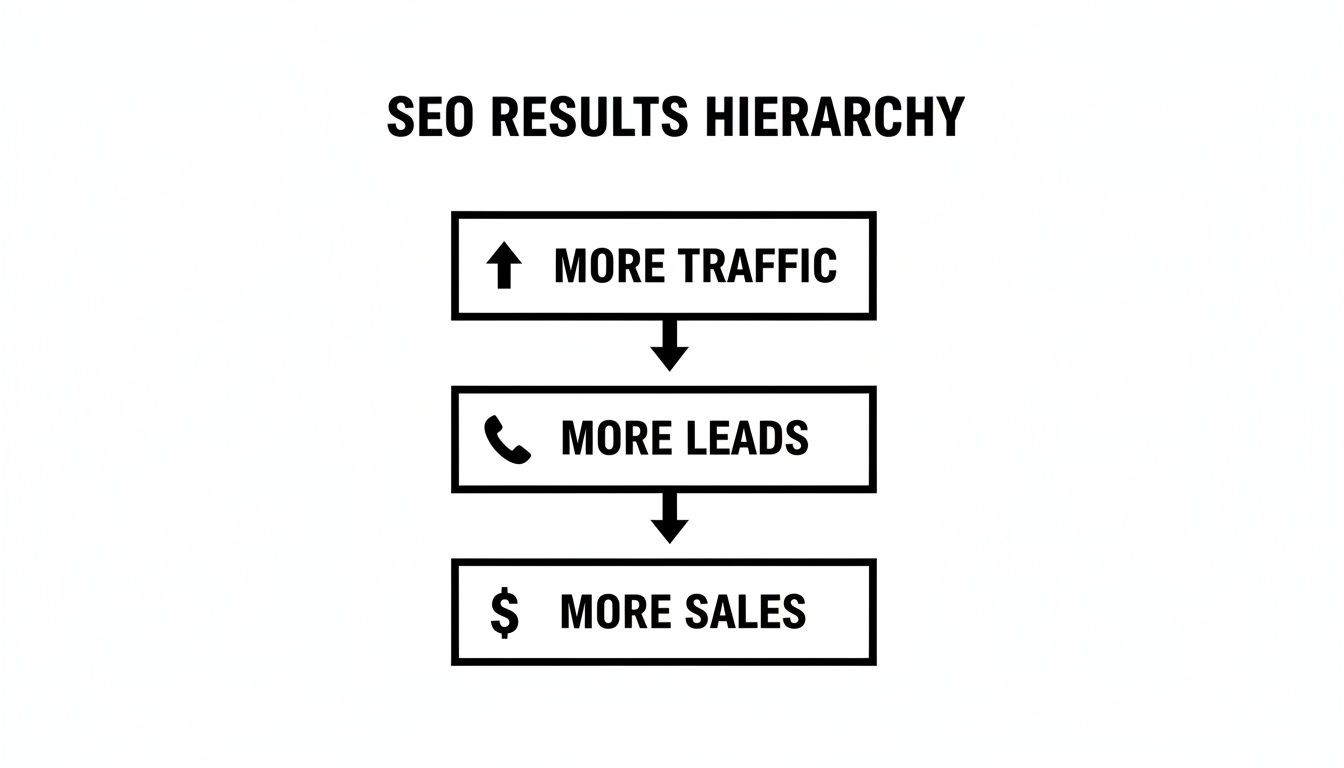
As you can see, a successful SEO program doesn’t just stop at getting more traffic. It’s designed to drive the leads that ultimately turn into sales and revenue for your business.
Master Your Local SEO And Own Your Neighborhood

For most small businesses with a storefront or a specific service area, winning over the local market is the entire game. Local SEO is hands-down the most powerful way to bring in customers from right in your own backyard. It’s the modern-day version of being the most recommended business in town.
Think about it from your customer’s point of view. When someone down the street searches for “best coffee near me” or “emergency plumber in [Your Town],” you need your business to be the first, most obvious answer they see. This is exactly where a sharp local strategy becomes non-negotiable.
The big prize here is landing in Google’s “Local Pack”—that map with three business listings perched right at the top of the search results. Getting a spot there is like securing the best real estate in town, putting you right in front of people who are ready to buy.
Your Digital Storefront: The Google Business Profile
The absolute foundation of any local SEO work is your Google Business Profile (GBP). Don’t think of it as just another online listing; it’s a living, breathing profile that functions as your digital storefront. Optimizing it is the quickest way to boost your local rankings.
A top-notch GBP has a few key things:
- Complete and Accurate Info: Your business name, address, and phone number (NAP) have to be perfectly consistent everywhere online. No exceptions.
- Great Photos and Videos: Show off your products, your awesome team, and your location. Give people a real feel for who you are.
- Regular Updates: Use Google Posts to talk about specials, events, or new products. This keeps your profile fresh and tells Google you’re active.
A well-kept profile builds a ton of trust. When a potential customer finds a complete, active, and highly-rated GBP, it sends a clear signal that your business is professional and ready to help. To get into the nitty-gritty, our guide on how to improve your Google My Business ranking has practical steps you can use right now.
Building Local Trust with Citations and Reviews
Beyond your Google profile, strong local SEO means creating a consistent and positive footprint all over the web. This really comes down to two things: citations and reviews.
Citations are simply mentions of your business’s name, address, and phone number on other websites, like Yelp, Yellow Pages, and directories for your specific industry. Consistency is the name of the game here. Every single listing has to match your GBP info perfectly to send strong, clear signals to Google.
“Think of each consistent citation as a vote of confidence for your business’s location and legitimacy. The more votes you have from reputable sources, the more Google trusts that you are who and where you say you are.”
Online reviews are another massive piece of the puzzle. Great reviews, especially on Google, directly lift your local ranking and, more importantly, sway customer decisions. Consider this: an incredible 78% of local searches on a mobile device lead to an offline purchase within 24 hours. That shows the immediate impact of a solid local presence.
Businesses that show up in Google’s Local Pack don’t just get seen; they also enjoy a 40% higher click-through rate. This is huge when you realize that 46% of all Google searches have local intent. These numbers prove that local visibility isn’t just a nice-to-have; it’s essential for growth. You can see more stats on this in a small business SEO report from PageOptimizer.pro.
A professional SEO service will build a strategy to get you consistent citations and encourage a steady flow of positive customer reviews, turning those online searches into real people walking through your door.
Decoding SEO Pricing to Find the Right Fit
Figuring out what you’re actually paying for is the first step to making a smart investment in SEO. The pricing for seo services for small business can feel all over the place, but most agencies stick to a few common models.
Think of it like hiring a personal trainer for your business’s online health. Each payment structure is built for different needs and goals. Just like you’d pick a fitness plan based on your objectives, you’ll choose an SEO model that lines up with your business goals and budget.
Common SEO Pricing Models
Let’s break down the three most common ways agencies package their services. Each one has its own upside, depending on what you’re trying to accomplish.
- Monthly Retainer: This is the go-to model for most businesses. You pay a set fee every month for ongoing SEO work—things like creating content, keeping an eye on technical health, and building links. It’s like having that trainer on staff, constantly working to boost your performance and adapt to new challenges.
- Project-Based Fees: This is for a specific, one-off job with a clear beginning and end. Maybe you need a full website audit, a local SEO setup from scratch, or a fix for a nagging technical issue. This is like hiring a trainer for a specialized program, like getting you ready for a marathon.
- Hourly Consulting: If you just need some expert advice on a specific problem but plan to do the work yourself, you can pay an SEO consultant by the hour. Think of this as booking a single session with a trainer to perfect your form or get a new workout plan to follow.
For most small businesses that want consistent, long-term growth, a monthly retainer usually delivers the best value. SEO isn’t a one-and-done deal; it’s a long game that requires continuous effort to get and keep those top rankings.
What Influences the Cost of SEO
So, what should you actually expect to pay? SEO isn’t a one-size-fits-all service, and the costs can vary pretty wildly. A few key things will determine the final price you’re quoted.
For a small business, a realistic monthly investment can fall anywhere between $750 to $5,000. Be careful with services that seem way too cheap—they often have to cut corners, which can end up doing more harm than good.
Here’s a quick rundown of what usually moves the needle on price:
- Scope of Services: A basic local SEO package will naturally cost less than a full-blown national campaign that involves a ton of content creation and technical fixes.
- Industry Competition: Getting a local bakery to rank in a small town is a whole different ballgame than going up against national e-commerce giants. The tougher your industry, the more resources it takes to win.
- Your Business Goals: Are you trying to get a 20% bump in local leads, or are you aiming to double your website traffic in a year? Bigger goals demand a more aggressive—and therefore more expensive—strategy.
- Agency Expertise: An experienced agency with a solid track record is going to charge more than a freelancer who’s just starting out. You’re paying for their expertise, their professional tools, and their proven processes.
At the end of the day, the goal is to find a transparent partner whose pricing makes sense for your budget and business goals. You want to make sure every dollar you spend is an investment in real, measurable growth.
How to Choose the Right SEO Agency for Your Business

Picking a partner for SEO services for small businesses is one of the biggest moves you’ll make for your company’s growth. This isn’t just about hiring a contractor; it’s about finding a true extension of your team who gets what you’re trying to achieve. The right agency can be a game-changer, while the wrong one can be a serious drain on your time and budget.
So, how do you make a confident choice? It all starts with knowing what to look for and the right questions to ask. A great agency will be open, focused on real data, and dialed into your business goals—not just chasing abstract metrics. They should feel like a strategic partner who is just as invested in your success as you are.
Look for Proven Experience and Case Studies
Your first step is to find proof that they’ve successfully helped businesses like yours. SEO isn’t a one-size-fits-all game. An agency that gets amazing results for e-commerce stores might not have the right touch for a local service business.
Ask potential partners for case studies or examples of their work with companies in your industry or facing similar challenges. This is the best way to see if they understand your market and can deliver actual results. For a wider view on vetting professional services, you can find some great advice in our guide on how to choose a marketing agency.
Look for agencies that are proud to show off their work. Specifically, you want to see:
- Specific Client Examples: They should be able to walk you through a client’s journey from where they started to where they are now.
- Measurable Improvements: Look for real numbers—data showing boosts in organic traffic, more leads, or increased sales.
- Relevant Testimonials: What are their past and current clients saying about the experience of working with them?
Prioritize Transparency and Communication
A trustworthy SEO agency doesn’t hide behind smoke and mirrors. You should never feel like their methods are a big secret or that you’re in the dark about how your campaign is doing. Good communication is the foundation of any successful partnership.
Set clear expectations for communication right from the start. Will you have one person you talk to? How often will you get reports, and what will they tell you? A good partner provides regular, easy-to-understand updates that connect what they’re doing directly to your business goals.
“A great SEO agency doesn’t just send you a report full of jargon; they translate data into a story about your business’s growth. They explain what they did, why they did it, and how it’s moving the needle for you.”
Beware of SEO Red Flags
Unfortunately, the SEO world has its share of providers who make promises they can’t keep. Knowing the warning signs can help you steer clear of costly mistakes and protect your website’s hard-earned reputation.
Be very cautious of any agency that:
- Guarantees #1 Rankings: Nobody can ethically guarantee a specific ranking on Google. The algorithm is just too complex and is always changing.
- Uses “Secret” or “Proprietary” Methods: A good agency will be open about its strategies. Secrecy is often a cover for outdated or even harmful “black-hat” tactics.
- Focuses Only on Rankings: Rankings are nice, but the real goal is business growth. A solid partner talks about leads, sales, and your return on investment.
- Offers Unbelievably Cheap Services: If a price tag seems too good to be true, it almost certainly is. Quality SEO requires expertise, time, and professional tools—all of which have a cost.
Agency Vetting Checklist Key Questions to Ask
To help you stay organized during your search, use this checklist on your consultation calls. These questions are designed to get past the sales pitch and help you find a truly transparent and effective SEO partner.
| Category | Question to Ask |
|---|---|
| Experience & Results | “Can you show me case studies for businesses similar to mine in size and industry?” |
| Strategy & Tactics | “What is your process for keyword research and content strategy?” |
| Technical SEO | “How will you handle the technical audit and ongoing health of my website?” |
| Communication | “Who will be my main point of contact, and how often will we meet or receive reports?” |
| Reporting & KPIs | “What key performance indicators (KPIs) will you track to measure success for my business?” |
| Contracts & Pricing | “Can you walk me through your pricing model and the terms of your contract?” |
Asking these direct questions will give you a much clearer picture of who you’re dealing with and whether they’re the right fit to help you grow.
Choosing the right SEO agency is a critical investment. By focusing on proven experience, demanding transparency, and watching out for red flags, you can find a partner who will help you navigate the path to sustainable online growth and hit your business objectives.
Frequently Asked Questions About Small Business SEO
Diving into SEO for your small business can feel like learning a new language. You’ve got a business to run, and the last thing you need is a bunch of jargon and confusing concepts getting in the way.
We get it. That’s why we’ve put together some straight, honest answers to the questions we hear most often from business owners just like you. Our goal here is to cut through the noise and give you the clarity you need to make a smart decision for your company’s future.
How Long Does It Take to See SEO Results?
This is always the first question, and it’s a great one. Think of SEO less like a light switch and more like planting a garden. You have to prepare the soil, plant the seeds, and tend to them consistently. You’re not going to see a full harvest overnight.
You might notice some early sprouts within the first 1 to 3 months—maybe a small jump in website traffic or a few more phone calls. That’s a good sign! But for the really significant results, like ranking on the first page for the keywords that bring in customers, you’re typically looking at 6 to 12 months of consistent effort.
A few things can speed up or slow down that timeline:
- Your Market’s Competition: A local bakery in a small town will probably see results much faster than a real estate agency in a major city.
- Your Website’s Starting Point: A brand-new website is starting from scratch. An older site might have some authority already, but it could also have technical problems that need fixing first.
- The Scope of Work: The more you invest in a comprehensive strategy, the quicker you’ll build momentum.
The most important thing to remember is that SEO builds lasting value. Unlike paid ads, which disappear the moment you stop paying, the rankings and authority you earn through SEO become a genuine asset for your business for years to come.
Can I Do SEO Myself or Should I Hire an Agency?
You can absolutely tackle some SEO tasks yourself. In fact, it’s a great way to get a feel for the basics. Things like updating your Google Business Profile or tweaking the titles of your website pages are fantastic places to start.
But when you’re ready for serious growth, hiring an agency is like bringing in a general contractor to build your house. They show up with specialized tools, a skilled team, and years of experience navigating the complexities of Google’s constant algorithm updates. An agency knows the technical details that can truly make or break your success online.
Hiring an agency frees you up to do what you do best—run your business. You let the experts handle the complex, time-consuming work of getting qualified customers to find you. If you’re in a competitive field or just want to grow faster, a partnership is almost always the most effective way to get there.
What Is the Difference Between SEO and Google Ads?
SEO and Google Ads (often called Pay-Per-Click or PPC) are two different ways to get your business seen on a Google search results page. They both have their place.
SEO (Organic Search):
- The Goal: Earn a spot in the main, unpaid search results.
- The Method: This is done by making your website trustworthy and valuable in Google’s eyes through optimizations, great content, and building authority over time.
- The Timeline: It’s a long-term strategy that builds a steady, reliable stream of traffic.
- The Cost: You don’t pay Google directly when someone clicks, but it requires an investment in time and professional expertise.
Google Ads (Paid Search):
- The Goal: To appear in the sponsored ad sections, usually right at the top of the page.
- The Method: You bid on specific keywords and pay Google each time a person clicks on your ad.
- The Timeline: The results are immediate. As soon as you launch your campaign, you can be visible.
- The Cost: The traffic stops the second you turn off your ad budget.
Many of the most successful businesses use a mix of both. SEO builds a strong foundation for long-term, sustainable growth. Google Ads are perfect for getting immediate traffic or promoting something specific, like a seasonal sale or the launch of a new service.
How Much Should a Small Business Budget for SEO?
While there’s no one-size-fits-all answer, a typical monthly investment for solid, professional SEO services for a small business is usually in the range of $750 to $5,000. Where you fall in that range depends entirely on your business and your goals.
Factors that shape your budget include:
- Your specific goals (e.g., doubling local leads is a bigger project than a simple 10% traffic increase).
- How competitive your industry is.
- The scope of services you need (e.g., just technical fixes versus a full-blown content and link-building plan).
A word of caution: be wary of services that seem too good to be true. Rock-bottom prices often mean they’re cutting corners, using outdated tactics, or doing very little work at all, which can sometimes do more harm than good. A good agency will want to understand your business first before giving you a custom quote. It’s best to see SEO as an investment in a growth engine for your business, not just another monthly expense.
Ready to see how a tailored SEO strategy can drive real growth for your business? The team at SWAT Marketing Solutions specializes in creating data-driven SEO programs that attract, engage, and convert customers. Request a complimentary website and SEO assessment today to discover your biggest opportunities.