
At 8:47 a.m., you're pouring coffee when a Google notification appears. A customer has left your business one star, mentioned a team member by name, and described an experience that feels unfair. Your first impulse is to defend yourself immediately. Don't. The next few minutes should produce a process, not an emotional reaction.
A negative review is read by more than the person who wrote it. Ninety-seven percent of review readers read business responses, according to the review research summarized by Reply on the Fly's Google review response statistics. Your reply becomes part of the public evidence future customers use to judge whether your business is attentive, accountable, and safe to hire.
The right approach covers the entire arc: triage the complaint, publish a disciplined response, move sensitive details offline, resolve the issue, document what happened, and close the loop. You'll find timing rules, response templates, escalation guidance, and privacy boundaries that help you handle the next notification without improvising under pressure.
Reading the Notification Without Panicking
The notification can trigger an immediate defense, especially when the reviewer's account feels unfair. Wait before replying. Read the review twice, copy its text into your internal record, and note each specific claim before anyone edits or deletes information. Separate observable facts from conclusions, such as “the appointment started late” versus “this company doesn't respect anyone.”
Assign the review to someone who can investigate it. A front-desk employee may know what happened during the visit, while a manager may access payment records, delivery details, or call history. The owner should not debate every sentence personally. The owner should ensure that the right person checks the facts and approves the public response.
Response speed affects how the thread looks to prospective customers. Research summarized by Reply on the Fly reports that consumers expect responses to negative reviews within a range from the same day to one week, with expectations varying by timing. The same source cites Cornell-linked hotel findings in which businesses responding to reviews received 12% more reviews and a 0.12-star rating increase over time. These figures do not guarantee that a reply will repair the relationship. They do show why review response deserves a defined operating process instead of occasional attention.
Your first reply demonstrates how your business handles friction. The detail matters less than the signal.
Acknowledge the experience and establish a next step. You can post before every internal detail is confirmed. If the investigation will take time, state that you are reviewing what happened and provide a direct way to contact a manager. Publish a prompt, responsible acknowledgment while the investigation proceeds, rather than waiting for a complete defense.
Keep the immediate workflow simple:
- Pause: Do not publish while emotionally activated.
- Capture: Save the review text, date, reviewer name, and relevant internal details.
- Investigate: Check the transaction, appointment, delivery, or communication history.
- Classify: Decide whether the review is legitimate, inaccurate, off-topic, or reportable.
- Draft: Use an apology, concise explanation, and corrective action.
- Approve: Have a manager review privacy, legal, tone, and contact details.
- Follow up: Move resolution to a private channel and record the outcome.
The reviewer may never respond, but the public reply still serves future customers reading the thread. They are assessing whether your business responds with care, takes responsibility where appropriate, and handles sensitive details discreetly. That public signal remains part of the review's context even after the private conversation ends.
Sorting the Review Before You Sort Your Reply
Approach every negative review as a triage problem first, with wording as the second step. A one-star rating may describe a genuine service failure, a misunderstanding, a competitor's post, or content that violates Google's rules. Each category requires a different response.
| Review type | What to verify | Public action |
|---|---|---|
| Legitimate service complaint | Transaction records, staff notes, delivery or appointment timeline | Acknowledge the experience, explain briefly, and offer a remedy |
| Factually wrong accusation | Receipts, timestamps, call logs, signed documents, delivery photos | Avoid calling the reviewer a liar. Correct only the necessary point and invite private discussion |
| Partly accurate but exaggerated | What went wrong, what the business did correctly, and where expectations diverged | Own the valid part without endorsing claims you cannot support |
| Spam or policy violation | Repeated text, unrelated content, threats, personal information, or no identifiable interaction | Report the content through Google and use a short neutral reply only if a public acknowledgment helps |
The middle category causes the most confusion for local businesses. A customer may have waited longer than expected, but not as long as the review says. A technician may have completed the work correctly while failing to explain the invoice. A restaurant may have prepared the order accurately, while the handoff created confusion. Identify the valid service gap within the review instead of classifying it as entirely true or false. Respond to that gap, not to every disputed detail.
Build a short internal timeline before drafting:
- Customer identity: Match the name, contact details, order, booking, or account without exposing them publicly.
- Sequence of events: Record when the request arrived, who handled it, and what the team communicated.
- Evidence: Check receipts, delivery photos, call logs, messages, appointment notes, and refund records.
- Resolution status: Mark whether the issue is open, partially addressed, or complete.
- Ownership: Assign one manager to communicate with the reviewer so the customer does not repeat the story to multiple employees.
A structured customer feedback collection process helps your team identify recurring problems before customers take them to Google. It gives you a consistent way to compare public complaints with internal records, surfacing recurring gaps before they reach Google.
Your factual position determines your tone. If the business clearly failed, apologize directly and offer a remedy. If responsibility is shared, acknowledge your part and clarify the relevant context. If the review does not match any customer record, avoid a public accusation. Ask the reviewer to contact a named manager so you can verify the situation privately, then report the post if it violates platform rules. Public replies should show control, while private follow-up handles the facts that should never be exposed in a review thread.
The Response Framework That Moves Purchase Intent
A one-star review can expose a service failure to every future customer. Your reply must show three things in sequence: you understand the harm, you can explain the relevant facts, and you will correct the problem. Politeness alone does not move purchase intention. A simulation-based experiment published by MDPI on organizational responses to negative reviews found that purchase intention increased only when the response combined an apology, an explanation, and a pledge to correct the issue.
Use this structure:
- Apology: Acknowledge the disappointing experience without challenging the customer's emotions.
- Explanation: Provide concise, verified context. Keep private records and detailed evidence out of the public thread.
- Correction: State the next action, such as investigating, replacing, refunding, redoing the service, or arranging a manager call.

Write as a manager, not as a corporate policy department. Use the reviewer's name when appropriate, sign with the manager's name, and remove phrases such as “we regret any inconvenience this may have caused.” That wording avoids responsibility and sounds copied. State what you understand, what you have verified, and what you will do next. Keep personal details, account information, and disputed evidence private.
Service complaints
Hi [Name], I'm sorry your experience with [service] fell short, especially [specific issue]. We had [brief factual context], but we should have [corrective responsibility]. I'd like to review this with you and arrange [manager call, redo, or service correction] at [contact detail].
[Name], [Role]
The explanation should clarify the situation without excusing it. If an appointment window was missed, say that the schedule changed and the customer was not updated. The correction could be a manager callback and a new appointment with clear expectations.
Product defects
Hi [Name], I'm sorry the [product] arrived with [defect or damage]. Our team is reviewing the packing and fulfillment record so we can understand where the failure occurred. Please contact [name] at [email or phone] so we can arrange a [replacement, repair, or refund] and confirm the next step.
Do not debate product use in public. Collect those details privately, then apply the return or warranty policy consistently.
Pricing disputes
Hi [Name], I'm sorry the final price did not match what you expected. The charge included [brief explanation], but we should have made that clear before completing the service. Please reach [manager name] at [contact detail] so we can review the invoice and correct any billing error.
Keep other customers' pricing, confidential contracts, and internal margin information out of the reply.
Staff behavior issues
Hi [Name], I'm sorry you felt dismissed during your interaction with our team. We're reviewing the conversation and the service notes so we can address what happened responsibly. Please contact [manager name] at [contact detail], and we'll discuss the matter directly and determine the appropriate corrective action.
Do not name or blame an employee publicly. The business owns the customer experience, and public punishment makes the company appear unstable.
Miscommunication
Hi [Name], I'm sorry our communication about [appointment, delivery, scope, or policy] was unclear. We communicated [brief context], but we should have confirmed [specific expectation] before moving forward. Please contact [name] at [contact detail] so we can clarify the record and propose [specific remedy].
For restaurants, delivery businesses, and agencies, precise wording protects the customer relationship when a small misunderstanding affects the entire transaction. High-volume teams can review the guide by OrderOut for ideas on routing and drafting review replies. Automation can prepare drafts, but a manager should approve any reply involving refunds, safety, privacy, or legal risk.
Your public response also demonstrates expertise, authority, and trustworthiness. Use this explanation of what EAT means when documenting the standards behind customer-facing content. The reply should lead to a private conversation, a defined remedy, and a record of what was resolved, not end with a polished sentence on Google.
Timing, Visibility, and Why Silence Is Publicly Costly
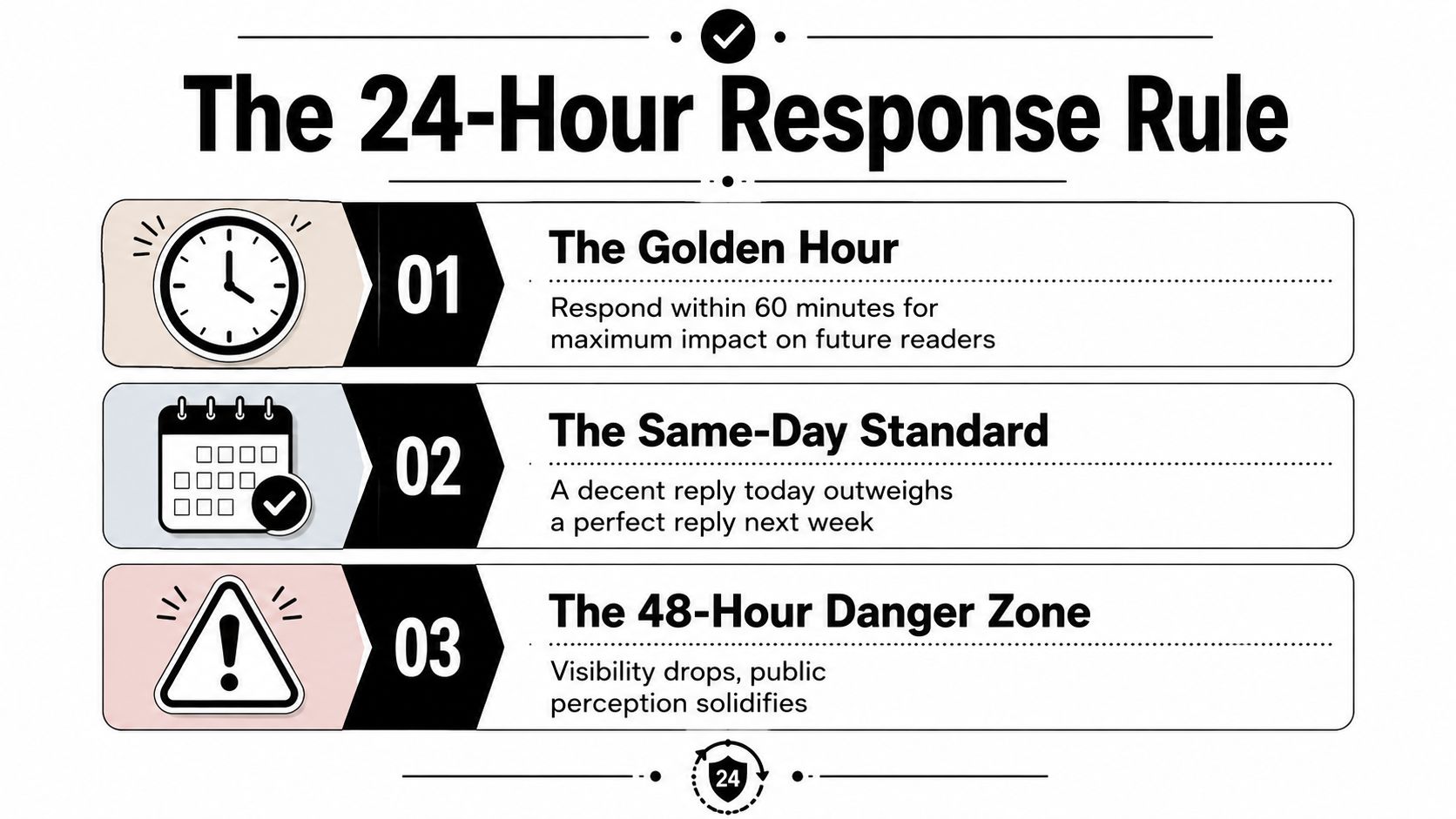
A one-star review appears while your team is still checking the order, appointment, or account. Meanwhile, prospective customers are deciding whether the business noticed the complaint and whether someone credible accepted responsibility. A late, polished response can underperform a decent reply posted promptly.
Reputation.com survey data summarized in its consumer decision-making survey reports that 85% of consumers factor responses to negative reviews into their decision-making, while 33% are more likely to upgrade their rating when a business responds within 24 hours. Reply on the Fly's research summary reports that 53% expect a response within one week, with smaller groups expecting a reply within two to three days or on the same day. Set an operating standard from these findings, but do not promise a specific result.
A workable response clock
- Emergency: Safety allegations, threats, sensitive personal information, legal claims, or rapidly spreading posts go to an owner or counsel immediately. Publish only a careful acknowledgment after review.
- Urgent: Refund requests, factual disputes, delivery failures, and complaints naming employees deserve a prompt acknowledgment while the team verifies the record.
- Standard: General dissatisfaction still warrants a timely, human reply. Lower apparent severity does not justify silence.
Before publishing, confirm four details: the contact route works, the named manager knows about the reply, the wording reveals no private information, and the length fits the problem. A short complaint usually needs a short response. A complicated matter may need a public acknowledgment followed by private handling, rather than a lengthy public chronology.
Do not promise an outcome that has not been approved. “We'll investigate this today” is safer than “we'll refund you” when the manager still needs to review the account. Speed opens the door to resolution; accuracy protects the business once the conversation moves forward. That first reply is only the public start of a process that should end with documented offline resolution.
Lines You Should Never Cross in a Public Reply
A one-star review can tempt you to explain everything immediately. Resist that impulse. The reply is public business communication, readable later by the reviewer, future customers, employees, regulators, and attorneys. Discipline makes warmth credible in a public reply.
Research from Griffith University found that responding to a negative review increased perceived trustworthiness and customer concern compared with no response. The research also emphasized timely replies and a human voice. A reckless answer erases those benefits by making the business appear focused on defending its ego instead of addressing the customer's concern.
Replace risky language before it goes live
| Risky public move | Safer alternative |
|---|---|
| Admission of fault | “We're sorry this happened and we're reviewing the situation.” Confirm legal conclusions privately with counsel |
| Medical or protected information | “We can discuss your account privately through our secure contact channel” |
| Confidential contract details | “Our manager can review the service agreement with you directly” |
| Threat of legal action | “Please contact us directly so we can address the matter through the appropriate process” |
| Sarcasm or jokes | Use plain, respectful language focused on the next action |
| Personal attack | State the conduct standard and invite a private conversation |
| Employee blame | “We're reviewing the interaction and will address it internally” |
Healthcare, counseling, education, financial services, and other regulated businesses need extra care. Do not confirm that someone is a patient, client, student, account holder, or customer if the reply would reveal private information. A well-intended sentence can disclose more than the reviewer originally shared.
Keep screenshots, order numbers, phone numbers, addresses, camera footage, payment details, and private messages out of the reply. Do not identify an employee to prove that you acted. If the review contains personal information, threats, impersonation, or content that appears defamatory, preserve the record and ask counsel or the relevant platform team how to respond.
A factual correction can still sound combative. Replace “That's a lie, and we have proof” with “Our records show a different timeline, and we'd welcome the opportunity to review the details with you directly.” This protects your position without inviting a public argument.
Businesses that want to improve brand perception should apply the same rule throughout their reputation work. Public communication should demonstrate control while containing internal conflict within private channels. Do not threaten to sue, demand deletion, accuse the reviewer of fraud, or promise an employee's termination in a Google reply. Report clear policy violations, but do not use reporting as a substitute for answering a legitimate complaint.
Taking It Offline, Escalating, and Closing the Loop
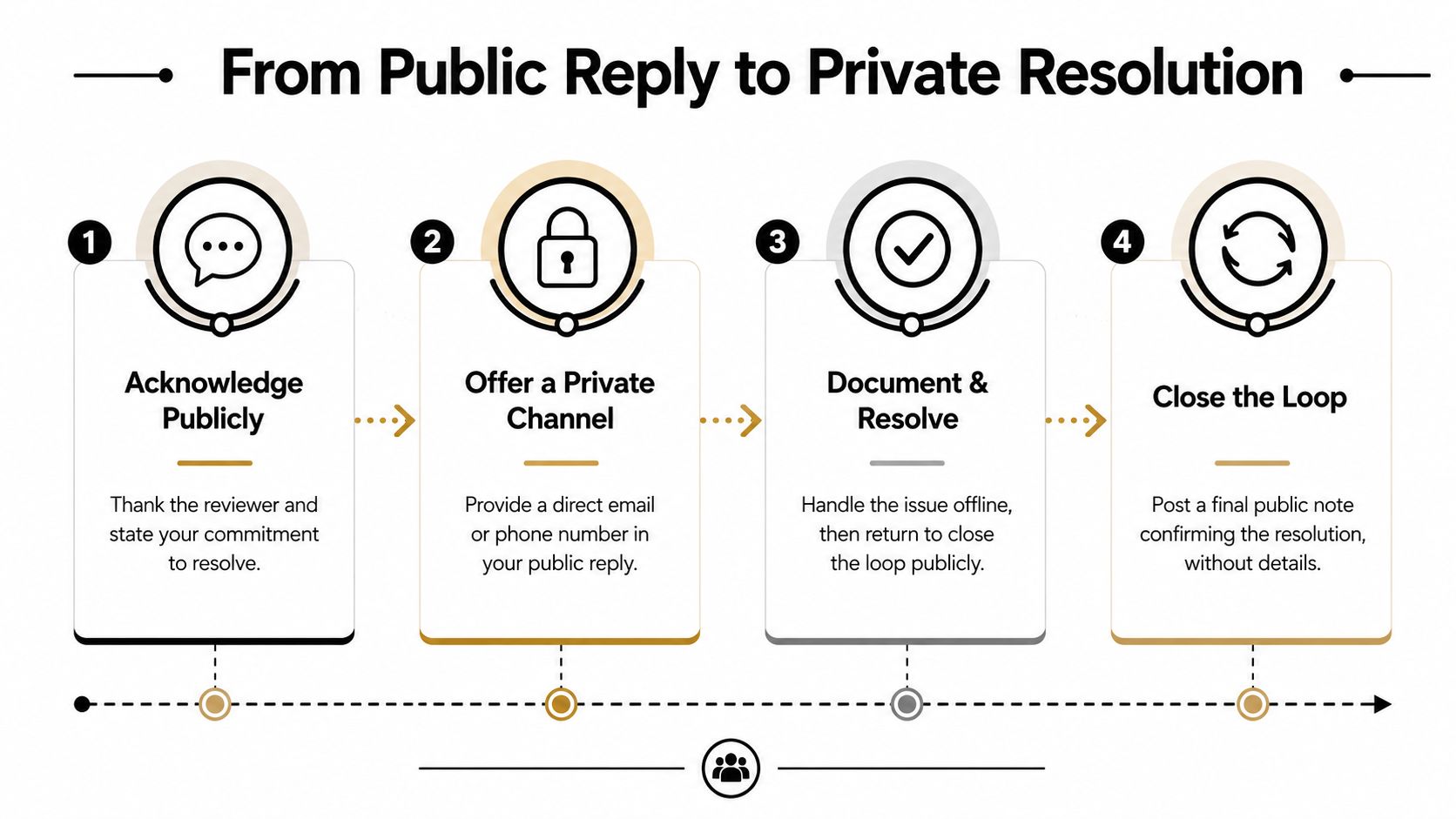
A one-star review needs a clear public acknowledgment and a private owner who can finish the investigation. A public reply opens the door, but resolution requires a controlled private process. Invite the reviewer to contact a named person through a real phone number or monitored email address. Give that person authority to investigate and offer an appropriate remedy.
Your reply should make the next step visible without exposing the dispute:
We're sorry this happened, and we'd like to review the details with you directly. Please contact [manager name] at [phone or email] so we can investigate and discuss the appropriate next step.
Once the customer contacts you, verify the account privately and listen before deciding what to offer. Depending on the facts, the remedy may include a refund, replacement, redo, corrected invoice, manager callback, or explanation of the applicable policy. Do not offer a reward solely to obtain a positive review. Resolve the service problem first.
Record the interaction
Log the review and follow-up in your CRM system, or in a controlled customer-service record if your business does not use a CRM yet. Capture the complaint category, assigned owner, evidence reviewed, contact attempts, resolution offered, customer response, and any operational change. Keep sensitive information out of casual shared notes and employees' personal devices.
Escalate complaints involving personal injury, discrimination, harassment, threats, alleged fraud, regulated information, insurance, a demand letter, or an issue that could affect multiple customers. Legal counsel can determine whether the matter needs formal preservation or a carefully limited statement. Report spam, impersonation, unrelated content, prohibited personal information, and other genuine policy violations to Google. A review you dislike is not automatically removable.
After the customer confirms that the issue is resolved, you may politely mention that they are welcome to update the review if their experience has changed. Never pressure them, condition a refund on a rating change, or ask for a five-star review. The revised review must reflect the customer's independent judgment.
Use a simple follow-through schedule:
- Same day: Save the review, assign an owner, and publish or approve the acknowledgment.
- Next business check-in: Verify that the customer was contacted and the promised action is underway.
- Resolution review: Confirm the remedy, record the outcome, and identify the process failure.
- Public close: Add a brief note such as, “Thank you for speaking with us. We're glad we were able to address this directly,” without private details.
- Ongoing review: Look for repeated themes across complaints and update training, scheduling, fulfillment, or communication procedures.
The strongest review response demonstrates that your business can acknowledge a problem, protect privacy, take action, and finish what it started, regardless of whether the rating changes.
SWAT Marketing Solutions helps small and mid-sized businesses monitor and respond to undesirable reviews while strengthening local SEO, websites, listings, and lead-generation systems. Visit SWAT Marketing Solutions to request a complimentary website, SEO, or local listings assessment and build a review response process your team can follow.