
Are you wondering how to generate more leads? Before you can start reeling in new leads, you need a solid foundation. This means getting your website tuned up for speed and mobile users, building landing pages that actually convert, and putting the right tools in place to see what’s working from the very first click. It’s all about building a reliable system before you spend a dime on advertising.
Build Your Lead Generation Foundation

It’s tempting to jump straight into the exciting stuff like paid ads or fancy content strategies. But if your website—your primary digital asset—isn’t built to convert, you’re just throwing money away. Think of it like building a house; you wouldn’t put expensive windows on a crumbling foundation.
Your website is that foundation. It’s the central hub where all your marketing roads lead. If it’s slow, a nightmare to use on a phone, or just plain confusing, you’re not just losing traffic. You’re losing real people who get frustrated and click away.
Prioritize Website Performance and User Experience
A fast, modern website isn’t a luxury anymore; it’s a non-negotiable. People today have high expectations and zero patience. We’ve all seen the studies showing that even a one-second delay in page load time can send conversion rates plummeting. Your first job is to make sure your site is quick, secure, and looks great on a phone.
Here’s what to focus on:
- Mobile Responsiveness: A huge chunk of your visitors will be on their phones. Your website has to deliver a smooth experience, with text that’s easy to read and buttons that are easy to tap. No pinching and zooming allowed.
- Page Speed: Use a tool like Google’s PageSpeed Insights to find out what’s bogging your site down. Slow load times are probably the #1 reason people bounce before they even see what you have to offer.
- Reliable Hosting: Don’t cheap out on hosting. Your website’s speed and stability are directly tied to it. Quality hosting ensures your site stays online and fast, even when you get a sudden rush of visitors.
The user’s journey starts the second they land on your site. A bad first impression can end that journey right there, costing you a lead before you’ve even had a chance to make your pitch.
Transform Landing Pages into Conversion Machines
A landing page isn’t just another page on your site. It’s a specialized tool with one job and one job only: to capture a lead. So many businesses make the mistake of sending ad traffic to their homepage, which is usually cluttered with distractions. Every campaign needs its own dedicated landing page that’s laser-focused on a single offer.
For some proven strategies on creating offers that really connect, check out these essential 8 B2B lead generation best practices.
A great landing page has a crystal-clear value proposition, almost no navigation to distract visitors, and a simple, frictionless form. You have to make it incredibly easy for people to understand what you’re offering and why it’s worth trading their contact information for. This simple shift can make a massive difference in your conversion rates.
Establish Your Essential Toolkit
You can’t improve what you don’t measure. Setting up the right analytics and tracking tools from day one isn’t some “advanced” step—it’s a fundamental requirement for figuring out what works.
Get Google Analytics installed to track where your visitors come from, what they do on your site, and how many of them convert. Then, pair it with a Customer Relationship Management (CRM) system to keep track of the leads you capture. This basic toolkit will give you the data you need to make smart decisions and optimize every other strategy in this guide.
Attract High-Intent Buyers with Search Engines
Every single day, your best potential customers are heading to Google. They’re typing in questions, looking for solutions, and searching for answers to problems your business is perfectly equipped to solve.
Being there in that moment of need is one of the most powerful ways to bring in new leads. That’s the magic of search engine optimization (SEO). It’s not about playing games with algorithms; it’s about positioning your business as the most helpful, authoritative answer when someone is actively looking for what you do.
Think of SEO as your long-term lead generation engine. Unlike paid ads that vanish the second you stop funding them, a smart SEO strategy builds a durable asset for your business. The time you invest in helpful content and a solid local presence will pay you back for months, and even years, by delivering visitors who are already warmed up because they came looking for you.
Turn Your Blog into a Lead Generation Machine
One of the most common missteps I see is businesses using their blog as a simple company news feed. If you want to generate leads, your blog needs to be much more—it has to become a go-to resource library for your ideal customer. It needs to answer their nagging questions and solve their real-world problems.
Put yourself in your customer’s shoes. They aren’t searching for your company by name. They’re searching for things like “best way to insulate a drafty window” or “how to choose a local accountant.” Every blog post you publish is a new hook in the water, a chance to show up for one of these highly specific searches. A website with just a handful of pages might rank for a few terms, but a site with a consistent blog can rank for hundreds, if not thousands.
This approach has a massive payoff. Research shows that SEO leads have a close rate of 14.6%, which blows most outbound methods out of the water. It’s also why websites with blogs pull in 67% more leads than those without one. This direct line between creating useful content and attracting motivated buyers is one of the biggest benefits of SEO for small businesses.
Pro Tip: Don’t just write for the sake of writing. Every single blog post should target a specific keyword phrase your customers are actually searching for. Use a few free tools to get ideas and then build content that directly answers a question or solves a specific problem.
Dominate Local Searches and Google Maps
If your business serves a specific geographic area—whether you’re a plumber, a cafe owner, or a local consultant—mastering local SEO is absolutely non-negotiable.
When someone searches “plumber near me,” they aren’t just browsing; they have an urgent need. Showing up at the top of Google Maps and in the local search results is today’s equivalent of having the best storefront on Main Street.
The key to getting this right is consistency. Your business name, address, and phone number (what we call NAP) must be identical everywhere it appears online. Even tiny differences can create confusion for search engines and customers alike, which will hurt your rankings.
Here’s where to focus your efforts to boost your local visibility:
- Claim and Optimize Your Google Business Profile: This is your #1 asset for local SEO. Fill out every single section. Upload high-quality photos, actively encourage customer reviews, and use the Q&A feature to answer common questions before they’re even asked.
- Lock Down Your NAP Consistency: Your business details need to be the exact same on your website, your Google Business Profile, your Facebook page, Yelp, and other key online directories. Something as small as “St.” vs. “Street” can cause problems.
- Build Local Citations: A citation is simply any online mention of your business’s NAP. The more reputable directories your business is listed in, the more Google trusts that you are a legitimate, active local business.
- Encourage Customer Reviews: Positive reviews are a massive ranking factor and provide incredible social proof. Don’t be shy about asking your happy customers to leave you a review on Google.
By concentrating on these two core pillars of SEO—creating valuable blog content and building a strong local presence—you create a reliable, repeatable system for attracting high-intent buyers. These aren’t just random visitors; they are people actively looking for the exact expertise and services you offer, making them the best leads you can possibly get.
Turn Website Visitors into Qualified Leads
Getting people to your website is a great first step, but it’s only half the job. The real challenge is turning those anonymous clicks into actual, qualified leads for your business. This is where your on-site strategy comes in—transforming your site from a simple online brochure into an active lead-generation machine.
Every single element on your page, from the headline down to the buttons, needs to guide visitors toward taking action. Without a clear path and a good reason to engage, even your most interested prospects will likely just click away and disappear forever. Your job is to make it incredibly easy and appealing for them to raise their hand and show interest.
Craft Compelling Calls to Action
Your Call-to-Action (CTA) is arguably the most critical conversion element on any page. It’s the specific moment you ask the visitor to do something. So many businesses miss the mark with generic CTAs like “Submit” or “Click Here.” These are wasted opportunities because they offer zero value and no context.
A powerful CTA has to answer the user’s unspoken question: “What’s in it for me?” It needs to be action-oriented and packed with benefits.
- Instead of “Download”: Try “Get My Free Marketing Checklist”
- Instead of “Subscribe”: Try “Join 5,000+ Readers & Get Weekly Tips”
- Instead of “Contact Us”: Try “Request a Free, No-Obligation Quote”
See the difference? The second options are specific, personal, and promise a clear result. They create a sense of ownership (“My Free Checklist”) and remove hesitation by explaining exactly what happens next. The goal is to make clicking that button feel like the most logical, obvious next step for them.
A well-optimized content and SEO strategy is the engine that drives these conversions. Just look at the impact it can have.
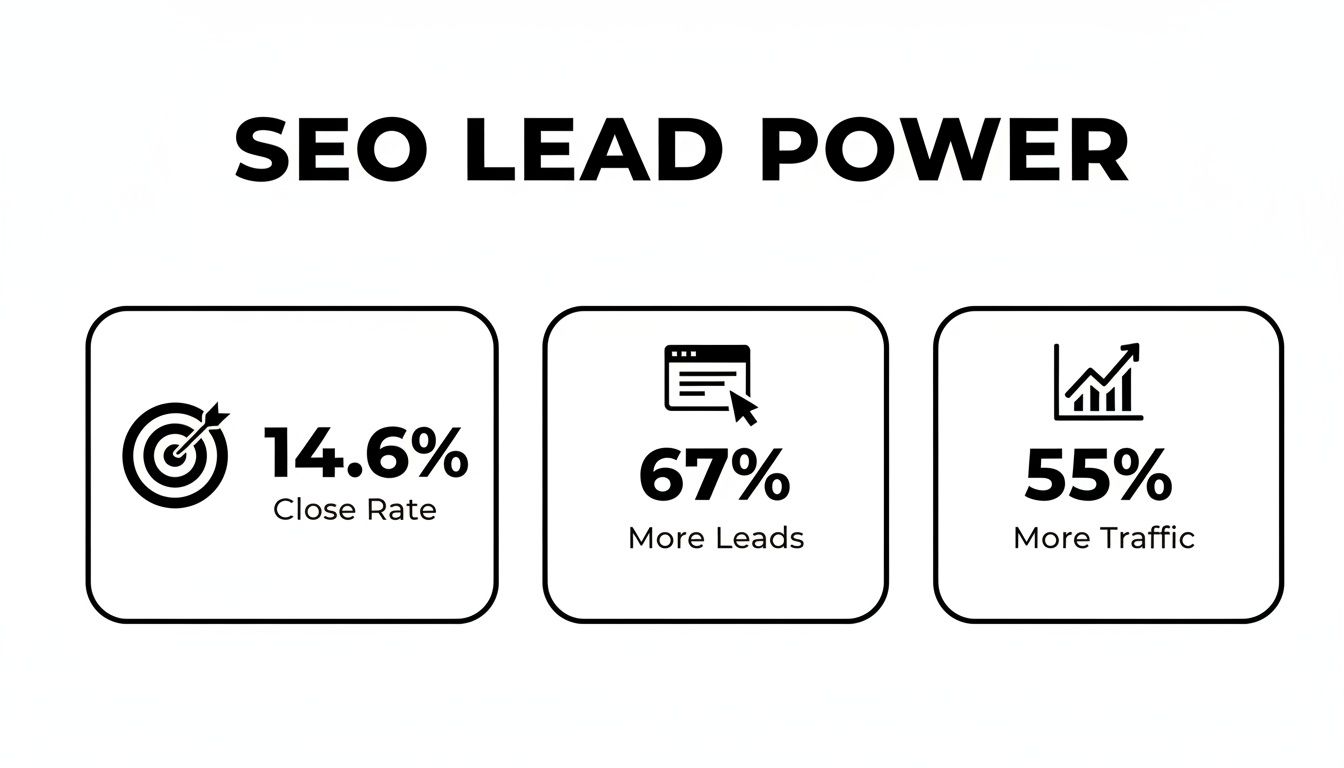
These numbers don’t lie. A solid foundation in SEO and quality content directly translates to higher close rates and a much healthier pipeline of leads and traffic.
Design Frictionless Forms and Landing Pages
Think of your lead capture form as the final hurdle between you and a new lead. Every extra field you add, every bit of friction, increases the odds that a visitor will just give up. Stick to the absolute essentials—the information you truly need to qualify and contact them. You can always gather more details later on in the sales process.
Make your forms a breeze to complete with clear labels, mobile-friendly design, and a quick note about privacy to build trust. This idea of simplicity is also key for the entire page. We’ve seen firsthand how incredibly effective well-designed landing pages are when they are laser-focused on one conversion goal.
A great landing page has one job: get a visitor to take you up on a specific offer. To do that, you have to remove all distractions—ditch the main navigation, sidebars, and anything else that doesn’t directly support that single goal. Less choice often leads to more action.
Engage Visitors in Real-Time with Live Chat
Think about how many potential leads have landed on your site with a simple question, couldn’t find an immediate answer, and just left. Live chat is the perfect solution. It gives you a way to provide instant, real-time help and engage visitors at the exact moment their interest is highest.
Whether you staff it with your own team or use a managed service, a 24/7 live chat lets you answer questions, handle objections, and capture lead info before that visitor clicks away. It turns a one-way browsing session into a two-way conversation, building trust and grabbing leads that would have otherwise been lost for good. For small and medium-sized businesses, it’s one of the most direct ways to boost on-site conversions.
Amplify Your Reach with Paid Ads and Social Media
While a great SEO strategy is your long game for building authority, sometimes you just need to get in front of your ideal customer right now. That’s where paid advertising and a smart social media plan come into play. They give you immediate visibility and the kind of laser-focused targeting that organic marketing just can’t match.
Think of it this way: SEO is like building a fantastic permanent storefront on a busy street. Paid ads? They’re the giant, flashing billboard you put up exactly where you know your best customers are driving. Both are essential, but they serve different roles in your lead generation playbook.
Deploy Highly Targeted Paid Advertising Campaigns
Modern ad platforms like Google Ads and Facebook Ads are so powerful because they remove the guesswork. Instead of just shouting your message into the void, you can zero in on your perfect audience based on their demographics, what they’re interested in, their online behavior, and even what they’ve been searching for recently.
For instance, a local HVAC company can show ads only to homeowners in specific zip codes who just searched for “AC repair.” A B2B software firm can target its ads directly to people with the job title “Operations Manager” at companies of a certain size. This precision means every dollar you spend is working harder to reach people who are actually likely to become a lead.
If you’re looking for immediate action and serious growth from your ad spend, you’ll want to explore methods like mastering direct response video ads.
The secret to a winning paid campaign isn’t a massive budget; it’s hyper-relevant targeting. A small, focused campaign that speaks directly to the right audience will always beat a large, generic one.
To get your ads off the ground, concentrate on these fundamentals:
- Compelling Copy: Your ad copy has to grab attention and hit on a specific pain point. Try asking a question or leading with a bold benefit.
- Eye-Catching Visuals: Whether it’s a static image or a short video, your creative needs to stop the scroll. Think bright colors, real people, and clear branding.
- A Clear Offer: What’s the next step? “Download Our Free Guide,” “Get a 15-Minute Demo,” and “Claim Your 20% Off Coupon” are all specific, value-driven offers.
- Dedicated Landing Pages: This is a big one. Never, ever send ad traffic to your homepage. Create a dedicated landing page that mirrors the ad’s message and has one, single, focused call to action.
Transform Social Media into a Lead Generation Engine
Too many businesses see social media as just a branding tool—a place for company updates and the occasional article share. But when you get strategic, it can become a direct pipeline for high-quality new leads, especially in the B2B world.
The trick is to stop broadcasting and start engaging. Instead of just talking at your followers, you need to spark conversations, provide real value, and build a community around your expertise. That’s how you build the trust needed to turn a follower into a lead.
The numbers don’t lie. An incredible 66% of marketers generate leads from social media by spending just six hours a week on it. For B2B, LinkedIn is an absolute giant, sourcing 80% of all B2B social media leads. The platform is proven to be 277% more effective for lead generation than others, with its native Lead Gen Forms converting at a jaw-dropping 13%—that’s five times higher than most website conversion rates.
Here’s how to make your social channels work for you:
- Share Gated Content: Offer up valuable resources like ebooks, whitepapers, or webinar replays. Use a Lead Gen Form to capture an email address in exchange for the content.
- Engage in Relevant Groups: Don’t just be a lurker. Join groups where your ideal customers gather. Answer questions, offer genuinely helpful advice, and establish yourself as the go-to expert.
- Optimize Your Profile: Your company’s social media page should be a mini-landing page. Make sure it clearly says what you do and includes a direct link to a lead capture page on your website.
By blending the immediate punch of paid ads with the long-term community building of social media, you create a powerful strategy that captures leads from all angles. You’ll reach people actively looking for a solution today while nurturing an audience that will turn to you when the time is right.
Nurture Leads and Measure What Matters
Getting a lead is a huge win, but it’s definitely not the finish line. An email address sitting in your database is just potential. The real magic happens when you turn that initial flicker of interest into a paying customer. This is where so many businesses stumble, letting perfectly good leads go cold because they don’t have a solid follow-up game.
Here’s the thing: most people aren’t ready to pull out their credit card the second they download your guide. They’re doing their homework, checking out the competition, and just learning. Your job is to stay on their radar, build some genuine trust, and gently show them why you’re the right choice. This whole process is called lead nurturing, and it’s the bridge that takes someone from “just looking” to “sold.”
Build Relationships with Email Nurturing
Even with all the new channels out there, email marketing is still a powerhouse for nurturing leads. It’s personal, it’s direct, and it lets you deliver valuable, targeted content over time without being annoying or pushy.
A single “welcome” email is nice, but a strategic nurturing sequence is what really moves the needle. This is simply an automated series of emails, where each one is designed to solve a problem or share a useful tidbit, nudging your prospect a little closer to making a decision.
For someone who just downloaded a guide, a simple flow could look like this:
- Email 1 (Right away): Send them the guide they asked for with a warm, personal welcome.
- Email 2 (2 days later): Follow up with a related blog post or a quick tip that builds on what was in the guide.
- Email 3 (5 days later): Share a powerful case study or customer success story. Show them how you’ve helped others just like them.
- Email 4 (8 days later): Extend an invitation for a no-pressure consultation or a spot in an upcoming webinar.
Setting this up on autopilot ensures no one falls through the cracks. Every single prospect gets consistent, helpful communication that positions you as the expert they need.
Centralize Your Efforts with a CRM
As you start bringing in more leads, trying to keep track of everything in a spreadsheet is a recipe for disaster. This is where a Customer Relationship Management (CRM) system becomes your best friend. It’s the central command center for all your lead and customer info, giving you one clear picture of what’s going on.
A CRM tracks every little interaction—every email opened, every link clicked, every page visited on your site. This gives you an incredible 360-degree view of a lead’s journey, helping you understand exactly what they’re interested in so you can tailor your conversations perfectly. To really get into the weeds, our guide on the benefits of a CRM breaks down how this tool can completely change the game for your business.
Think of your CRM as your business’s memory. It remembers every conversation and every touchpoint, so your team can pick up right where they left off, providing a seamless and personalized experience for every lead.
Track the Metrics That Drive Growth
You can’t fix what you don’t measure. If you want to build a lead generation machine that actually works, you have to look past the “vanity metrics” and focus on the numbers that directly impact your bank account. Tracking your performance lets you see what’s working, ditch what isn’t, and make smart decisions backed by real data.
Get started by keeping a close eye on these key performance indicators (KPIs):
| Metric | What It Measures | Why It Matters |
|---|---|---|
| Cost Per Lead (CPL) | The average you spend to get one new lead from a specific source (like Google Ads or Facebook). | This tells you how efficient your marketing dollars are and helps you double down on your most profitable channels. |
| Conversion Rate | The percentage of website visitors who actually do what you want them to do (e.g., fill out your contact form). | This shows you how good your website and offers are at turning casual browsers into actual leads. |
| Lead-to-Customer Rate | The percentage of your qualified leads that become paying customers. | This is the ultimate report card for your lead quality and sales process. If this number is low, it might mean your leads aren’t a good fit or there’s a snag in your sales cycle. |
When you consistently nurture your leads and track your results like a hawk, you close the loop on your marketing. It stops being a bunch of random activities and becomes a cohesive, measurable system that reliably brings in qualified leads and fuels real, sustainable growth.
Your Action Plan for Generating More Leads

Alright, we’ve covered a lot of ground. It’s easy to feel overwhelmed by all the possibilities, and that often leads to doing nothing at all. Let’s cut through the noise and turn all this information into a straightforward, prioritized roadmap.
This isn’t about tackling everything at once. That’s a recipe for burnout. Instead, it’s about making smart, sequential moves that build on each other. We’ll start with the foundational “quick wins” before layering on the more advanced tactics. This is your guide to focusing your energy where it matters most, starting right now.
Your Foundational Checklist (Weeks 1-4)
Think of these first steps as non-negotiable. They create the solid base you need for every other marketing effort to actually work.
- Website Health Audit: Before you do anything else, run a speed test using Google’s PageSpeed Insights. Is your site mobile-friendly? Click through it on your own phone. Fix any glaring issues that make it hard to use.
- Analytics and CRM Setup: Make sure Google Analytics is installed and that you’re tracking conversions—like form submissions. Set up a simple CRM, even a free one, to start capturing lead information so no one falls through the cracks.
- Optimize Google Business Profile: For any local business, this is your most important online asset, period. Fill out every single section. Upload new photos. And most importantly, start asking your happy customers for reviews.
Don’t skip the basics. I’ve seen businesses waste thousands on ad campaigns that send people to slow, broken websites. Fixing your foundation first means every dollar you spend later has a much better chance of paying off.
Your Growth Checklist (Weeks 5-12)
With a solid foundation in place, it’s time to start actively attracting and converting new visitors.
- Launch Your First Blog Post: Think of one big question your customers always ask you. Write a detailed blog post that answers it better than anyone else online. Do a little keyword research to optimize it.
- Install Live Chat: This is a surprisingly easy win. Add a live chat widget to your site. Even a simple one can start grabbing leads from people who are browsing and just have a quick question.
- Set Up a Simple Paid Ad: Dip your toes in the water. Create a small, tightly targeted ad campaign on Google or Facebook. Don’t send them to your homepage; direct them to a specific landing page with a single, compelling offer.
- Create an Email Nurture Sequence: What happens after someone gives you their email? Don’t just let them go cold. Set up a simple 3-email automated follow-up. The goal is to provide value and build trust before you go in for the hard sell.
Common Questions About Generating Leads
Even with the best playbook in hand, questions always come up. When you’re trying to figure out how to get more qualified leads in the door, a few common hurdles can feel a bit confusing. Let’s walk through some of the most frequent ones we hear from business owners.
How Much Should I Actually Budget for This?
This is always the big question, and the honest-to-goodness answer is: it depends.
A solid rule of thumb for many small businesses is to put about 10-20% of your total revenue toward all your marketing, which includes lead generation. But that’s just a starting point. A brand-new business might need to be more aggressive with their spending to start making a name for themselves. On the other hand, a more established company can be more surgical, focusing its budget on channels they already know work well.
Instead of just pulling a number out of thin air, try working backward. Figure out your revenue goals, what an average customer is worth to you over their lifetime (LTV), and your current lead-to-customer conversion rate. This data helps you calculate a realistic Cost Per Lead (CPL) you can actually afford. Suddenly, your budget becomes a strategic investment, not just a blind expense.
Which Lead Generation Channels Are Best for My Industry?
The best channels are always going to be where your ideal customers are spending their time. There’s no magic bullet that works for everyone, but we can definitely draw some clear lines based on experience.
- For B2B companies (like consultants or software firms): Your bread and butter will be LinkedIn and SEO. Professionals live on LinkedIn, making it perfect for targeted outreach. Meanwhile, SEO catches people actively searching for the exact business solutions you provide.
- For local services (plumbers, dentists, etc.): You absolutely must focus on Local SEO and Google Ads. Your goal is to own the Google Maps results and pop up for every “near me” search. This is where your new business will come from.
- For E-commerce and B2C brands (retail, online shops): Facebook/Instagram Ads and Email Marketing are incredibly powerful. Social ads let you get visually creative and target specific interests, while a good email list is your secret weapon for driving repeat business.
Here’s a pro tip: Don’t try to be everywhere at once. You’ll get much better results by mastering one or two channels that are a perfect fit for your audience, rather than spreading your efforts too thin across five or six.
How Long Until I Start Seeing Results?
Patience is a virtue here, but the timeline really depends on the channel you’re using.
With paid advertising, like Google Ads or Facebook Ads, you can start seeing leads roll in within a few days of launching a campaign. You’re essentially paying for immediate visibility. If your targeting is on point and your offer is compelling, the results can be almost instant.
SEO and content marketing, however, are the long game. Think of it as building an asset. It can easily take 4-6 months or even longer to see a significant boost in organic traffic and leads from these efforts. The payoff is huge, though. You’re creating a lead-generating machine that works for you for years, unlike ads that shut off the second you stop paying.
Ready to stop guessing and start growing? The team at SWAT Marketing Solutions builds data-driven strategies that turn your website into a lead generation powerhouse. Request your free website and SEO assessment today.