You can be running Google Ads, posting on Instagram, maybe even paying for a few creator mentions, and still hear the same thing at a community event, nobody can quite say your brand name back to you. That's the gap brand awareness campaigns are meant to close. They're not about making noise for its own sake, they're about making sure the right people remember you, trust you, and think of you when they're ready to buy.
Why Small Businesses Need Brand Awareness Campaigns Now
A small business can run paid search, post on social, and still hear the same complaint at a local event, people recognize the product but not the name behind it. That is the gap brand awareness campaigns are meant to close. They do the quieter work of making your business easier to remember, easier to trust, and easier to choose when a buyer is finally ready.
The pressure to do that work has only increased. Brand decisions are now showing up earlier in marketing planning, and video is doing more of the heavy lifting for recall. That matters because awareness is not just about getting seen once, it shapes how efficiently later channels work, how often people come back, and how much value each customer can generate over time.
For a small business, the question is usually not whether awareness matters. It is how much to fund it, which channel can carry the message, and what proof will show it is paying off. A local service brand may need social and video to build familiarity fast. A retail brand may get more from creators, PR mentions, or out-of-home in a tight geographic area. The trade-off is always the same, wider reach can lift memory, but only if the creative is clear enough to connect the impression to the business.
Awareness also sits upstream of the rest of the funnel. Search, email, and retargeting all work better when people already know the name, the category, or the promise. That is why loyalty resources matter here too. If you want a practical look at how repeated recognition turns into repeat buying, ViralRef's guide to brand loyalty for merchants is a useful companion read for merchants trying to turn first-time buyers into familiar buyers.
A simple rule helps with budget decisions. If your current marketing can generate clicks but not recall, the next dollar should probably go into awareness before another short-term promotion. If people remember you, later acquisition tends to cost less and convert with less resistance.
What a Brand Awareness Campaign Actually Is
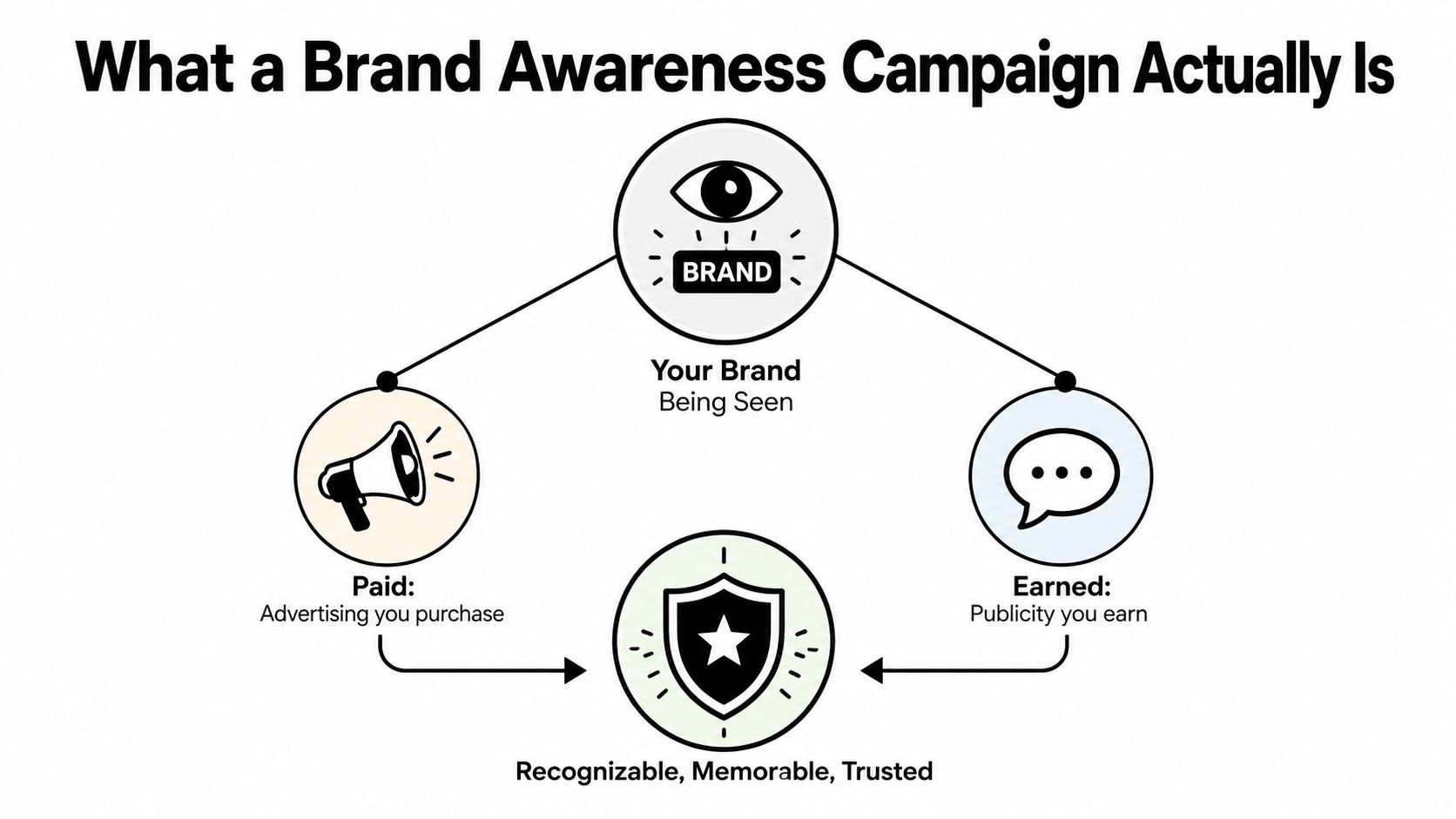
A brand awareness campaign is a coordinated effort to make your brand easier to recognize, easier to remember, and easier to trust before the customer is ready to buy. That usually means a mix of paid exposure, earned exposure, and repeated creative signals that help people connect your name, category, and promise over time. It's not just about getting seen once, it's about being seen often enough that the brand sticks.
That is different from a performance campaign. Performance campaigns chase a click, a lead, or a sale now. Awareness campaigns chase memory first, then let memory support the sale later. The creative should reflect that difference, too. A conversion ad can be direct and urgent, while an awareness ad often needs a stronger identity cue, a clearer emotional angle, or a more repeatable story.
The three layers you should measure
The cleanest way to think about awareness is in layers. First comes delivery, which tells you whether the media reached people. Then comes behavior, which shows whether people started acting like they remembered you. Finally comes recall, which asks people directly whether the brand stuck.
The delivery layer includes reach, impressions, frequency, and CPM. Frequency is calculated as Impressions / Reach, and CPM as Spend / (Impressions / 1000), so you can see whether you bought exposure efficiently. The behavior layer includes things like branded search volume, direct traffic, and brand mentions. The recall layer includes unaided awareness, aided awareness, and brand recall.
A campaign can look busy and still fail to move memory. If the ads showed up but no one later searched your name, you bought exposure, not recognition.
That's why awareness campaigns are not the same as boosted posts, follower growth, or generic reach. Real recognition shows up in how people remember you later, not just in how many times an ad was served.
Channel Mixes That Build Recognition
A small business usually does not choose channels by preference alone. It starts with the goal, the budget, and how much repetition the market can tolerate before the message turns into noise. If the goal is local familiarity, the mix may tilt toward organic social, paid social, and out-of-home. If the goal is broader credibility, video, PR, and creator-led placements usually do more work.
The strongest mixes rarely rely on one channel. They combine repeated exposure with a clear memory cue, then match that to how people already pay attention. Video remains one of the clearest ways to build recognition, and broad advertising investment keeps moving in that direction because repeated exposure still matters. For a closer look at how social channels are used tactically, this guide on social media marketing strategies is a practical reference. Broader planning also continues to favor paid media, with brand awareness statistics 2026 pointing to continued growth in ad investment.
What each channel does in a real mix
Organic social gives a brand a public rhythm. It is slower than paid media, but it helps people see the same tone, faces, and offers often enough to remember them later.
Paid social adds control and speed. It works well when you need a defined audience to see the same message more than once, and it also lets you test which creative holds attention before you spend more broadly. That makes it useful for small businesses that need to shape a message before committing larger budget.
Online video does a lot of memory work because it brings together sight, sound, and motion. It is a strong format for introducing a founder, showing a problem being solved, or repeating a signature visual cue that people will recognize later.
Connected TV can make sense when the audience already streams heavily and the message is simple enough to land in a short spot. It can be expensive for an SMB, so the creative has to carry more weight than it would in cheaper placements.
Out-of-home works best in local markets where repeated visibility supports familiarity. A service business that keeps appearing on the same routes can feel more established, even if the business is still building its name.
PR and earned media add third-party credibility. A mention in a relevant local publication often carries more trust than the same claim inside your own ad.
Creators and influencers help a small brand borrow trust inside a niche community. The right partnership can do more than extend reach, it can make the brand feel like part of the conversation instead of an outside interruption.
If you are weighing whether to bring in a branding partner, the list of best branding agencies is a useful place to compare what that role should cover.
Targeting the Right Audiences and Framing the Message
Audience targeting for awareness starts with the people most likely to buy, refer, and stay loyal, not the broadest possible demographic bucket. A landscaping business serving three zip codes doesn't need the same message as a B2B software company speaking to operations managers. Both can build recognition, but they need different proof, different language, and different cues for memory.
One overlooked issue is access. A lot of awareness advice stops at “define your audience” and never asks whether the audience can see, hear, understand, or trust the message in the first place. Commentary on reaching underserved groups argues for moving beyond demographics and into real barriers like low-bandwidth access, multilingual needs, and trust-building through referrals and community relevance (marketing to the underserved). That's not a niche concern. It affects how practical your campaign is.
A better audience brief
Start with three layers.
- Who buys first: the people most likely to need the service or product soon.
- Who influences the decision: family members, co-workers, or community connectors who shape trust.
- Who remembers and repeats: people who may not buy today, but will refer you later.
That structure keeps you from writing a message for “everyone” and landing with no one. It also forces creative decisions that are specific. A local home-services brand might need a plainspoken promise about responsiveness and local familiarity. A SaaS brand may need a sharper message about saving time, reducing errors, or keeping teams aligned.
Keep the message simple enough to repeat
A strong awareness message usually has one core promise, one proof point, and one call to memory. The promise says what you do. The proof point says why someone should believe it. The call to memory is the repeated phrase, visual, or idea people can carry forward.
If a prospect can't repeat your message to someone else, it probably isn't clear enough yet.
That framework keeps the creative consistent across channels without making it boring. Your social post, video intro, and PR pitch can all sound different while still reinforcing the same brand memory.
Step-by-Step Planning Checklist for Launch
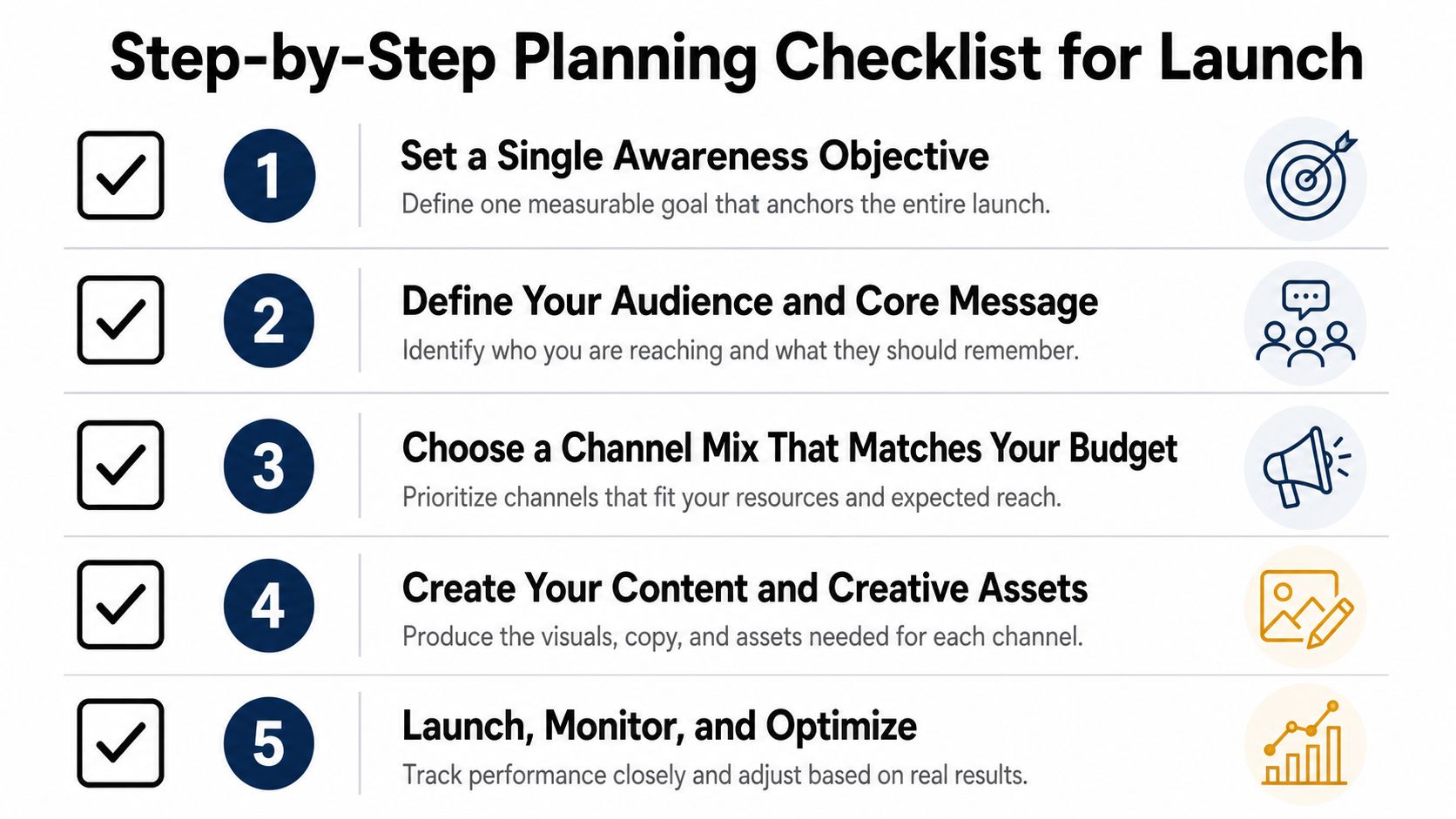
The cleanest launches are the ones that make decisions before spending starts. Set one awareness objective, define the audience and message, choose channels that fit the budget, build the creative system, and lock measurement before the first dollar goes out the door. If the tracking isn't ready, the campaign is not ready.
The timing matters more than many owners realize. A practical measurement setup starts with a 14 to 28 day baseline for reach proxies, branded search, direct traffic, and mentions before launch, then continues weekly during flight and for 4 to 6 weeks afterward because awareness often lags delivery (measure brand awareness). If you skip the baseline, you're guessing. If you stop too soon, you miss the lift.
The launch sequence that avoids expensive mistakes
- Set one awareness objective. Decide whether the campaign is for recognition, local legitimacy, category introduction, or trust building.
- Define the audience and message. Write the single promise you want repeated, then adapt it by segment.
- Choose the mix. Pick channels that match your geography, buying cycle, and budget shape.
- Create the assets. Make sure the same visual and verbal cues can live in short video, static ads, PR visuals, or creator content.
- Monitor and optimize. Check that the tracking works before you scale spend.
The most common mistake is launching creative before the measurement is verified. The second is running media without a baseline, then calling every traffic spike a success. Neither mistake is small, because both make it impossible to prove whether the campaign did anything.
Budgeting Without Burning Cash
A small business rarely loses money on awareness because it spends too much in one place. It loses money by buying the wrong kind of attention for the goal. A local service company needs repeat exposure in a tight area. An ecommerce brand entering a new region usually needs broader reach first, then a second pass that builds familiarity. Those are different buying jobs, so the budget has to be shaped around the channel, not the other way around.
The trade-off is simple. Some channels buy scale, some buy credibility, and some buy repetition. Paid social and display usually fit a CPM model because you can control distribution and adjust spend without much friction. Creator partnerships and publication placements often work better as flat-fee buys because the value sits in the relationship, the audience trust, or the outlet's local standing. If you are deciding between buying models, a practical CPC or CPM comparison helps before the first dollar goes out.
How to think about spend shape
CPM buys make sense when you need predictable delivery across paid social, display, or video. They let you scale up or trim back without rebuilding the whole plan.
Flat-fee partnerships fit placements where the value is the publisher, the creator, or the local legitimacy that comes with the mention.
Creator deals work when the audience trusts the messenger more than the brand. That tends to matter in niche categories, community-driven businesses, and lifestyle products where a familiar voice carries more weight than a polished ad.
The budget split should follow the job. Reach introduces the brand to new people. Frequency makes the message stick. If you buy only reach, people may see you once and forget you. If you buy only frequency inside a narrow audience, you can waste money showing the same ad to the same group too often. The point is to size the pool first, then decide how many times you need to show up inside it.
The case for awareness is stronger than the last click suggests. In the 2026 data set, strong brands were reported to grow 2.5x faster than weaker brands in the same sector, and consumers were said to pay an average of 23% more for brands they know and trust (brand awareness statistics 2026). That does not mean every campaign pays back right away. It does mean the value of recognition usually shows up beyond the first lead or sale, which is why the budget should be judged on lift, not just immediate response.
For a small business, the safest approach is to start with the cheapest channel only if it still fits the audience and the message. Cheap reach that misses the right people is expensive waste. A slightly higher-cost placement that builds memory in the right market can be the better buy if it supports the larger plan.
Measuring Lift Without Fooling Yourself
Awareness measurement has to behave like a funnel of evidence, not a single dashboard number. Start with what people say they remember, then check whether their behavior changed, then try to isolate whether the campaign caused the shift. If you only track impressions, you can end up celebrating exposure that never turned into memory.
The most useful recall metrics are unaided awareness, aided awareness, and brand recall. Those tell you whether people remember the brand on their own, recognize it when prompted, and can connect it to the right category. Then add behavioral proxies like branded search volume, direct traffic, and brand mentions so you can see whether people acted like they remembered you.
What good looks like in a mid-budget campaign
Modern KPI guidance points to effective frequency, the average number of exposures per unique person, with 3 to 7 exposures commonly cited as the range where recognition starts to form (a marketer's guide to brand awareness). The same source notes that a 3 to 5 percentage-point ad-recall lift can be meaningful for a mid-budget campaign. Those aren't promises, they're benchmarks that help you avoid reading too much into tiny movement.
You should also report share of voice, share of impressions, and brand lift survey scores. Those metrics help you separate real awareness gains from generic traffic noise. If a post got clicks but no one later searched your brand, the campaign may have created attention, not recognition.
The final test is incrementality. Holdout tests and geo-split tests are the cleanest way to prove that the campaign changed awareness instead of just showing up in places people already would've seen you. That's the point where measurement becomes useful, because you're no longer asking whether the ads were delivered. You're asking whether the campaign changed what people know.
If you need a reference on the measurement side of paid social reporting, social media impressions is a helpful starting point, especially when you're trying to separate visibility from lift.
Two SMB Examples and Your Next Move
A local home-services company with a few target zip codes doesn't need the same awareness plan as an ecommerce brand opening in a new region. The local business benefits from concentrated repetition, a visible local signal, and a few trust-building touchpoints that make the company feel established. The ecommerce brand needs broader exposure, stronger creator proof, and a way to capture branded search once people start remembering the name.
For a useful look at how creators can be used to build spread quickly, viral campaign examples for 2026 is a handy reference point. The right lesson isn't “go viral.” It's that shareable creative, if paired with the right audience and tracking, can seed memory fast.
Two SMB Brand Awareness Playbooks Side by Side
| Scenario | Channel Mix | Primary Metric | Post-Flight Signal |
|---|---|---|---|
| Local home-services business | Geo-targeted video, local OOH, referral-friendly PR | Reach inside the service area | Direct traffic and branded searches in the target zip codes |
| Ecommerce brand entering a new region | Creator partnerships, paid social, branded search capture | Share of impressions and recall | Branded search growth and repeat social mentions |
The home-services business should care less about broad national reach and more about whether people in the service area keep seeing the brand in enough places to trust it. The ecommerce brand should care less about one-off clicks and more about whether the new market starts searching the brand by name.
If your current reporting can't prove lift, that's the next problem to solve. SWAT Marketing Solutions offers marketing strategy, paid social, creative design, analytics integration, and complimentary website or SEO assessments, which makes it a sensible fit if you want a partner to audit the tracking and map the right awareness mix. Visit SWAT Marketing Solutions and ask for a review of whether your campaign can prove recognition, not just impressions.