
A customer checks your business on Google, compares a competitor's recent reviews, notices your unanswered complaint, and moves on before calling. Meanwhile, your team is checking several platforms manually, asking satisfied customers for feedback inconsistently, and treating every new review as equally urgent. Online review management fixes that disorder by turning monitoring, response, escalation, review generation, and reporting into one cross-platform operating process.
Reviews aren't just a star count. They're public evidence of how your business communicates, handles mistakes, and maintains standards. Consumers also question whether reviews are authentic, which makes response quality, review diversity, recency, and consistency as important as volume.
A Typical Week for a Business Owner Drowning in Reviews
Monday starts with a two-star Google review posted late Sunday. The complaint mentions a missed appointment window, but the owner doesn't see it until after payroll, supplier calls, and a staffing issue. A rushed reply goes live near lunch. It apologizes, but it doesn't explain what happens next, and the customer's frustration remains visible to everyone searching.
Tuesday brings a Facebook tag from someone asking whether the business is reliable. The owner answers from a phone between jobs, then forgets to record the conversation. On Wednesday, a glowing five-star Yelp review appears to be missing from the public page because Yelp's recommendation system hasn't displayed it. Nobody knows whether the customer needs clarification or whether the review needs monitoring.
By Thursday, a Trustpilot review has been unanswered for four days. The writer isn't furious, but the silence makes the business look inattentive. On Friday, the owner notices that a competitor's active response pattern is visible in local search results, while their own listing shows unresolved complaints. Saturday becomes a catch-up day instead of a day spent improving service.

What the chaos is really costing
The problem isn't one late reply. It's the absence of a review operating system.
- Monitoring is incomplete: Reviews, comments, and platform notifications sit in separate places.
- Priority is unclear: A serious service failure competes with a routine thank-you.
- Ownership is vague: Everyone assumes someone else will respond.
- Resolution is undocumented: The public reply doesn't connect to an internal service-recovery action.
- Measurement is missing: The owner can't tell which channel, customer moment, or response approach is producing useful outcomes.
A small business doesn't need to answer every review in the same way or chase every directory. It needs a reliable process that surfaces meaningful issues quickly, gives each channel an owner, and records what happened after the response.
Tools such as social ops review reporting tools can help organize reporting and monitoring, but software won't replace judgment. The practical sequence is straightforward: monitor, prioritize, respond, escalate, learn, and measure. Once those steps have clear owners, the owner's week stops revolving around surprise notifications.
Why Online Review Management Is Now a Trust and SEO Problem
Online reviews became a buying filter before most local businesses built a management process around them. Pew Research Center reported that 82% of U.S. adults at least sometimes read online ratings or reviews before buying something for the first time, while 40% said they always or almost always do so. The same survey found that 51% of review readers considered reviews generally accurate, but 48% said it was often difficult to tell whether reviews were truthful and unbiased. That combination matters. Reviews influence first-time purchase behavior, yet buyers also inspect authenticity and business responses. Pew Research Center review findings
The later local-business figures point to an even more demanding environment. A survey summarized in 2026 reported that 97% of consumers read reviews when evaluating a local business, and 41% said they always read them, compared with 29% in 2025. Another 2026 review-statistics summary reported that consumers read an average of 10 online reviews before trusting a business, while 76% trusted mixed ratings more than an entirely five-star profile. The cited local review statistics summary
Search visibility and buyer confidence use overlapping signals
A business listing needs more than a high average rating. Review activity, freshness, response behavior, written detail, and channel consistency all shape how credible the business appears to searchers and platforms. Google is usually the primary discovery channel for local companies, but customers often validate what they find by checking another site.
| Signal | Local SEO impact | Buyer trust impact |
|---|---|---|
| Rating quality | Helps searchers compare nearby businesses and can strengthen listing appeal | Communicates perceived satisfaction, but an unusually perfect profile may invite skepticism |
| Review recency | Shows that the business is active and still serving customers | Reduces uncertainty about the current experience |
| Owner responses | Demonstrates active listing management and gives platforms more public business context | Shows accountability, especially when the review is negative |
| Review diversity | Creates broader evidence across relevant directories and industry sites | Helps buyers compare perspectives instead of relying on one source |
| Review detail | Adds service and location language that can clarify relevance | Gives prospects concrete evidence about what the customer experienced |
A strong reputation playbook for local business should therefore treat reviews as both public customer service and local search evidence. A fragmented approach weakens both. If Google receives attention but Yelp, Facebook, Trustpilot, or an industry directory contains unresolved issues, prospects can form a negative impression before they ever reach your website.
The operational answer is to prioritize platforms by discovery value, customer intent, and response visibility. Build that decision into the wider reputation management strategy rather than leaving it to whoever happens to notice a notification.
Picking the Right Review Platforms to Focus On
You don't need to manage every review site equally. You need to manage the platforms that influence your customers' decisions and expose your business to meaningful local or industry-specific searches.
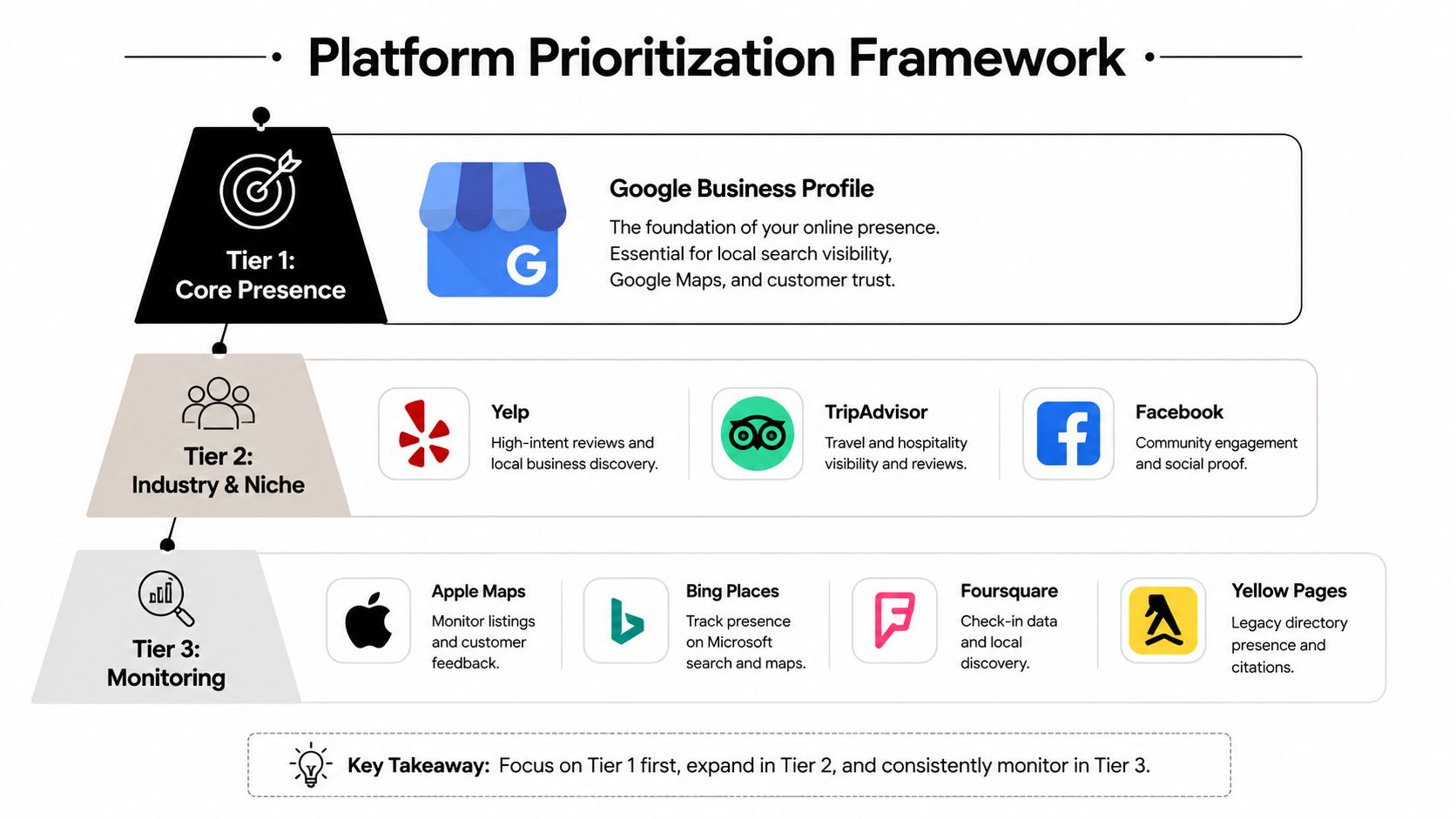
Use a tiered platform model
Tier 1 is your core presence. For most local businesses, that means Google Business Profile because it connects directly with Maps and local discovery. Complete the profile, monitor new reviews, and make owner responses part of the daily operating routine.
Tier 2 covers high-intent industry platforms. A restaurant or home-service company may need Yelp. A healthcare provider may need Healthgrades or Zocdoc. Hospitality businesses should examine TripAdvisor, while B2B software companies may find G2 or Capterra more relevant. The right platform is determined by customer behavior, not by a generic checklist.
Tier 3 supports brand consistency. Facebook and Apple Business Connect can reinforce accurate business information and provide additional places for customers to validate your reputation. They may not deserve the same response resources as Google, but ignoring them can leave visible gaps.
Tier 4 consists of niche and trade sites. Keep these when they produce referral traffic, appear for valuable searches, attract the right audience, or provide a credible industry signal. Otherwise, place them on a lighter monitoring schedule.
Score platforms by business value
For each platform, record:
- Search visibility: Does it appear when customers search for your service and location?
- Audience fit: Do the platform's users match your customer base?
- Competitor activity: Are comparable businesses receiving fresh reviews there?
- Public response access: Can prospects see whether the business answers feedback?
- Lead evidence: Do calls, form submissions, direction requests, or referral visits originate there?
Give each platform a clear owner and a response expectation. A shared sheet is enough at first. Later, local business listing management software can centralize profile information and review activity.
Your decision rule should be strict: if a platform consumes recurring staff time, has little search visibility, produces no identifiable referrals, and doesn't serve a strategic audience, reduce it to periodic monitoring or remove it from the active workflow. Focus creates better coverage where trust is decided.
Setting Up Real-Time Monitoring Without Living in Your Inbox
A useful monitoring system doesn't send every notification to everyone. It routes the right review to the right person with enough context to act.
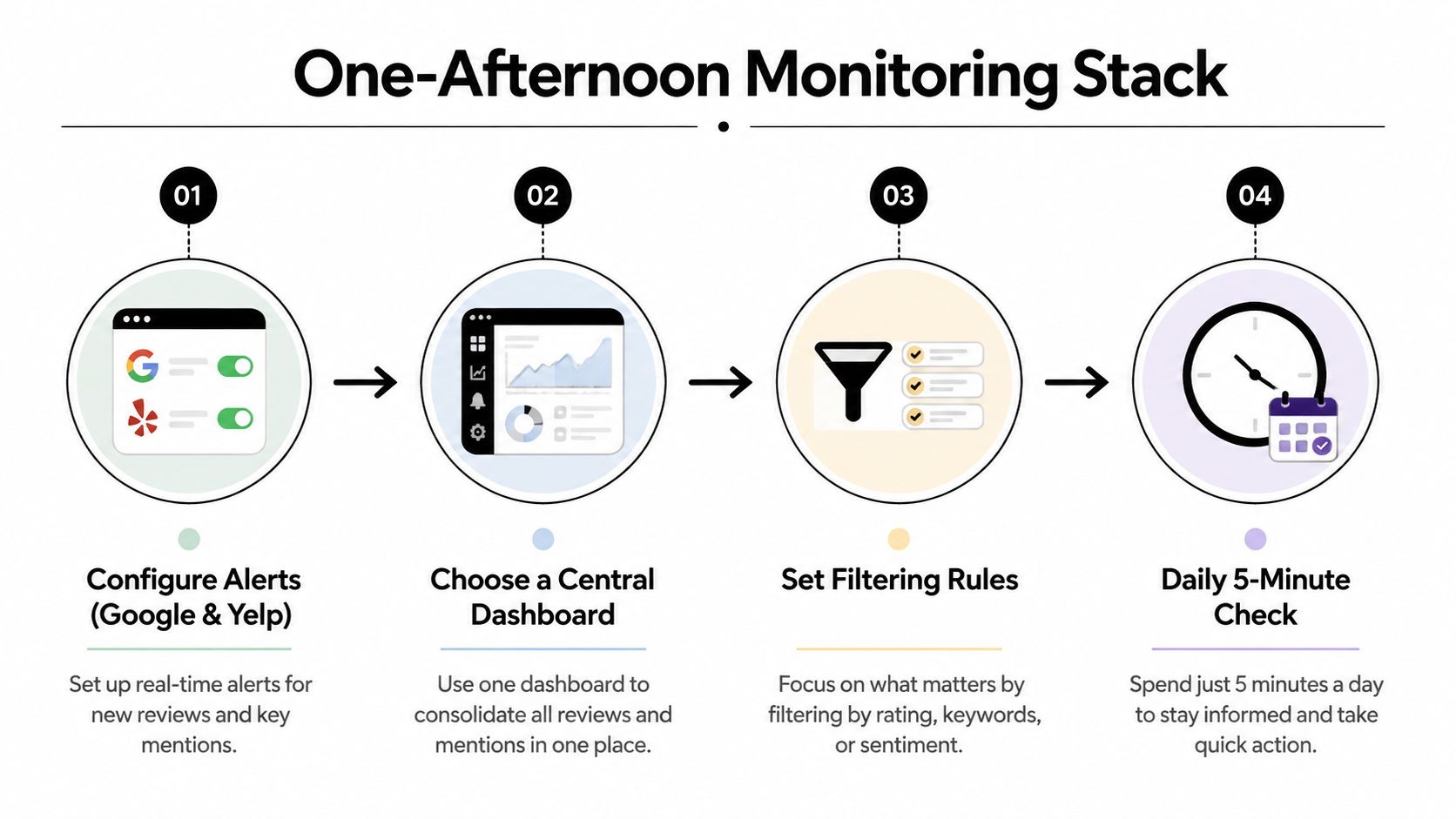
Start by configuring owner alerts on Google Business Profile and Yelp. Add Facebook, Trustpilot, TripAdvisor, or an industry platform only when those channels matter to your customers. If your team has more than one location or several active sources, consider a central dashboard such as Birdeye, Podium, or Chatmeter. The platform should aggregate incoming reviews, assign ownership, preserve response history, and support tags.
Build the workflow in one afternoon
Use a shared inbox or dashboard with three essential tags:
- Urgent: Safety concerns, allegations of discrimination, threats, privacy issues, suspected fraud, or a severe service failure.
- Service recovery: A legitimate complaint that requires a manager, refund review, callback, rescheduling, or operational correction.
- Thank you: Positive feedback that deserves a personal response and may reveal a strength worth reinforcing.
Add a fourth tag for policy or authenticity review when the content appears unrelated, abusive, deceptive, or in breach of platform rules. Don't label every negative review as fake. A harsh but genuine complaint belongs in service recovery.
Set one primary owner for each channel and a documented backup. Configure SMS or Slack escalation for urgent tags and for reviews below the star threshold your leadership chooses. The threshold should trigger attention, not dictate the final response. A detailed three-star review may contain more useful operational information than a vague one-star post.
Practical rule: Alerts should interrupt the team only when a human decision is needed. Mute vendor announcements, marketing emails, duplicate digests, and non-actionable activity.
A daily sweep should check new reviews, unassigned items, overdue replies, escalation status, and recurring themes. Keep a weekly management view for unresolved cases and a monthly view for trends by location, service, employee, and platform. The owner shouldn't have to search five inboxes to learn that one customer complaint has become a repeated process failure.
Generating Authentic Reviews at the Right Moments
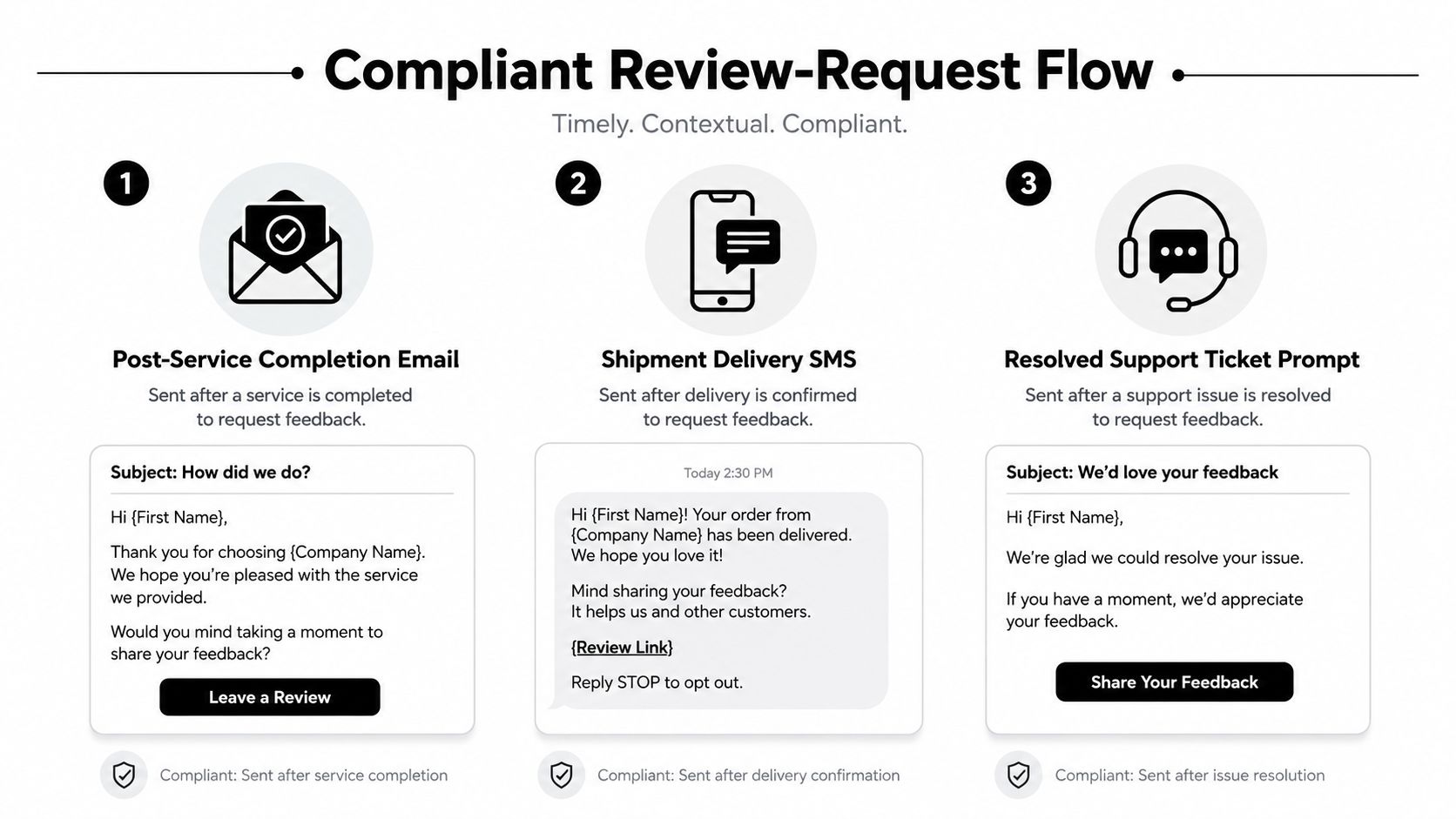
Review requests work best when they follow a completed customer moment, not when they arrive as a random marketing blast. Ask after a service is complete, after a shipment is delivered, or after a support ticket has been resolved and the customer has had an opportunity to confirm the outcome.
The request must be neutral. Don't ask only customers you believe will leave positive feedback, don't offer rewards in exchange for favorable sentiment, and don't pressure customers to change an honest review. If a platform permits an incentive under its rules and applicable law, disclose it clearly. Otherwise, leave incentives out.
Match the prompt to the customer moment
Post-service email
Hi [Name], thanks for choosing [Business]. If you're willing, please share an honest review of your experience on [Google/Yelp/Facebook]: [direct link]. Your feedback helps us improve.
Shipment delivery SMS
Hi [Name], your [order] was delivered. How did the experience go? You can leave an honest review on [platform] here: [short link]. If anything went wrong, contact us at [support path] so we can help.
Resolved support-ticket prompt
We're glad we could address your issue. If you'd like to share your experience, you can leave an honest review on [platform]: [link]. Thank you for taking the time.
A front-line verbal ask can be even simpler: “If you're comfortable sharing honest feedback, I can send you the review link.” Train staff to offer the opportunity without predicting what the customer should say.
Use QR codes on receipts, completion documents, packaging inserts, or follow-up emails where the customer can access them naturally. Keep a log of the trigger, channel, platform, location, and template used. The point isn't to manipulate sentiment. It's to identify which legitimate customer moments make it easiest for people to provide feedback.
For a structured approach, DigiVisi Ltd's data-first review strategy offers useful context on connecting review requests with measurable workflow decisions. Businesses can also formalize their customer feedback collection so public reviews and private operational feedback inform each other without being improperly blended.
Response Strategy That Turns Reviews Into Revenue
A review response is a public message to three audiences: the writer, future customers, and your own team. It should sound human, protect private information, and show that the business knows how to act.
Use the AAAAR framework:
- Acknowledge the specific experience or concern.
- Apologize for the frustration or service failure, without admitting facts you haven't verified.
- Address the relevant issue with concise context.
- Act by explaining the next step your team will take.
- Resolve privately when account details, refunds, personal data, or investigation are involved.
The extra “A” for Act keeps the reply from ending with a generic apology. “We're sorry” is not a recovery plan.
Prioritize by risk, not just rating
The hotel-review study cited in the brief found that responding hotels experienced a 0.12-star rating increase and a 12% increase in review volume. It also found that response activity was often triggered by a negative rating shock rather than applied evenly across all reviews. The hotel response study
That supports a practical priority order:
| Star rating | Response SLA | Primary AAAAR step | Channel notes |
|---|---|---|---|
| One or two stars | Same business day when possible | Acknowledge, apologize, act, and move resolution offline | Escalate safety, legal, privacy, or discrimination issues |
| Three stars | Promptly after review | Address the mixed feedback and identify the improvement | Don't argue with a customer who has described both strengths and weaknesses |
| Four or five stars | Within the normal review cycle | Acknowledge and reinforce the specific positive detail | Thank the reviewer without copying the same sentence repeatedly |
For a one-star service failure, write: “Hi [Name], I'm sorry we missed the appointment window you were given. I understand why that was frustrating. I'm reviewing the scheduling record with our team and would like to discuss the next step directly. Please contact [named owner] at [private channel].”
For mixed feedback: “Thank you for noting what went well and where the experience fell short. We're pleased that [specific positive detail] helped, and we're reviewing [specific issue] with the team.”
For praise: “Thanks, [Name]. We're glad [specific employee, service, or outcome] made the visit easier. We appreciate you taking the time to share this.”
AI can draft replies, summarize themes, and suggest tags. A human must verify every factual statement, remove sensitive information, check the tone, and approve high-risk responses. Don't paste confidential customer details into an unapproved tool. If local rules or your company policy require disclosure of AI assistance, follow that requirement. Never publish an unreviewed AI draft to hit a response target.
Escalation, Disputes, and Fake Review Removal
A review program needs a dispute process because not every negative review is a customer-service case. Classify the issue before responding publicly.
Route each review to the right owner
Flag urgent content internally as soon as it appears. Then classify it as:
- Service recovery: The customer describes a real interaction that requires investigation or remedy.
- Factual dispute: The review contains claims your records contradict, but it may still come from a real customer.
- Fake or spam: The content appears unrelated, duplicated, coordinated, promotional, or generated by someone without a plausible customer connection.
- Hostile or potentially defamatory: The post includes threats, private information, targeted harassment, or allegations that may create legal risk.
For service recovery, the manager should investigate records, contact the customer privately, document the outcome, and publish a brief public reply. For a factual dispute, avoid accusing the writer of lying. State that you can't identify the interaction from the information available and invite private contact.
For suspected policy violations, preserve screenshots, profile details, dates, review text, and relevant transaction records. Report the content through the platform's official process. Google generally requires businesses to flag policy violations rather than delete reviews themselves. Yelp, Facebook, and industry platforms each apply their own moderation and appeal procedures, so use the current help or owner tools for the specific listing.
Recognize patterns without overclaiming
Possible warning signs include burst timing, generic profiles, off-topic content, repeated wording, reviews from people your records can't connect to, and coordinated activity involving competitors or former employees. None of these proves fraud. They justify documentation and review, not a public accusation.
A removal request is not a substitute for customer service. If the complaint is genuine, solve the underlying problem even when the wording is unfair.
Don't offer payment, gifts, refunds conditioned on deletion, or other benefits in exchange for removing criticism unless the arrangement is clearly lawful, permitted by the platform, and transparently disclosed. Don't pressure customers to revise honest feedback. If a post contains threats, private data, impersonation, or serious defamatory allegations, involve counsel before making detailed public statements.
Use a 30, 60, and 90-day dispute calendar
Within 30 days: Classify the review, preserve evidence, respond once if a public reply is appropriate, and submit the platform report.
By 60 days: Check the appeal status, add relevant documentation through the official process, and escalate to the platform's designated support channel if available.
By 90 days: Decide whether further action is proportionate. If removal is unavailable, stop repeating the dispute publicly, keep monitoring for related activity, and focus on accurate service recovery and steady authentic feedback.
Measurement should go beyond the average rating. Track response coverage, time to first response, unresolved escalations, recurring complaint themes, platform distribution, and review recency. In one hotel sample, 31.5% of TripAdvisor reviews had management responses compared with 2.3% on Expedia, showing how uneven coverage can become across channels. Another benchmark found that 67.27% of properties responded at least once, while the overall response rate was 56.91%, indicating intermittent participation rather than full process coverage. The hotel response benchmark
A practical dashboard should tell you which platforms are ignored, which locations have unresolved issues, and whether responses are improving the quality of customer conversations. AI can help triage and draft, but managers still decide what deserves escalation and what the business should change.
Recent evidence also suggests that AI already handles 42% of review replies, while AI and data science helped remove 90% of detected fake reviews on one major platform in the cited 2025 trust report. The same report says Google captured 81% of reviews in that dataset. The 2025 online reviews report Those figures make governance more important, not less. A fast reply that sounds automated can weaken confidence, while a carefully reviewed draft can help a small team maintain coverage.
Cross-platform behavior reinforces the point. One 2026 survey reported that only 42% of consumers trusted online reviews as much as personal recommendations, and 59% checked more than two review sites before choosing a business. Another 2025 source reported that 88% wanted multiple perspectives across review platforms, while 95% read reviews before buying. The cited reputation statistics Your local SEO and listings program should therefore measure not only Google performance, but whether the complete public reputation looks current, credible, and responsive wherever customers validate their choice.
SWAT Marketing Solutions helps small and mid-sized businesses manage reputation signals through review monitoring, response support, local SEO, and listing updates. If your team is missing reviews or struggling to connect feedback with visibility, visit SWAT Marketing Solutions to request a practical audit and discuss a review-management workflow built around your priority platforms.