
Think of a website audit as a complete health checkup for your website. It’s a deep dive that uncovers the technical issues, SEO weak spots, and user experience hiccups that are quietly hurting your online performance. It's like a detailed inspection that points out exactly what's holding your site back from bringing in more visitors and turning them into loyal customers.
Your Website's Annual Health Checkup
Your website is your hardest-working employee, representing your brand around the clock, 24/7. Just like any key player on your team, it needs a regular performance review to make sure it’s at the top of its game. That's exactly what a website audit delivers: a methodical, data-backed look at its overall health and effectiveness.
The process is a lot like a home inspection. You wouldn't buy a house without a professional checking the foundation, plumbing, and wiring for hidden problems. In the same way, an audit peeks "under the hood" of your website to find the kind of issues you can’t see on the surface.
Beyond a Simple Scan
It’s a common mistake to think a website audit is just a quick scan for broken links. While that’s certainly part of it, a real audit goes much, much deeper. It looks at how well your site is built for search engines, how engaging your content is, and how easily real people can navigate it to find what they need.
The main goal is to pinpoint opportunities for improvement that directly support your business goals. This could mean:
Boosting your site’s visibility in Google search results.
Making the user experience better to keep visitors on your site longer.
Increasing conversion rates to bring in more leads and sales.
A website audit transforms guesswork into a strategic roadmap. It moves you from asking, "Why isn't my website performing well?" to knowing, "Here are the exact steps we need to take to improve performance."
This table breaks down the essential areas a professional audit will investigate.
Key Areas Covered in a Standard Website Audit
| Audit Area | What It Checks | Why It Matters for Your Business |
|---|---|---|
| Technical SEO | Site speed, mobile-friendliness, crawl errors, site architecture, and security (HTTPS). | A technically sound site is the foundation for good rankings and a trustworthy user experience. |
| On-Page SEO | Keywords, title tags, meta descriptions, content quality, and internal linking. | This ensures Google understands what your pages are about and helps them rank for the right searches. |
| Off-Page SEO | Backlink profile quality, domain authority, and online brand mentions. | A strong backlink profile from reputable sites signals to Google that your website is an authority. |
| User Experience (UX) | Navigation, site layout, call-to-action (CTA) placement, and overall design. | A smooth, intuitive experience keeps visitors engaged and makes it easy for them to become customers. |
| Conversion Rate Optimization (CRO) | How effectively your site turns visitors into leads or sales through forms, buttons, and landing pages. | This directly impacts your bottom line by making sure your traffic leads to actual business growth. |
Each of these components is a piece of the puzzle. A thorough audit ensures they all fit together perfectly to create a high-performing website.
Why a Proactive Audit Is Essential
Imagine launching a beautiful new website, only to find that potential customers are leaving in seconds because of hidden technical problems. This is where a website audit becomes your secret weapon. By 2026, you'll be competing with over 1.13 billion websites globally—with 350.4 million right here in the U.S. alone. Just looking good isn't enough to stand out anymore.
A detailed audit uncovers critical issues like poor Core Web Vitals, which an astonishing 54.6% of sites still failed to meet as of November 2025. These metrics directly influence your Google rankings and whether users trust your site. You can explore more on these website statistics to see how you stack up.
Ultimately, understanding what a website audit is—and making it a regular practice—is what keeps minor technical snags from turning into major revenue blockers. It's a smart, proactive investment in your digital storefront, making sure it remains a powerful tool for attracting, engaging, and converting customers.
The Different Types of Website Audits
A website audit isn't just one thing. It's actually a collection of specialized checkups, each designed to look at a different part of your site's health. Think of it like taking your car to a mechanic: you wouldn't ask a transmission specialist to fix your air conditioning. You need the right kind of audit to properly diagnose and fix whatever is holding your website back.
When you choose the right audit, you're making sure your time and money go where they'll make the biggest difference. Each type gives you a unique look into your site’s performance, uncovering opportunities you might have missed otherwise.
The Technical SEO Audit
A Technical SEO Audit is like looking under the hood of your website. It goes beyond the pretty design and catchy content to inspect the underlying code and structure—the real engine of your site. This audit is all about making sure search engine crawlers, like Googlebot, can easily find, understand, and index your pages without running into roadblocks.
We look at things like:
Crawlability and Indexability: Can search engines actually get to all your important pages, or are technical glitches blocking them?
Site Speed: How fast do your pages load? A site that takes more than three seconds can lose almost half of its visitors before they even see what you have to offer.
Mobile-Friendliness: Does your website work smoothly on a smartphone? Most people are browsing on their phones now, so a clunky mobile site is a huge turn-off.
Site Security: Is your site using HTTPS? This keeps your visitors' information safe and builds trust, which is a big deal for both users and search engines.
Without a solid technical setup, even the most brilliant content and marketing will fall flat. This audit makes sure your website is built on a strong foundation.
The On-Page SEO Audit
If the technical audit is the engine check, the On-Page SEO Audit is all about fine-tuning your message. This audit dives into the actual content and HTML code on your individual pages. The whole point is to make sure your pages are perfectly optimized to show up when your ideal customers are searching for what you offer.
This means we're analyzing elements like:
Keyword Optimization: Are you using the right keywords in your page titles, headlines, and content? And more importantly, does it sound natural and not like a robot wrote it?
Content Quality: Is your content actually helpful? Does it answer the questions your visitors have and give them the information they're looking for?
Meta Tags: Are your title tags and meta descriptions interesting enough to make someone click on your link in the search results instead of a competitor's?
This audit has a direct impact on how well your pages connect with both search engines and real people, which is absolutely critical for bringing in the right kind of traffic.
The Off-Page SEO Audit
An Off-Page SEO Audit shifts the focus to your website's reputation across the internet. It’s less about what’s happening on your site and more about what other sites are saying about you. The main thing we look at here is your backlink profile—that's all the links pointing to your website from other places online.
Think of it this way: backlinks are like votes of confidence in the SEO world. When a respected, trustworthy website links to you, it's telling Google that your content is valuable. That kind of endorsement can give your rankings a major boost.
This audit checks the quality and number of your backlinks, finds any spammy or "toxic" links that could be hurting you, and pinpoints opportunities to earn more high-quality links. With Google handling 8.5 billion searches every single day, a strong backlink profile is what helps you stand out. A good audit is the first step to building the authority you need to grab your share of that traffic, especially as you compete with things like zero-click searches and AI Overviews. You can find more current SEO statistics on Incremys.com.
The User Experience Audit
Finally, a User Experience (UX) Audit is all about the people visiting your site. We look at how real users navigate and interact with your pages. Is it easy to find things? Is the menu confusing? Is it obvious how to fill out a form or make a purchase?
This audit uses special tools and analysis to find the frustrating parts of your website—the "pain points"—that cause visitors to give up and leave. The goal is to make sure your site doesn't just attract people, but actually helps them become customers.
How to Conduct a Website Audit Step by Step
Knowing the theory behind a website audit is one thing, but actually doing one is where the rubber meets the road. An audit might sound like some hyper-technical job best left to developers, but the process itself is really quite logical and strategic. When you break it down into clear, manageable steps, a scary project becomes a straightforward plan for improvement.
Think of it like building a house. You wouldn’t just start hammering nails without a blueprint, and you definitely wouldn't be picking out paint colors before the foundation is solid. In the same way, a good audit follows a specific order to make sure every step builds on the last, creating a solid strategy for your website's future.
Phase 1: Set Your Goals and Define the Scope
Before you even think about opening a tool or looking at data, the very first step is to decide what success actually looks like. What do you want this audit to do for your business? Without clear goals, an audit can turn into a messy pile of data points with no real direction. Your objectives need to tie directly to business outcomes.
For example, your goals might be:
Increase organic traffic from search engines by 20% in the next six months.
Improve the conversion rate on your main service pages by 15%.
Reduce your website's bounce rate by finding and fixing user experience headaches.
Once your goals are locked in, you need to define the audit's scope. Are you just focusing on one specific area, like technical SEO, or are you doing a full-site review? A clear scope stops the project from getting out of hand and keeps your efforts focused on what truly matters.
Phase 2: Gather Data and Crawl Your Website
With your goals in place, it’s time to collect the raw materials. This part involves using specialized tools to “crawl” your website, just like Google’s bots do. This process gathers all the critical information about every single page, link, image, and line of code on your site.
The key data sources you'll lean on here usually include:
Google Search Console: This gives you a direct look at how Google sees your site, showing you things like crawl errors, which pages are indexed, and keyword performance.
Google Analytics: This is a goldmine for user behavior data, like where your traffic comes from, bounce rates, and the paths people take to convert.
SEO Crawling Tools (like Screaming Frog or Semrush): These tools do a deep scan to sniff out technical problems like broken links, messy redirect chains, and duplicate content.
Think of data collection as the fact-finding mission of your audit. You aren't analyzing anything yet; you're just gathering all the evidence needed to make smart decisions later. For a quick look at your site's SEO health, you can get a baseline with a free SEO analysis tool.
Phase 3: Analyze the Data and Identify Issues
Now for the detective work. With all your data collected, you can start connecting the dots to figure out what’s causing performance problems. This is where you compare the information you've gathered against your goals and industry best practices.
This flowchart shows the key areas of analysis in a typical website audit process.
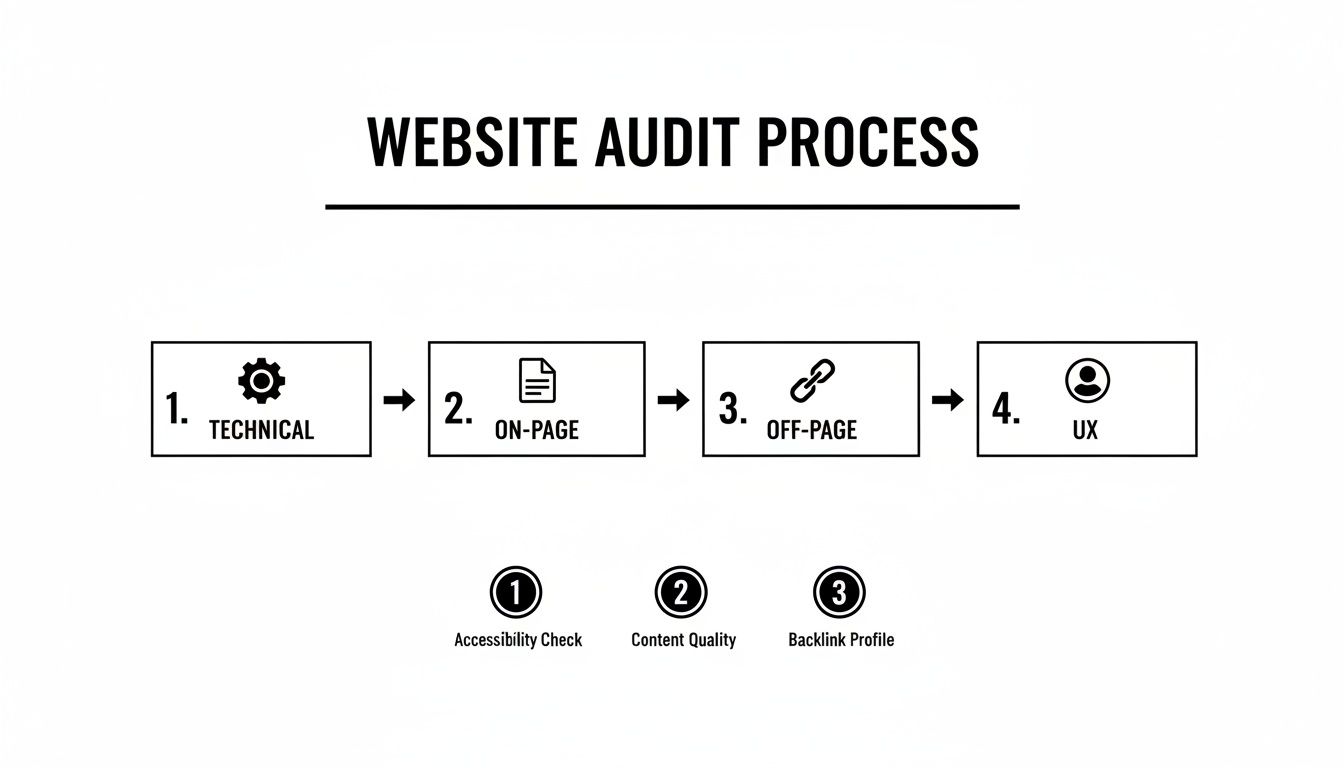
As you can see, a solid analysis starts with the technical foundation and moves up to the finer details of content and user engagement.
For instance, you might see in Google Analytics that a key service page has a whopping 90% bounce rate. By checking that against data from your crawling tool, you might discover that the same page takes eight seconds to load. Boom. You've just found a likely culprit: slow page speed is scaring potential customers away. This analysis phase is all about finding those "aha!" moments that explain the why behind the numbers.
Phase 4: Create Your Report and Prioritize Actions
The final phase is where you turn all your findings into a clear, actionable roadmap. An audit is only useful if it leads to real change. This step involves documenting everything you found and—most importantly—prioritizing it.
An audit report shouldn't be a simple list of problems. It should be a strategic document that prioritizes solutions based on their potential impact on your business goals versus the effort required to implement them.
A great way to prioritize is with an impact/effort matrix. Fixes that are low-effort but high-impact (like fixing broken links or optimizing title tags) should be at the top of your list for some quick wins. High-effort, high-impact projects (like a complete site redesign) will need more planning. This final step makes sure your audit results in a practical, step-by-step plan that drives real, measurable growth.
Essential Tools for Your Audit Toolkit

Trying to audit a website without the right tools is like a mechanic trying to fix an engine just by listening to it. You might have a hunch about what's wrong, but you'll never know for sure without popping the hood and running some diagnostics.
The right tools take the guesswork out of the equation. They give you the hard data you need to move from a vague feeling that something's off to a precise, data-driven action plan. Luckily, there are plenty of options out there for every budget and skill level, from free must-haves to professional-grade platforms.
Foundational Free Tools from Google
For any business owner, the absolute best place to start is with the powerful, free tools that Google gives you. Think of these as getting information straight from the source—an unfiltered look at how the world's biggest search engine sees your website.
Google Search Console (GSC): This is your direct line to Google. It’s where Google tells you about critical health issues, like crawl errors that are stopping its bots from seeing your pages. It also shows you which keywords people are actually using to find you and how your pages stack up against the all-important Core Web Vitals.
Google Analytics (GA4): While Search Console tells you how people find your site, Analytics tells you what they do after they arrive. It tracks user behavior, showing you organic traffic trends, bounce rates, and conversion numbers. This is how you connect your SEO efforts to real business results.
The screenshot below gives you a quick look at the kind of top-level data you'll find in Google Search Console's dashboard.
This single view instantly flags performance metrics, indexing problems, and user experience issues, giving you a quick health check. Understanding this data is fundamental, and you can learn more about turning these numbers into insights with professional analytics and reporting.
Industry-Standard Paid Tools
When you're ready to really dig deep, paid tools open up a whole new world of competitive analysis, in-depth technical crawling, and advanced keyword research. These are the workhorses that professional SEOs rely on every day.
Here are a few of the most trusted names in the game:
Semrush: This is a true all-in-one platform, but it really shines when it comes to sizing up the competition. Its killer feature is the ability to see exactly which keywords your competitors are ranking for, basically handing you a roadmap for your own content strategy.
Ahrefs: Famous for its backlink data, Ahrefs has one of the most comprehensive link databases on the planet. It’s the best way to understand your off-page health, showing you who is linking to your site, helping you spot toxic links to remove, and uncovering new opportunities to build authority.
Screaming Frog SEO Spider: This powerful desktop program crawls your website just like a search engine bot would. It's second to none for finding technical problems at scale, like broken links, duplicate content, and messed-up meta tags across thousands of pages.
These tools don’t just throw data at you; they provide crucial context. They show you exactly where you stand against your competitors and pinpoint the specific technical flaws that could be dragging your whole site down.
By combining the foundational insights from Google's free suite with the deep-dive power of these paid platforms, you can build a complete, 360-degree view of your website's health. This is how you conduct an audit that leaves no stone unturned.
Turning Audit Findings into Actionable Strategies
A website audit report packed with technical jargon is like a doctor handing you complex lab results without explaining what they mean. The numbers are interesting, but they’re useless without a clear plan of action. The most valuable part of any audit is what comes next: turning those findings into a real-world growth strategy.
This is where you connect the dots between analysis and execution. An audit isn't a report card meant to point out what you did wrong; it’s a roadmap showing you the most direct path to hitting your business goals. It lets you stop guessing what might be broken and start fixing the exact issues holding you back.
From Data Points to Strategic Projects
The trick is to translate every technical finding into a specific business initiative. Your audit data tells a story about where you’re losing potential customers, and your job is to give that story a better ending. This process turns abstract problems into concrete projects with results you can actually measure.
Here’s how common audit findings can become strategic to-dos:
Finding: "Low mobile usability scores and high bounce rates from mobile users."
- Actionable Strategy: Kick off a project to implement a fully responsive design. This means making sure buttons are easy to tap and navigation feels natural on any screen size.
Finding: "High bounce rates and low time-on-page for key service pages."
- Actionable Strategy: Schedule a deep dive into your content and user experience (UX). This involves sharpening your messaging, adding eye-catching visuals, and making your calls-to-action impossible to miss.
Finding: "Slow-loading product pages in an e-commerce store."
- Actionable Strategy: Make image optimization and code cleanup a top priority to boost page speed. This directly tackles a huge reason for abandoned carts. In fact, 40% of visitors will bounce to another site if yours takes more than three seconds to load.
Making this translation is critical. Once you’ve identified what needs fixing, you should follow a clear roadmap to updating an outdated website to keep your site competitive and effective.
Real-World Scenarios for Small Businesses
For small and mid-sized businesses, an audit often uncovers critical, money-draining issues that have been flying under the radar. These are problems that directly impact how new customers find and trust you.
A local plumber, for instance, might discover their business name, address, and phone number are all slightly different across dozens of online directories. This doesn't just confuse potential customers—it confuses Google, too, hurting their local search rankings. The clear next step is to launch a listings management campaign to get that information consistent everywhere.
Likewise, an e-commerce shop could find out their checkout process has way too many steps, causing a huge number of people to give up right at the finish line. The strategy here is simple: streamline the checkout flow to reduce friction and win back those lost sales. Understanding the benefits of SEO for small businesses helps you see these technical fixes for what they are: direct investments in your growth.
The real value of a website audit isn’t in the problems it finds, but in the clarity it provides. It gives you a prioritized to-do list where each item is directly linked to improving your bottom line.
Ultimately, turning audit data into action is all about changing your perspective. Instead of seeing a list of errors, you start seeing a list of opportunities. Every issue you find is another chance to make your website faster, easier to use, and much better at turning visitors into loyal customers.
What to Expect from a Professional Website Audit
A DIY website audit is a great place to start. Think of it like taking your own blood pressure—it gives you a useful snapshot of what's going on. But a professional audit? That’s like getting a full physical from a specialist. You get a much deeper, more strategic look at your website's health, connecting all the technical dots back to your actual business goals.
When you bring in an expert agency like SWAT Marketing Solutions, you're not just buying a list of errors. You’re getting a strategic partner who knows how to translate complex data into a clear, prioritized plan for growth. This is how you move from just fixing isolated problems to building a truly stronger and more competitive online presence.
A Comprehensive Analysis, Not Just a Scan
A professional website audit goes way beyond what any automated software can do on its own. While tools are essential for gathering data, the real value comes from the human analysis layered on top. An expert can spot the subtle issues that software misses—things like a confusing user journey or content that just doesn't quite connect with your ideal customer.
This process is a multi-faceted investigation, looking at how all the different parts of your site work together:
Technical Health: A deep dive into your site’s architecture, speed, and mobile usability to make sure the foundation is solid.
SEO Performance: A full analysis of your on-page, off-page, and local SEO to uncover every opportunity for higher rankings.
Competitive Landscape: A close look at what your top competitors are doing right and, more importantly, where you can get a leg up on them.
Conversion Pathways: An examination of how real users navigate your site to find and remove any roadblocks that stop them from buying or contacting you.
This holistic approach makes sure no stone is left unturned. You get a complete picture of your website's strengths and weaknesses.
A Prioritized Action Plan with Clear Business Cases
Here's the most important part: the biggest deliverable from a professional audit isn't the report itself. It's the strategic roadmap that comes with it. A good agency won't just dump a 50-page document full of technical jargon on your desk. Instead, you should expect a prioritized action plan that’s easy to understand.
A professional audit translates technical findings into business language. For example, "fixing 404 errors" becomes "reclaiming lost traffic and improving user trust." "Optimizing meta descriptions" becomes "increasing click-through rates from Google search results."
Every recommendation will be tied to a specific business outcome. It will also be prioritized based on how much impact it will have versus how much effort it will take. This means you’ll know exactly what to tackle first to get the biggest and fastest results.
Deliverables and Ongoing Support
Once the audit is finished, you should receive a few key items that give you the confidence to move forward. A typical package from a professional service includes a detailed report, a strategy call to walk you through the findings, and a clear proposal for getting the work done.
The goal is to build a partnership focused on real, tangible results. A thorough website audit is the critical first step, giving you the clarity and direction you need to improve your rankings, generate more qualified leads, and achieve sustainable growth for your business.
Frequently Asked Questions About Website Audits
Even after laying it all out, you might still have a few questions swirling around. Let's tackle some of the most common ones we hear from business owners, so you can feel confident about what a website audit really means for you.
Think of these as the practical, "how does this actually work?" part of the conversation.
How Often Should I Do a Website Audit?
For most businesses, we recommend a deep, comprehensive audit once a year, with a smaller "health check" every quarter. Your website isn't a static brochure; it’s a living part of your business in a digital world that’s always shifting. Search engine algorithms change, new content gets added, and little technical glitches can pop up when you least expect them.
Keeping a regular eye on things is crucial for a few big reasons:
Algorithm Changes: Regular checks make sure you're always playing by Google's latest rules.
Proactive Fixes: You’ll catch small issues—like a broken link or a slow page—before they turn into major problems that cost you traffic and sales.
Competitive Edge: Staying on top of your site's performance helps you pull ahead of competitors who might only look under the hood when something is obviously broken.
Can I Do a Website Audit Myself?
Absolutely. You can definitely get started with a basic audit using free tools like Google Search Console. This is a fantastic way to spot obvious problems, like broken links or pages Google can't find. It gives you a great first look at your site's overall health.
Where a professional agency comes in, though, is in the depth of the analysis. An expert uses advanced tools and, more importantly, years of experience to uncover the tricky problems. We're talking about things like complex site architecture issues, the quality of your backlinks, and hidden gaps where your competitors are beating you.
A DIY audit gives you a list of errors. A professional audit delivers a strategic, prioritized roadmap that connects those technical errors directly to your business goals.
How Long Does a Website Audit Take?
The timeline really depends on the size and complexity of your website. A simple, automated scan from an online tool might spit out a report in just a few hours.
A comprehensive, hands-on audit done by a professional team is a different beast altogether. This is a much more involved process that typically takes anywhere from one to four weeks. Why so long? This timeframe gives us the space to do a deep dive into your data, conduct thorough research on your competitors, and build a detailed, actionable plan that’s made just for your business.
Ready to uncover the hidden opportunities on your website? The team at SWAT Marketing Solutions provides a comprehensive audit that turns complex data into a clear roadmap for growth. Get your free, no-obligation website assessment today.