
Choosing the right marketing agency starts with some crucial homework. You first need to get crystal clear on your internal business goals. From there, you can set a realistic budget and finally nail down the specific services you'll need to hit those goals. This prep work is non-negotiable; it ensures you approach potential partners with a clear vision, making the whole process much more efficient and successful.
Laying the Groundwork Before You Start Your Search
Before you even think about Googling "marketing agency near me," the most important work happens inside your own business.
Jumping into conversations with agencies without a solid plan is like starting a road trip without a map—you'll burn through a lot of time and money, and you probably won't end up where you wanted to go. Think of this internal prep as your pre-flight checklist.
Define Your Business Goals
First things first: what does success actually look like for your business? Vague goals like "get more traffic" or "do better on social media" simply won't cut it. Your objectives must be specific, measurable, and tied directly to real business outcomes.
Here are a few examples of strong, actionable goals we've seen clients bring to the table:
- Increase qualified leads from organic search by 25% within six months.
- Boost e-commerce sales from paid ads by 40% in the next quarter.
- Show up in the top 3 of the Google Map Pack for five of our main service keywords within 90 days.
- Grow our email list by 1,000 new subscribers every month.
When you're laying this groundwork, also consider the importance of working with a partner who follows strong ethical marketing practices. An agency committed to transparency and integrity is key to building sustainable, long-term growth.
Determine Your Marketing Budget
The "how much does it cost?" conversation is coming, so it's best to have a number ready. Your budget shouldn't be some random figure; it has to be a realistic investment tied to your goals.
If your goal is to generate an extra $100,000 in revenue, a $500 monthly budget just isn't going to get you there. Do a little research on industry benchmarks and think about what a new customer is truly worth to your business. This will help you land on a comfortable range, whether that's $2,000 or $10,000 per month.
Pro-Tip: Stop thinking of your marketing budget as an expense. It's an investment. The right agency will deliver a clear return on that investment, turning your marketing spend into a predictable revenue driver for your business.
Pinpoint Your Must-Have Services
Once you have your goals and budget locked in, you can start identifying the specific services you'll need to hit your targets. The truth is, not every business needs every marketing service out there. Focusing on your priorities ensures you only pay for what will actually move the needle.
A great starting point is to get a clear picture of where your website stands right now. You can get a much better sense of what you need with a free SEO analysis of your current online presence.
This flowchart shows how these three pieces fit together, creating a solid foundation for your search.
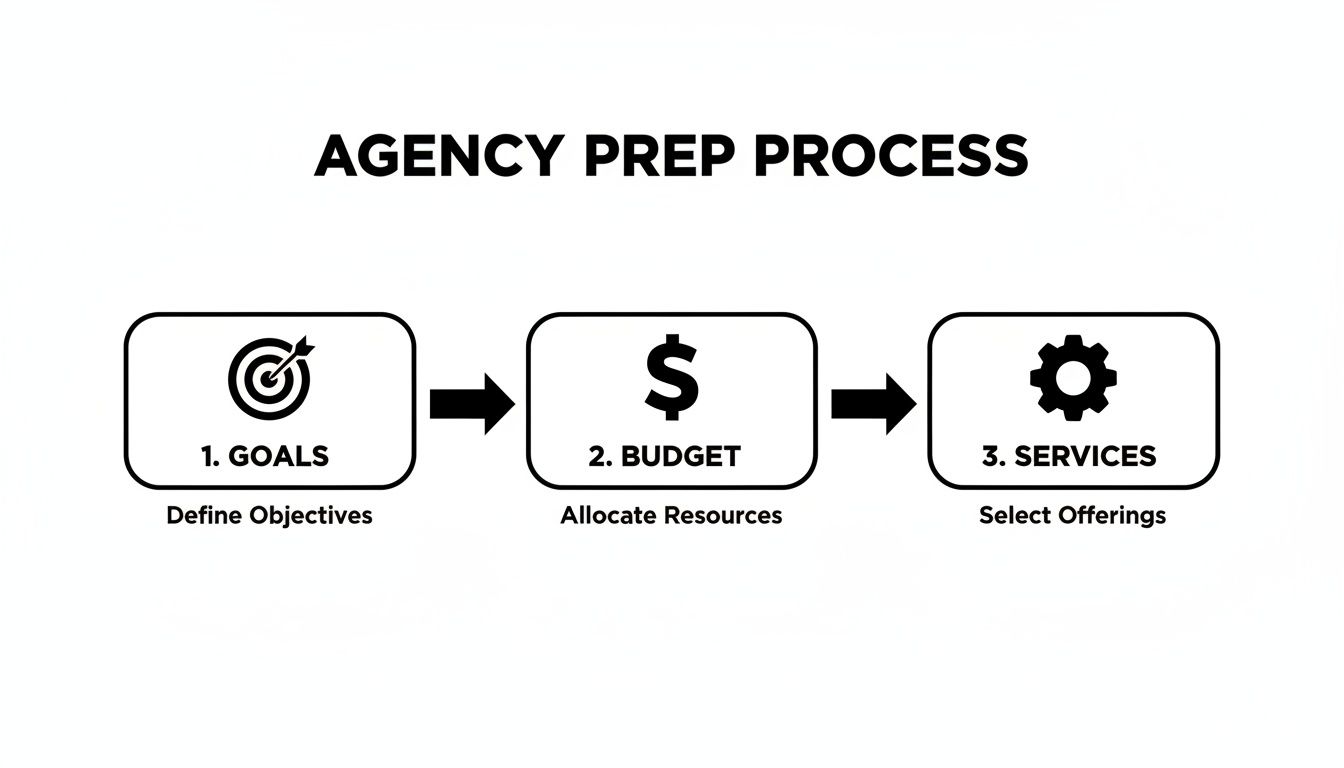
Each step builds on the last, giving you the clarity and confidence you need to find the perfect agency partner.
Connecting your goals to the right services can feel overwhelming, so we put together this table to help you match your objectives with the marketing tactics designed to achieve them.
Matching Your Goals to the Right Marketing Services
| If Your Goal Is… | You Need This Service | What It Accomplishes For You |
|---|---|---|
| Increase website traffic and leads | Search Engine Optimization (SEO) | Boosts your visibility on Google, driving more organic visitors who are actively searching for what you offer. |
| Show up for local customers | Local SEO & Listings Management | Puts your business on the map (literally) in local search results and directories like Google Maps and Yelp. |
| Get immediate traffic and leads | Pay-Per-Click (PPC) Advertising | Places your ads at the top of search results, generating instant traffic and leads from highly motivated buyers. |
| Build a community and brand loyalty | Social Media Marketing | Engages your audience on platforms like Facebook and Instagram, fostering relationships and driving brand awareness. |
| Convert visitors into customers | Web Design & Development | Creates a professional, user-friendly website that turns visitors into leads and sales, and works great on any device. |
With this framework, you're not just looking for "a marketing agency." You're looking for a partner with proven expertise in the specific services that will help you achieve your unique business goals.
Finding and Vetting Potential Agency Partners

Alright, you've got your goals mapped out and a budget in hand. Now it's time to shift from planning to the real hunt. The objective isn't to find every agency on the planet; it's to build a short, solid list of 3-5 potential partners who are actually worth your time. A quick "marketing agency near me" search is a decent start, but it's just that—a start.
To find the real pros, you have to dig a little deeper. Start by tapping into your own professional network. Ask other business owners in your industry who they use and, more importantly, what the experience has really been like. A personal referral gives you an unfiltered look into an agency's communication, responsiveness, and whether they actually deliver on their promises.
Beyond your contacts, industry directories and review sites are goldmines. Platforms like Clutch or UpCity offer verified reviews from real clients, which gives you a much clearer picture than a simple star rating. This initial research is all about gathering a bigger list of maybe 10-15 promising names before you start trimming it down.
Look Beyond the Polished Homepage
Once you have your initial list, it's time to start filtering. The first stop is always an agency's website, but your job is to look past the slick design and buzzwords. Go straight to their portfolio or case studies—this is where you’ll find the proof in the pudding.
When you're looking at their past projects, don't get distracted by vanity metrics like "more social media followers." You need to see tangible business results that line up with your own goals.
- Did they increase qualified leads? Look for hard numbers, like a 35% increase in marketing-qualified leads (MQLs).
- Did they drive e-commerce sales? Search for metrics like a 4:1 Return On Ad Spend (ROAS) or a 20% boost in average order value.
- Did they improve search rankings? They should be able to show you exactly how they moved clients to page one for valuable keywords.
For instance, a good portfolio shows you what they're capable of across different industries and services. You can see how we showcase our work at SWAT Marketing Solutions to demonstrate our track record.
A great case study tells a story. It should clearly outline the client's problem, the agency's strategy, the specific actions they took, and—most importantly—the measurable business results they achieved. If a case study feels vague or lacks hard data, consider it a red flag.
Assess Their Niche Expertise and Tools
Generalist agencies that claim to be experts in everything are rarely masters of anything. Look for a partner with proven experience in your industry. An agency that gets the nuances of B2B SaaS will have a completely different playbook than one that works with local restaurants.
Their team should "speak your language" and already have a good grasp of your customers' pain points. This industry-specific knowledge is a massive advantage because it shortens the learning curve and leads to better strategies right out of the gate.
Also, pay attention to the technology they use. Modern marketing runs on software for analytics, automation, and campaign management. An agency that invests in the right tech is better equipped to optimize your campaigns and give you transparent reporting. For a peek into the kind of tech top agencies use, you can check out these essential digital agency tools. This is a key part of choosing an agency that is truly data-driven.
Ultimately, your goal here is to narrow down your big list to your top 3-5 contenders. These are the agencies that have shown relevant experience, backed it up with real results, and seem like they’d be a good fit for your team. From here, you’ll be ready to start the interview process with a handful of highly qualified candidates.
You’ve whittled down the list and have a few solid contenders. Now for the most important part: the interview. This is your chance to get past the slick sales pitches and glossy case studies to see what an agency is really made of.
Any agency can talk a big game. Your job is to ask the tough questions that reveal how they think, how they communicate, and what happens when things don't go according to plan. This conversation separates a real partner from a sales-focused vendor just trying to get a signature.

Questions About Strategy And Onboarding
The first 90 days can make or break the relationship. A well-planned onboarding sets you up for success, but a messy start can lead to frustration and missed deadlines right out of the gate. You need to find out how they’ll move from talking about your goals to actually working on them.
Do they have a clear, documented process, or are they just going to wing it?
- "Walk me through your onboarding process. What should we expect in the first 30, 60, and 90 days?" This question tells you a lot about their organizational skills. You're looking for a clear, step-by-step plan.
- "Based on what you know so far, what are the first one or two things you'd tackle for us, and why?" This is a great test of their strategic thinking. Can they prioritize actions that will make a real difference quickly?
- "How do you perform your initial research and audits? What tools are you using?" A good agency won't just start throwing ideas around. They'll start by digging into your analytics, checking out the competition, and running a full technical audit.
If their answers sound vague or disorganized, that's a huge red flag. You want to feel confident they have a system that works.
Uncovering Their Communication And Reporting Style
Poor communication is the silent killer of agency partnerships. You have to be crystal clear on expectations from day one. How often will you hear from them? Who’s your main point of contact? What do they do when the numbers aren’t looking so good?
Frequent, transparent communication is everything. You're not just paying for results; you're paying for a partner who keeps you in the loop.
The best agencies do more than just send a dashboard full of charts. They tell you the story behind the data. They explain what the numbers mean for your bottom line, what they’re learning, and how they’re adjusting the plan based on real-world results.
Get to the bottom of their communication style with these questions:
- "Who will be my day-to-day contact? Can I meet the other people who will be on my account team?" This is critical. You need to know if you'll be working with the senior expert in the meeting or if your account will be handed off to a junior-level manager.
- "Can you show me a sanitized example of a monthly or quarterly report?" This lets you see exactly what they track and how they present it. Make sure they focus on the metrics that matter to your business, not just vanity metrics like clicks and impressions.
- "Tell me about a time a campaign wasn't hitting its goals. What did you do to turn it around?" Listen carefully to this answer. Every agency has campaigns that stumble. What matters is how they respond—their honesty, their problem-solving skills, and their willingness to take ownership.
Assessing Team And Cultural Fit
Don't forget, you're not just buying a service; you're starting a long-term relationship. The people you'll be working with every week are just as important as their portfolio. Is this a team you can see yourself collaborating with?
You’re looking for a group that feels like a natural extension of your own team—people who are just as invested in your success as you are.
- "How do you keep up with all the industry changes, like Google algorithm updates?" Their answer shows how committed they are to staying on top of their game.
- "What really makes you different from the other agencies we might be considering?" This old classic forces them to get specific about their unique value instead of rattling off marketing jargon.
- "What do you need from us as a client to make this partnership work?" This is a fantastic question. A great partner knows that success is a two-way street. It shows they see you as a collaborator and helps set expectations for your involvement.
Agency Vetting Scorecard
When you're talking to multiple agencies, it's easy for the details to blur together. A simple scorecard can help you stay objective and compare your top candidates side-by-side. Use a 1-5 scale (1 = Poor, 5 = Excellent) to rate each agency on the criteria that matter most to you.
| Evaluation Criteria | Agency A Score (1-5) | Agency B Score (1-5) | Key Takeaways and Red Flags |
|---|---|---|---|
| Industry Experience | Does their experience align with our niche? | ||
| Strategic Approach | Did they have specific ideas or just generic plans? | ||
| Communication Style | Did they seem proactive and transparent? | ||
| Team Expertise | Are we meeting the actual people doing the work? | ||
| Reporting & Analytics | Do their reports focus on business goals or vanity metrics? | ||
| Cultural Fit | Do they feel like a true partner or just a vendor? | ||
| Overall Impression | What does my gut say about this team? |
After your interviews, sit down with your team and review the scores. This simple tool turns subjective feelings into a more concrete, evidence-based decision, ensuring you pick the partner that's truly the best fit for your business.
Decoding Proposals and Pricing Models
The interviews are done, the handshakes are over, and now the proposals start hitting your inbox. This is where a potential partnership gets real, and it’s critical to understand exactly what you’re signing up for.
Think of a proposal as more than just a price tag; it's the blueprint for your company's growth. Learning to read between the lines is one of the most important skills you can have when choosing an agency.
The first thing you’ll probably notice is the pricing. Agencies don't have a one-size-fits-all model, and the right fit for your business depends entirely on your goals, budget, and the scope of work. Understanding these models is key to finding a partnership that feels fair and sustainable for everyone.
Common Agency Pricing Models
Most agencies build their fees around one of three common structures. Each has its pros and cons, so it’s important to know which one aligns best with what you need.
- Monthly Retainer: This is the most common model you'll see. You pay a fixed fee each month for an agreed-upon set of services. It’s predictable for budgeting and perfect for long-term, ongoing work like SEO or content marketing.
- Project-Based Fee: Here, you pay a one-time flat fee for a specific, well-defined project, like a website redesign or a brand launch. It’s great for projects with a clear start and end, but can be less flexible if the scope changes midway through.
- Performance-Based Pricing: With this model, the agency’s pay is tied directly to the results they get—think a percentage of ad spend or a bonus for hitting lead generation targets. It's a great way to make sure the agency's goals are your goals, but it’s usually more expensive and reserved for channels with easily trackable metrics like PPC.
Many agencies now offer hybrid models, combining a base retainer with performance incentives. This can offer a nice balance, giving you budget predictability while motivating your agency to knock it out of the park.
What to Look for in a Strong Proposal
A great proposal does more than just list services and prices. It shows that the agency was actually listening during your interviews and has put together a thoughtful, customized plan to help you win. Vague proposals are a huge red flag; you want a partner who has clearly done their homework.
A winning proposal should always include:
- A Clear Understanding of Your Goals: It should start by restating your business objectives in their own words, proving they get what you’re trying to achieve.
- A Detailed Scope of Work: The proposal must clearly outline every single deliverable. If they’re providing SEO, it should specify things like the number of blog posts per month, keyword research, and technical audits. No ambiguity.
- Specific KPIs and Metrics: How will success be measured? The proposal should define the Key Performance Indicators (KPIs) they will be held accountable for, such as Cost Per Lead (CPL), Return On Ad Spend (ROAS), or organic traffic growth.
- A Realistic Timeline: It should provide a clear timeline with key milestones for the first 90 days and beyond, setting clear expectations from day one.
Agency leaders predict paid advertising will be the most effective channel next year, with a massive 89% now ranking PPC as a core service. This shows how businesses are prioritizing performance-driven tactics, and any proposal you get should reflect this expertise with crystal-clear KPIs for ad campaigns.
Key Takeaway: If a proposal feels generic or like a copy-and-paste job, it’s a sign that the agency may not be the strategic partner you’re looking for. The best proposals are detailed, customized, and focused on your specific business outcomes.
Don’t Skim the Contract
Once you’ve accepted a proposal, the final step is the contract or Statement of Work (SOW). It’s tempting to just sign on the dotted line, but you have to review the fine print carefully. This legal document governs your entire relationship, so make sure you understand every clause.
Pay close attention to these key areas:
- Ownership of Assets: The contract must clearly state that you own all creative assets, content, and ad accounts created for you—even if you part ways.
- Termination Clause: What are the terms for ending the agreement? Look for a reasonable notice period (usually 30 days) without crazy penalties.
- Confidentiality: Ensure there’s a strong non-disclosure agreement (NDA) to protect your sensitive business information.
For a clearer idea of how these pieces come together, you can review different marketing agency pricing packages to see how services and deliverables are typically presented. This can help you benchmark the proposals you receive and make a much more informed decision.
Finalizing Your Choice and Kicking Off the Partnership

You’ve done all the research, sat through the interviews, and pored over proposals. Finally, you’ve made a decision. But signing on the dotted line isn’t the finish line—it’s the starting block.
Those first few weeks with a new agency are critical. They really set the tone for everything that follows. A smooth, well-organized kickoff builds the foundation for a relationship that actually gets results.
The most important first step? A formal kickoff meeting. This isn’t just a quick "hello." It’s a dedicated session to get both teams aligned on goals, communication styles, and the immediate game plan. Make sure everyone who’s going to be involved is in that room (or on that call)—your main point of contact, their account manager, and any key specialists.
This meeting prevents the kind of early misunderstandings that can completely derail a partnership before it even gets off the ground.
Gearing Up for a Smooth Onboarding
Here's a little secret: proactive clients get better results. Your new agency will need access to certain accounts and assets to do their job, and having everything ready to go will prevent frustrating delays. Think of it like giving them the keys to the car; they can’t drive anywhere without them.
Before your kickoff meeting, get this information together:
- Website & CMS Access: Logins for your website's backend, like WordPress or Shopify.
- Analytics & Ad Accounts: Admin access to your Google Analytics, Google Search Console, and any existing ad platforms (e.g., Google Ads, Facebook Ads Manager).
- Social Media Logins: Credentials for all the business social media profiles they’ll be managing.
- Brand Assets: Your logo files, brand style guide, customer personas you’ve developed, and any professional photos or videos you have on hand.
When you show up with this stuff ready, you signal that you’re an organized partner ready to collaborate. It lets the agency skip the administrative back-and-forth and get straight to work.
Onboarding is a two-way street. A great agency will give you a clear checklist of what they need, but a great client has it ready before they even ask. This simple step can easily save a full week of back-and-forth emails.
What to Expect in the First 90 Days
The first three months are all about building momentum. Don't expect a complete business transformation overnight, but you should absolutely see clear, consistent progress. Any agency worth its salt will have a structured plan for this period.
Here’s what that typically looks like:
The First 30 Days: Discovery & Setup
This is the deep-dive phase. The agency will be running technical audits, digging into your competitors, and getting all the tracking codes installed. They'll set up your reporting dashboards and finalize the initial strategy based on what they find. Expect a lot of communication as they learn the ins and outs of your business.
The First 60 Days: Implementation & Launch
With the foundation in place, it's time to execute. This is when the first PPC campaigns might launch, the first batch of SEO-optimized content gets published, or the new social media calendars roll out. You should start seeing the first trickles of data flowing into those new reports.
The First 90 Days: Optimization & Refinement
By this point, there's enough initial data to start making smart adjustments. The agency will begin optimizing campaigns based on what’s working, refining audience targeting, and tweaking content strategy. You should have a solid communication rhythm down and a clear understanding of your key performance metrics.
It's vital to choose a partner that’s committed to growth. The average annual growth for digital agencies has recently slowed to 5%. But high-performing agencies—the ones expanding with AI and advanced analytics—grew 9.7%, while the ones standing still crawled at just 1.1%. This really highlights the value of picking a forward-thinking team. You can dive deeper into agency growth trends and what they mean for you.
Common Questions When Hiring a Marketing Agency
After all the research, interviews, and proposal reviews, you might still have a few questions rolling around in your head. It's totally normal. Making the final call on how to choose a marketing agency is a big decision, so let's tackle the most common queries we hear from businesses just like yours.
Think of this as your final gut-check before you sign anything. Getting clear answers here will give you the confidence you need to move forward.
How Long Until We See Real Results?
This is easily the question we get asked the most. And the honest-to-goodness answer is: it really depends on the service. Marketing isn't a light switch you can flip for instant success; it’s a long-term investment, and different pieces of the puzzle work on different timelines.
For example, a well-run paid advertising campaign can start bringing in traffic and leads almost right away—sometimes within the first week. You’re essentially paying for that immediate visibility on platforms like Google or Facebook, so the results come pretty quickly.
On the other hand, organic strategies like SEO and content marketing are a slow burn. It takes time to build up your authority with search engines and earn those coveted top rankings. You should expect to see some real, meaningful movement in about 4-6 months. The major, business-changing results often take a full 6-12 months to really kick in.
Any agency worth its salt will be upfront and transparent about these timelines. They should lay out a clear roadmap in their proposal, complete with expected milestones for each service, so you know exactly what to expect from day one.
Full-Service vs. Specialized Agency: What's Better?
The right answer here comes down to your specific needs and what resources you already have in-house. There’s no single "better" option—only what’s better for your business at this moment.
-
A full-service agency is your one-stop shop, handling everything from web design and SEO to PPC and social media. This is the way to go if you need a comprehensive, multi-channel strategy and prefer having a single point of contact managing all the moving parts.
-
A specialized agency (sometimes called a boutique agency) goes deep on one or two key areas. Think of a firm that only does technical SEO for e-commerce sites or one that’s the absolute best at video marketing for B2B companies. You’d bring in a specialist to tackle a very specific, high-stakes problem or to fill a gap in your own team's expertise.
For most small and mid-sized businesses, partnering with a full-service agency just makes more sense. It ensures all your marketing efforts are pulling in the same direction and working together toward your goals.
Which KPIs Actually Matter Most?
It’s way too easy to get buried in a mountain of data. Vanity metrics like "likes," "impressions," or "follower count" might look nice on paper, but they don't actually pay the bills. The Key Performance Indicators (KPIs) that truly matter are the ones tied directly to your business’s bottom line.
You need to focus on tracking the numbers that measure real business impact. Here’s a quick breakdown based on some common goals:
| If Your Goal Is… | The KPIs to Track Are… |
|---|---|
| Lead Generation | Cost Per Lead (CPL), Conversion Rate, Customer Acquisition Cost (CAC) |
| E-commerce Sales | Return On Ad Spend (ROAS), Average Order Value (AOV), Customer Lifetime Value (CLTV) |
| Brand Awareness | Organic Traffic Growth, Keyword Ranking Improvements, Share of Voice |
A great agency won't just send you reports filled with these numbers; they’ll work with you during the onboarding process to figure out which ones are most critical for your success. Their entire reporting structure should be built around these core, business-driving metrics, making sure every conversation is focused on what truly matters—growth.
At SWAT Marketing Solutions, we build partnerships on a foundation of transparency and measurable results. If you’re ready to see how a data-driven, full-service agency can help you hit your growth goals, we're here to talk. Get your free, no-obligation proposal today.